State of Michigan responds to Americans for Citizen Voting appeal to US Supreme Court
Sep 02, 2026 | 1:47 pm ET
Description
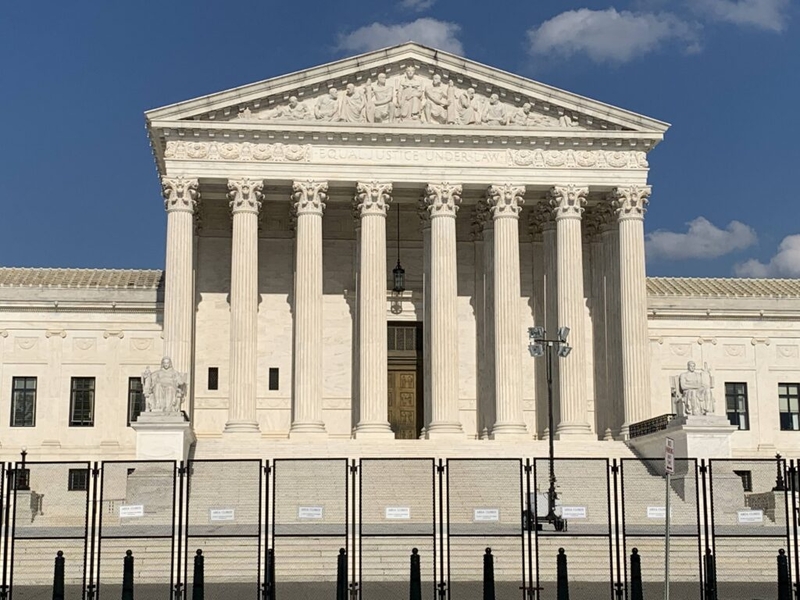
The U.S. Supreme Court's front steps in Washington, D.C. July 19, 2022. | Photo by Katherine Dailey/Michigan Advance.
In the wake of a deadlocked decision by the Board of State Canvassers that would leave a controversial citizens-only voting measure off the November ballot, state officials have responded to a petition to the U.S. Supreme Court seeking to overturn that outcome.
The sponsors of the ballot measure, Americans for Citizen Voting – Michigan, filed an application to the Supreme Court on Monday, requesting an emergency injunction against the Board of State Canvassers’ decision that would put the measure on the ballot.
The group argues that the due process rights of Michiganders who signed the ballot petition were violated when the Board Of State Canvassers determined that affidavits validating nine rejected signatures were submitted too late and as such could not be used to have those signatures — which would have put the petition over the threshold — count as valid.
The respondents to the petition, the Board Of State Canvassers, Secretary of State Jocelyn Benson and Director of Elections Jonathan Brater, argue in their response — which was requested on Tuesday by Justice Brett Kavanaugh — that the process of a referendum like this is a state-created right as opposed to one guaranteed by the First Amendment.
“Federal courts have previously recognized that such processes are not entitled to the same protection as the right to vote,” the state response continues. “To the contrary, many courts have held that private citizens lack a constitutional right to propose referenda or initiatives for any ballot, federal or state.”
Board of State Canvassers deadlocks on citizens-only voting measure, setting up court fight
They also add that the relief requested by the sponsors — an injunction that would force the state to place the referendum on the November general election ballot — would be granting the applicants “all the relief they could ever recover for their claims,” but that the application does “little to justify such an unusual request, other than to repeat the number of signatures they gathered—without acknowledging or contending with the high number of signatures that were found to be invalid.”
Ballots must be finalized by Sept. 4, leaving just two days for the nation’s high court to make a decision on whether to formally intervene and, if they do rule on the case, how they will proceed. The Board of State Canvassers will meet that morning to finalize the ballot, so the applicants have asked the court to make its ruling by Thursday.
Americans for Citizen Voting also filed a petition with the Michigan Supreme Court — the more standard avenue for recourse against the Board of State Canvassers’ decision — four days prior to filing with the U.S. Supreme Court. The response from the state notes that, as there has been no hearing, order, or opinion issued by the state court, the application is highly unusual for asking the nation’s highest court to be the first court to review their claims.
On the other hand, the sponsors of the ballot petition say the lack of immediate action from the state supreme court is exactly why they sought intervention from the nation’s highest court.
“Applicants filed their original complaint for mandamus with the Michigan Supreme Court only four days before this application, and there has been no hearing, order, or opinion issued by the state court,” the initial application states. “The Applicants here are asking this Court to be the first court to review their claims, and the application provides limited and sparse citation to any law.”
Similarly, the initial application argues that the Bureau of Elections and Board of State Canvassers delayed in considering the petition signatures submitted for the ballot measure, leaving an extremely short window for the courts — on either the state or federal level — to intervene in the case.
The respondents note that this was a standard timeline in which nominating and qualifying petitions for candidates are examined first, then voter-initiated laws and referenda, and then constitutional amendments, which is what the petition seeks to establish.
The response submitted to the court reads, “Director Brater explained in March, the ACVM petition was not filed so early that the canvass could be finished before the other petitions would need to be processed: ‘In this particular situation, the — this constitutional amendment petition came in, yes, before the candidate deadline, but the normal multi-week and month process that it takes us to get through all of that would take us into the nominating petition timeline’.”
The filing from the state goes on to argue that, by asking the court to only take up the nine affidavits in question, the group “wants to keep all its gains while disputing only its losses” in a one-sided analysis.
They conclude by asking the federal court to leave the decision in a state-level administrative matter up to the state, writing, “The Court should decline to put its thumb on the scale in this manner, particularly in the case of a state administrative proceeding where a state court can provide more fulsome and comprehensive review.”
Lansing, MI