Immigration activity is taking a toll on children’s health, doctors say
Sep 02, 2026 | 5:00 am ET
Description
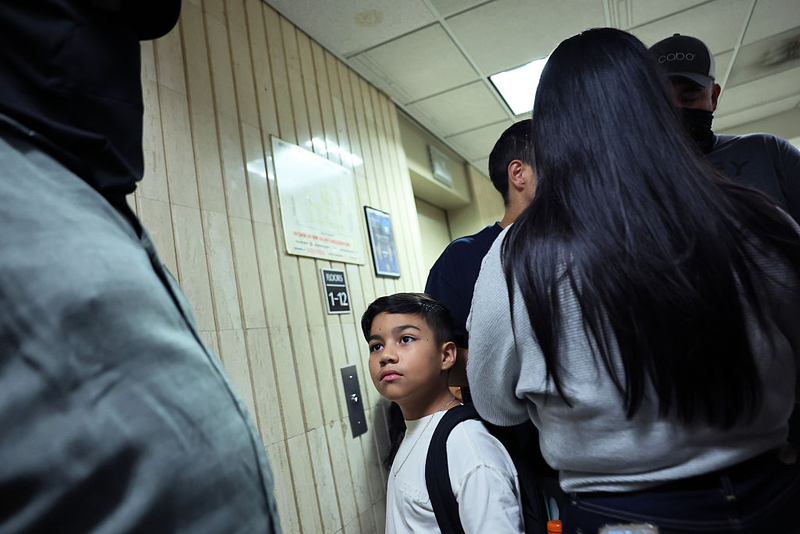
A child looks up at a masked federal agent as his parents are spoken to before being let go after a court hearing in immigration court in New York City in September 2025. The Trump administration’s immigration arrest program is creating a chilling effect, causing fear and isolation among families who are avoiding interacting with systems — including by missing critical pediatric health appointments. (Photo by Michael M. Santiago/Getty Images)
In Minnesota, an elementary schooler has gone without surgery to treat a rare, life-threatening neck infection that isn’t responding to antibiotics.
Another young child can’t use their hearing aids because the family ran out of batteries and hasn’t come to get replacements.
Yet another child’s cochlear implant surgery was delayed by several months.
These patients’ families, all immigrants, have been afraid of showing up to the hospital after immigration officers flooded their communities in recent months, said their doctor, pediatric otolaryngologist Asitha Jayawardena, a head and neck surgeon at Children’s Minnesota.
Clinicians like Jayawardena say immigration arrests and detentions are taking a particularly acute toll on children’s health as families isolate at home. He’s seen some cases — such as the child with the neck infection — worsen because fearful parents aren’t coming in.
ICE is using Medicaid data to find out where immigrants live
“Without a doubt, it oscillates between being infuriating and absolutely disheartening,” Jayawardena said about the chilling effect.
As the Trump administration’s immigration enforcement leads to sweeping arrests, healthcare workers say those actions have hit children hard — including children who are U.S. citizens and those in families without arrests.
Many healthcare providers report that since January 2025, they’ve seen a surge in missed pediatric appointments, delayed preventive care, and sick or injured kids going without treatment. Immigration and Customs Enforcement arrests have continued to climb — with a record 51,000 arrests in July — and experts predict continued unhealthy outcomes among children, causing collateral damage that could extend for years.
Healthcare workers told Stateline that in addition to the physical healthcare fallout, they’ve also seen a significant increase in depression, anxiety and post-trauma symptoms among their pediatric patients.
Delayed healthcare has critical consequences for young kids. For example, hearing loss, such as that experienced by Jayawardena’s patients, can hinder crucial development including speech, language and social skills. Along with missing health milestones and getting needed healthcare, kids are grappling with the long-term trauma of losing a parent.
“Community-wide trauma that is being inflicted is having a really important impact on families and children in particular. There are children that are losing their guardians. There are families that are losing their breadwinners,” said Amy Liebman, chief program officer of the Migrant Clinicians Network, a nationwide organization of healthcare workers serving migrant families.
“That certainly is going to ultimately impact their health and then their ability to access care,” she said.
The Trump administration also has introduced rules that allow federal agencies to take into account a family’s use of public benefits when reviewing applications for lawful immigration status. Dr. Gabriela Maradiaga Panayotti, a pediatrician in Durham, North Carolina, pointed to studies showing that such policies lead to a decrease in healthcare use, including among U.S. citizen children.
One of her patients, a U.S. citizen on Medicaid, had stopped a medication for ADHD that had helped him achieve better grades at school. His parents feared being targeted through Medicaid paperwork, so they didn’t refill his prescription. The child’s grades began to drop again.
“They didn’t want to be labeled as utilizing resources,” Maradiaga Panayotti said. “I hurt for him, especially because he’s at this tender preteen age where self-confidence and performance at school can really either build on and set a good foundation for success in high school, or can drop.”
Millions of children
Researchers at the Brookings Institution, a public policy research nonprofit, estimate that since Jan. 20 of last year, the day President Donald Trump was sworn in, and through early April of this year, over 146,000 U.S. citizen children have had a parent detained.
But many more are living with that fear.
The Pew Research Center estimates 4.6 million U.S.-born children lived with an unauthorized immigrant parent in 2023, and roughly 2.5 million children could face the detention of both household parents, according to a Brookings analysis.
But the trend cuts across immigration status — including those born to refugees, DACA recipients, asylees and people with temporary protected status. Across the nation, about a fourth of children are born to immigrant families, according to the Migrant Policy Institute.
State, local officials plan for potential immigration enforcement at schools
Increased ICE activity has included arrests at hospitals, and the agency has also made unprecedented efforts to obtain private health data, including Medicaid patient records, to extract addresses and immigration statuses — another major source of fear for families.
Jayawardena and his colleagues published a study in the American Academy of Pediatrics medical journal in August measuring whether pediatric outpatient care visits were disrupted during and after the large-scale immigration raids of Operation Metro Surge in Minneapolis, when the Trump administration deployed 3,000 agents, heavily targeting Somali and South Asian communities.
The research team found that the rate of missed appointments among Hispanic or Latino children increased by over 50% during Metro Surge compared to the same time period — the first week of December to second week of February — in the prior two years.
Missed appointments increased by 80% among Spanish-speaking families and 53% among families needing language interpretation services.
“The barrier is not necessarily lack of access, but more the fear and the isolation, and so the enforcement is having this chilling effect on immigrant families who, even though they may need these critical services, may be avoiding the hospital, the counseling, the victim services, and other essential care,” said Jasiel Fernandez, vice president of psychosocial supports at the global pro bono nonprofit KIND, or Kids in Need of Defense. “We see that happening over and over.”
It's just very disheartening knowing that there's something I can do, but I am prohibited from doing it because families don't feel safe.
The Migrant Clinicians Network, along with Physicians For Human Rights, surveyed nearly 700 healthcare workers across 30 states between March and August of last year, amid spikes in immigration activity. Most of the surveyed professionals — 84% — reported significant or moderate drops in pediatric patient visits since Trump’s January 2025 executive orders on immigration.
Kids also were spending less time outdoors, which affects overall health, and saw delayed diagnoses of their conditions. About 27% of clinicians said patients feared enrolling in benefits for their children, and couldn’t afford doctor visits. Preventive care, such as vaccinations, as well as chronic disease management and mental health care were the most affected, healthcare workers reported.
And in both the survey and through interviews with Stateline, clinicians have reported seeing kids show up to emergency departments alone.
In Missouri, one pediatric emergency medicine physician, who spoke with Stateline on the condition of anonymity because he feared retaliation against his hospital, recalled an 11-year-old child who had been attacked by a dog, his legs riddled in bites. He came to the hospital with only his teenage sister.
“He told us that (his parents) were scared to come in because ICE might be at the hospital,” the physician recalled.
Others aren’t showing up to care at all. “Kids like these are so vulnerable that they kind of could fall through the cracks,” he added. “We see the downstream effects of policy changes, and we try to address all these needs. But when kids are coming in, they’re super sick.”
Missed care, advanced illness
Some clinicians told Stateline that by the time some children reach their clinics, their health conditions have advanced to a more difficult stage.
One North Carolina pediatrician has seen kids with asthma miss inhaler prescriptions, leading to more asthma attacks. In another case, a large family of refugee children came in covered in splotchy, itchy rashes — scabies. The family had been sharing two bedrooms. Afraid, they had postponed care for four weeks.
“All of these children, totally ridden throughout their bodies, and it’s so uncomfortable. You can’t sleep because it’s horribly itchy,” said the pediatrician, who spoke to Stateline on the condition of anonymity, fearing retaliation since her clinic receives federal funding.
“We’re creating tremendous problems for our community that will probably come back to bite us, because now these kids are going around with untreated medical conditions that are only going to get worse,” she said. “It’s a time when they need even more support than before, and our administration just isn’t really allowing that.”
Changes to immigration program for domestic violence victims impede safety, advocates say
She and others said they’re also noticing worsening depression among their patients.
“They’re spiraling out, and they’re not getting any support because they can’t come in and get care,” said the North Carolina pediatrician. She recalled one teenager telling her that they couldn’t sleep at night. “ ‘I’m sobbing and crying, terrified that my parents will be taken away,’ ” she recalled the teen telling her.
Elsewhere, one of KIND’s clients in California, a preteen sexual assault victim, has gone weeks without mental health care.
“The child’s sponsor, who is undocumented, is very afraid to take the young person to mental health appointments or any other kind of follow-up service,” Fernandez said. “Choosing basically to forgo that for the time being.”
In Texas, which has the most immigrant detainees of any state, a 14-year-old’s primary caregiver was detained. The teen has been suffering suicidal ideation.
“That young person is unable to access services,” Fernandez said. “Even if we think that a teenager has a certain level of agency to do certain things, when the caregiver is removed abruptly … the sponsor is not able to support, is not able to meet significant needs and monitoring for that young person.”
Fernandez said KIND has been offering Uber and Lyft rides to field offices because clients are afraid to drive to appointments to receive healthcare.
In southeast Florida’s Indian River County, Heather Miranda is CEO of Treasure Coast Community Health, which runs multiple clinics serving nearby communities of agricultural workers. Clinic staff in the northern area of the county, where Miranda said most immigration enforcement activity has been concentrated, told her they’ve seen a significant decrease of kids coming in — nearly 500 pediatric no-shows since February, 16% of all appointments.
“They’ve seen kids not coming in for sick visits,” Miranda said. “Not coming in for their well-child or their vaccines. … It’s just been, overall, a decrease in preventative care, which is really, really important.”
Back in Minneapolis, Jayawardena said that even months after Operation Metro Surge, fear among his patient families remains “a persistent problem.”
“I want to help take care of these children, and the families want to get taken care of, as does my entire hospital system — and we cannot get them just physically into the hospital for things that are necessary,” he said.
“It’s just very disheartening knowing that there’s something I can do, but I am prohibited from doing it because families don’t feel safe.”
Stateline reporter Nada Hassanein can be reached at [email protected].