USC leaders tout buildout, enrollment growth amid broader higher ed headwinds
Aug 31, 2026 | 9:41 am ET
Description
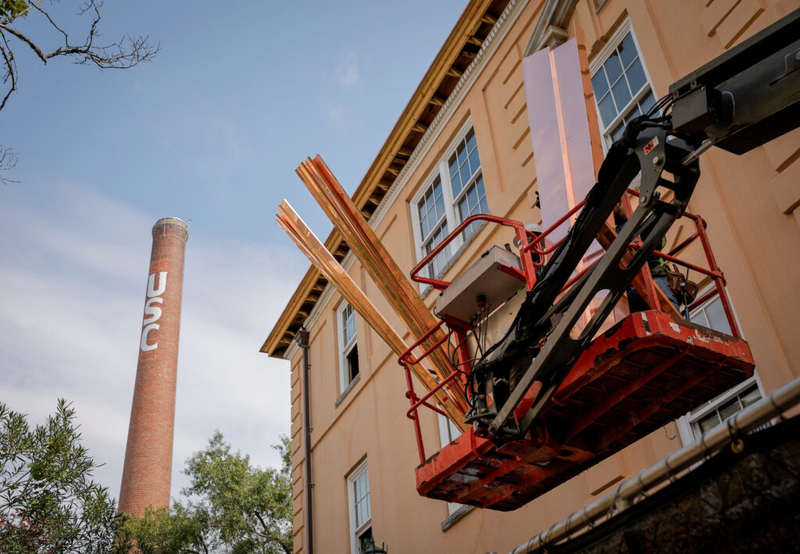
Renovations continue on the University of South Carolina campus in Columbia, S.C., as seen on Friday, Aug. 28, 2026. (Travis Bell/STATEHOUSE CAROLINA/Special to the SC Daily Gazette)
COLUMBIA — The University of South Carolina has been on a massive construction spree while also setting new records annually around student enrollment, private fundraising and securing a large share of state taxpayer dollars to make it all happen.
At least $1.8 billion worth of construction underway or in the planning stages includes:
- a new, $350 million state-of the art healthcare campus and $300 million neuro hospital, both funded by state dollars and debt.
- $350 million in upgrades to the football stadium to match the offerings of others across the Southeast, funded with athletic fees and private donations.
- major renovations to the main campus library ($65 million), buildings around the historic Horseshoe (more than $270 million), and student center ($250 million), financed with student fees.
- plans for a new district centered around engineering and energy, funded by private donations and at least $100 million from the state.
- a total revamp of the area south of the Statehouse to add student housing and retail, funded by the school’s development foundation. No estimate’s been released.
It’s a 180-degree turnaround from the USC of five years ago, when the school was stumbling through leadership changes gone awry, fallouts with major donors, and reckoning with multiple allegations of sexual harassment by employees, who have since resigned.
Lately, the news has been about ribbon cuttings and ground breakings.

The university seeks to keep that momentum going even as higher education undergoes major changes across the country.
“The university is in a position better than it’s ever been in,” outgoing Board of Trustees Chairman Thad Westbrook told the SC Daily Gazette in an exclusive interview last Thursday, nearly a week after he handed over the title to the school’s first female chair.
“We’re hitting on all cylinders at a time when higher ed is facing some headwinds,” added the Columbia lawyer who’s been chairman since 2022.
Colleges nationwide are competing for a shrinking pool of potential students due to a declining national birth rate. And federal funding cuts have led to reduction in national grant funding that has hit some colleges harder than others. This has left some schools facing budget deficits, hiring freezes, and in the case of smaller private schools, closure, as they struggle to make up for the loss in tuition dollars and research funding.
Leaving the ‘noise’ behind
Westbrook credits much of that to USC President Michael Amiridis, the school’s former provost who returned to South Carolina in 2022 after spending seven years as chancellor of the University of Illinois-Chicago.

He came in after a politically-charged presidential search landed the school in hot water with accreditors following the appointment of former West Point Superintendent Bob Caslen.
The retired three-star Army general successfully led the school through the COVID-19 pandemic but resigned in May 2021, after less than two years at the helm, following a blundered commencement address. Not only did he mistakenly refer to graduates as the “newest alumni of the University of California,” but he plagiarized part of his speech, quoting from a Navy SEAL’s 2014 address in Texas without crediting him.
Former President Harris Pastides was asked to return in an interim role until the school could make a new hire.
“I knew that we had the basics and we had them very well,” Amiridis said of his decision to take the job. “At the same time, there was noise. And the problem was, let’s get the noise behind us and let’s move forward in what we want to do.”
Amiridis and Westbrook knew they had to regain the confidence of state legislative leaders if the school was to receive financial support to accomplish its lofty goals.
So, the school prioritized its budget requests on things leadership knew could benefit the state as a whole.
Requests under Amiridis started with a network of clinics to diagnose and treat tough cases of Alzheimer’s and dementia around the state. (The $30 million brain health clinic opened in Columbia earlier this year.)
USC leaders used data on the clinics’ success when they returned to ask for money for an even higher-dollar project — a $350 million neurological hospital to conduct research and train the next generation of brain doctors on treating the most severe cases and the latest in rehabilitation. Taxpayers covered $150 million of the construction cost.
It will be built next to USC’s future, $300 million School of Medicine in downtown Columbia’s BullStreet District, slated to open in August 2027.
The school’s next ask will be $100 million for a nuclear workforce training center, an amount that will be matched by private investment. The announcement comes amid efforts to restart construction of a pair of partially built nuclear reactors in the state.

“I think we’re better aligned with the state than we’ve ever been,” Westbrook said.
What legislators are saying
State budget writers agreed.
“They are, at the present time, bringing a lot of research in to help build the reputation and name of South Carolina to convince the best, most prolific minds to come here,” said Sen. Ronnie Cromer, who chairs the Senate’s higher education budget panel.
The Newberry Republican acknowledged that USC has been doing a lot of building.
“But it’s necessary to continue to attract the best and the brightest,” he said.
House Ways and Means Chairman Bruce Bannister also praised USC’s efforts around brain health and called the nuclear center “a good idea to explore.”
“I’m not concerned that they’re just willy-nilly spending money,” the Greenville Republican said.
He said the laundry list of new construction certainly can’t continue indefinitely.
“At some point they’ll have to slow down and take stock of where they are,” he said. “But I think they’re doing the right thing by the university.”
Both Cromer and Bannister also pointed out that colleges across the state are catching up on about two decades worth of renovations and maintenance after years of cost-cutting following the Great Recession.
Spending questioned
Not everyone is enthusiastic about the latest spending levels.
“If the state is going to keep providing seemingly endless resources, it would be foolish for the university to say ‘no,’” said South Carolina Policy Council Research Director Sam Aaron. “Ultimately, I think the responsibility falls on lawmakers for allowing university spending and state support to grow at such a high rate.”

The government spending watchdog has been critical of taxpayer dollars directed to the state’s largest public college, particularly money sent to keep tuition rates steady for in-state students over the past eight years. The allotments are part of the Legislature’s “tuition mitigation” initiative, a priority of Gov. Henry McMaster, that’s kept in-state tuition frozen at public colleges statewide.
“South Carolinians are subsidizing this activity, even though a sizable percentage of people in this state did not attend college and will never attend college,” Aaron said. “I think the university needs to practice living within its means rather than returning to the Legislature every year requesting increased funding.”
“While I understand the tuition mitigation dollars are intended to benefit South Carolina students, a growing share of the overall university enrollment is coming from out of state,” Aaron added. “That raises a fair question about why South Carolina taxpayers should continue to finance the rapid expansion of facilities that increasingly serve students from outside the state.”
SC’s largest colleges celebrate record applicants for fall 2025. Most aren’t from SC.
Westbrook and Amiridis said it’s true USC has built a national reputation but not at the expense of in-state students.
“We have more students on campus in Columbia than we’ve ever had before, and most importantly, we’re educating more South Carolinians than ever before,” Westbrook said.
They also said, thanks to state funding, steady enrollment growth and internal budget controls, USC is in a better place financially than several other state schools, such as West Virginia University, Washington State University and Arizona State University.
“We’re not freezing hiring and we’re not cutting our budget out of necessity because a CFO (chief financial officer) has sounded an alarm,” Westbrook said. “But we’re also getting tremendous state support.”
Internally, USC cut back on administrative expenses, starting nearly a decade ago, and put those savings — $60 million to date — into an account it could use for hiring faculty and building the medical school.
“I think there are institutions that put themselves in a tough spot because they’ve overbuilt too quickly,” Westbrook said.
We’re the flagship institution. It’s our responsibility to make sure we do these things in a responsible way,” Amiridis added. “Build it and they will come is great for Hollywood, but it’s not a reality.”

Columbia