Stockard on the Stump: Outgoing lawmaker fears private-school vouchers will haunt Tennessee
Aug 28, 2026 | 6:01 am ET
Description
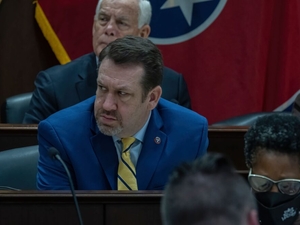
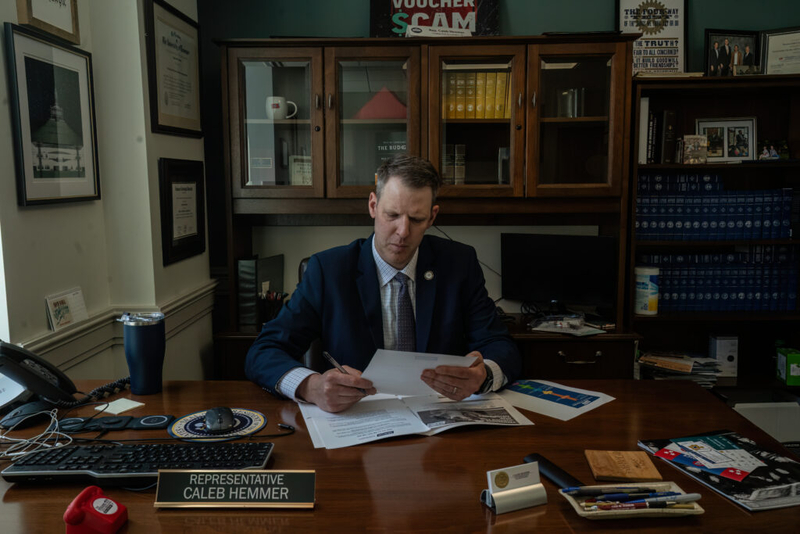
Rep. Caleb Hemmer, a Nashville Democrat retiring after two terms in office, calls the legislature's move to create private school vouchers "the single worst policy decision" of his time in office. (Photo: John Partipilo/Tennessee Lookout)
State Rep. Caleb Hemmer is leaving the Tennessee Legislature with the feeling he made a mark in just two terms but with major concern that lawmakers passed private-school voucher programs that will prove too costly for the state to stomach.
While some Democrats aren’t allowed to pass any bills, Hemmer, a Nashville Democrat, passed a children’s mental health bill and another measure this year designating Nashville hot chicken as an official state food, while working on policy and budgeting behind the scenes and focusing on constituent needs.
Yet his gun-storage bill designed to cut down on thefts went nowhere, as did a provision that would have shone a light on the state’s newest private-school voucher and put income limits on the program.
Hemmer doesn’t think Republicans who enacted the state’s two private-school voucher programs have completely given up on public schools. But he considers it “very shortsighted and misguided policy.”
Beyond that, he said, lawmakers who voted for the state’s two private-school programs are “more scared of the voucher lobby and Jeff Yass of Pennsylvania,” referring to the billionaire who pours money into political action committees — including Club For Growth — that focus solely on vouchers than worried about solid education policy.
“You either get in line or you pay for the crime, and they’ll spend millions of dollars against you,” he said. “I think it’ll go down as the single worst public policy decision we made during my term for sure. It’s not gonna improve outcomes. It’s not gonna make public schools better by any means. It just costs more money for the taxpayers.”
Tennessee won’t know how many new vouchers go to existing private school students
Besides giving out money, mainly to students who were enrolled already in private schools, the state requires few “accountability measures,” Hemmer pointed out. The legislature this year stripped any requirement that students receiving the “scholarship” vouchers take the state’s main achievement test, only a national test, meaning Tennessee has no way to compare students’ performance.
Gov. Bill Lee, who made them his main initiative over eight years, went “all-in” for vouchers “for better or worse,” Hemmer said. “I just fear it’s going to be for the worse. Think of all the things we can do in education policy that evidence has backed.”
Republican gubernatorial candidate U.S. Sen. Marsha Blackburn, likely the next governor, is backing school “choice,” though she has shied away from saying she would expand it beyond the legally allowed number of 5,000 students annually. Democratic gubernatorial candidate Jerri Green, a Memphis City Council member, is pledging to defund vouchers if elected.
In the backdrop
Indianapolis-based EdChoice Legal Advocates, a school “choice” group, has filed a motion to end an ACLU-backed challenge to the state’s newest private-school voucher program.
A hearing is coming up in Davidson County Chancery Court where Jefferson County parent Denise Fair and her husband, both first responders, are seeking to intervene. They worked extra jobs to pay the tuition for their two youngest daughters to attend private schools, and the state funds have cut the burden.
“It has allowed me more time to dedicate to attending activities with the girls and freed up enough financial resources to allow the girls to attend some school field trips,” Denise Fair said in a statement.
EdChoice is also representing Mike and Monica Sweeney of Knoxville, who rely on the money to send their children to a Catholic school after pulling them out of another school and homeschooling because of concerns about COVID-19 guidelines, according to a statement.
Their action comes in response to litigation by a group of 10 Tennessee parents and taxpayers who filed suit in November 2025 challenging the constitutionality of the state’s “universal” private-school voucher program, claiming it shifts funds to unaccountable private schools that “openly discriminate” against students.
In its first year, the program provided vouchers worth $7,300 to 20,000 students at a cost of $144 million, plus all the extras to entice passage. Lawmakers initially approved money for 10,000 students whose family incomes hit 300% of the federal subsidized lunch program, about $180,000, and 10,000 for students with no family income requirement.
Before even seeing how well it worked, lawmakers expanded the program this year to 35,000 students, pushing the cost above $260 million and the state’s total expense for private-school vouchers, including an initial program for low-income kids passed in 2019, well past the $300 million mark.
The fight might never end.
Senate Democrats pounced on the latest figures showing public school students receive less in state funding than private-school voucher students.
Their numbers show Lee and Republican lawmakers put $6.9 billion toward K-12 schools for this school year, $7,272 per student, about $260 less on average than those in the private-school voucher program receive, $7,530. Students in the Education Savings Account program receive even more from the state, roughly $9,000, even as their performance appears to be flagging.
Lawmakers took federal money under the Obama administration for the Race to the Top program, which some critics have referred to as the “Race Over the Edge,” turning an end-of-year test into the end-all-be-all of education.
Many teachers believe the move took the joy out of teaching, forcing them to “teach to the test” instead of focusing on fundamentals and expanding the mind (not through psychedelia).
That view goes out the door, though, now that the state is pouring money into private schools.
And while lawmakers such as Hemmer want a better accounting of the number of private-school students who received the money, Lee made no secret he was writing a check for private-school kids and parents when they surrounded him during the Capitol bill-signing ceremony two years ago.
Even some of the state’s staunchest Republicans call it a “give-away.” But by the time the state hits a financial crisis because of this government expansion, it might be too late to turn back.
More historical accuracy, please
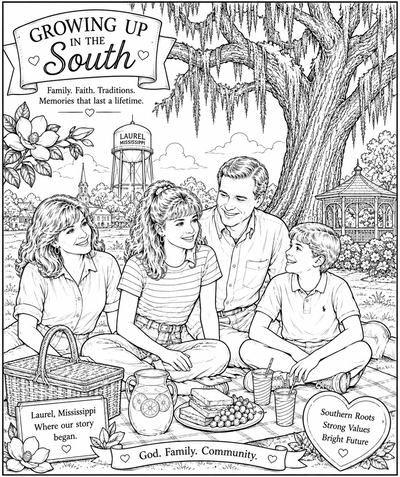
A new coloring book surfaced recently in support of Blackburn’s gubernatorial bid, displaying her in the idyllic setting of a Mississippi upbringing and, we might add, looking about 30 years younger. We’re told it wasn’t sanctioned by her campaign.
While it shows her wrapped in swaddling clothes, picnicking with the fam, going to school, helping others and visiting the local community theater, the coloring book leaves out a few minor details. It shows no “colored only” water fountains or segregated schools and theaters, nor does it mention the murders of three voter rights activists by the KKK in Neshoba County, Mississippi, which took place about the time Blackburn would have been 12 years old.
In short, while it mentions “Southern roots, strong values, and bright future,” the book glosses over the harsh reality of living in Mississippi and much of the South for Black Americans in the 1960s and ’70s. Then again, it is only a book that requires people to keep their colors within the lines.
Winning friends
Republican U.S. Rep. Diana Harshbarger introduced a federal bill Thursday that would have gone over well with Mayberry’s Morrison sisters, who used a “flower-making machine” to create their medicinal “elixir” on “The Andy Griffith Show.” (Admission: I had to look up their name.)
Harshbarger is sponsoring the Freedom to Home Distill Act, which would do exactly what it says, end the prohibition on distilling spirits at home and provide the tax-free, personal-use exemption enjoyed by beer and wine brewers.
“Distilling has deep roots in Tennessee and across Appalachia, tied to self-reliance and craftsmanship that go back generations. It’s long past time we modernize this outdated federal law,” said Harshbarger, who hails from Kingsport.
“Moonshiners” TV series star Eric “Digger” Manes brought the idea to her, saying even the nation’s first president, George Washington, made moonshine.
“Given that multiple states have legalized marijuana, it appears logical that we should be permitted to engage in our hobby without facing repercussions,” Manes said in a statement.
Apparently, he didn’t run that statement by Tennessee’s top GOP lawmakers. But it’s a start.
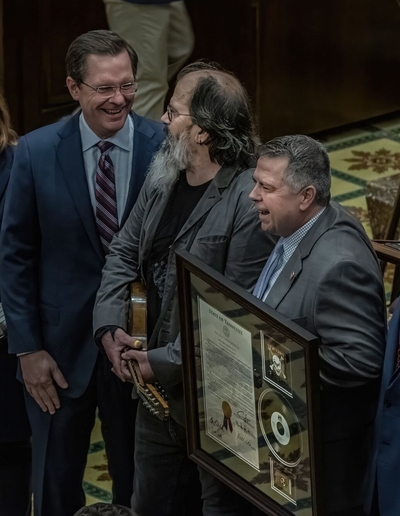
Of course, without the prohibition we wouldn’t have some of the state’s most popular tunes, one of which was sung on the state House floor.
“You hardly ever saw Grandaddy down here / He only come to town about twice a year / He’d buy a hundred pounds of yeast and some copper line / Everybody knew that he made moonshine.”*
*”Copperhead Road,” Steve Earle
Nashville, TN