Maryland, 22 other states sue Trump administration over family planning restrictions
Aug 27, 2026 | 6:47 pm ET
Description
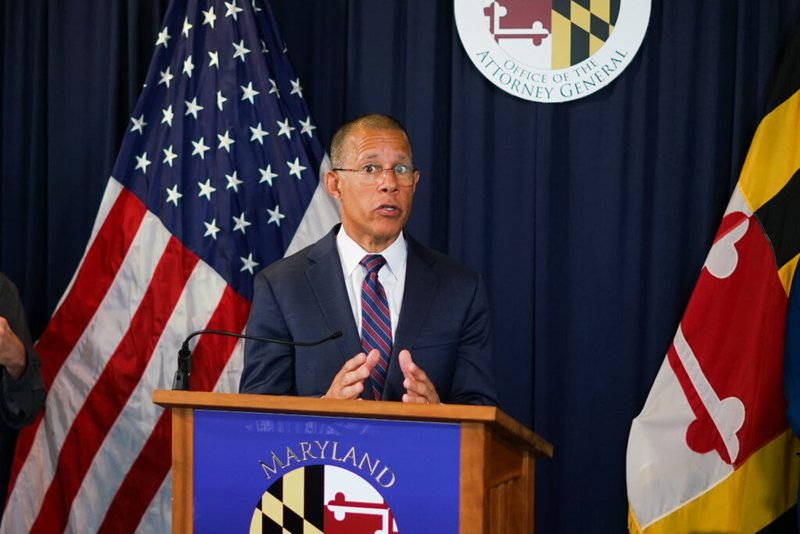
Maryland Attorney General Anthony Brown (D) at a 2024 news conference. Brown led a coalition of 23 states that sued the Trump administration over new restrictions on funding for family planning programs. (Photo by Elijah Pittman/Maryland Matters)
Maryland is co-leading a lawsuit with 22 other states challenging new Trump administration funding requirements that threaten family planning grants unless states comply with what Attorney General Anthony Brown calls “unlawful and discriminatory conditions.”
In the suit filed Thursday in U.S. District Court for Maryland, Brown, along with New York Attorney General Letitia James and officials from 21 other states, says the new conditions on the Title X program in the upcoming fiscal 2027 funding period will penalize states that “refuse to abandon nondiscrimination protections.”
Those new conditions require states to demonstrate that their programs align with federal priorities that Brown said would discourage the use of contraception, exclude transgender people from healthcare and eliminate diversity, equity and inclusion initiatives, among other changes.
“For decades, federal family planning funding has enabled Maryland to provide tens of thousands of families with care they could not otherwise afford,” Brown said in a written statement. “Cutting off that funding does not merely eliminate a budget line. It means fewer cancer screenings and more preventable diseases going undetected. My office will not stand by while the federal government puts politics ahead of patients’ health.”
Officials with the U.S. Department of Health and Human Services, the target of the lawsuit, did not immediately respond to request for comment on the legal challenge.
The Title X program was created by Congress over 50 years ago to promote comprehensive family planning programs and related reproductive health services, particularly for low-income communities.
Maryland, nine other states sue White House to protect interest payments to homeowners
Through Title X, the Health and Human Services provides grant funding for states to establish family planning programs covering a wide range of services, such as preventing unintended pregnancies, detecting cervical and breast cancer and treating sexually transmitted infections, among other services.
In 2026, Congress earmarked $286 million for Title X, according to the court filing.
But a notice of funding opportunity, or NOFO, issued in July for the next five-year funding cycle tacked on new conditions for states to receive those funds. The lawsuit claims the new terms are unlawful, and the states are asking the federal court to vacate the new requirements and prohibit federal officials from imposing those restrictions.
Brown and the other states’ officials allege that the Trump administration overstepped its own authority to cram in “agency priorities” that force states to demonstrate “alignment” with certain political goals or risk losing that funding.
Those goals include ending “support for gender ideology,” likely referring to policies that support transgender individuals, though one of the complaints in the lawsuit is that the terms are vague and will be challenging to adhere to.
The lawsuit notes that the state of Maryland has “never been denied a Title X grant.” For fiscal 2026, Maryland received $3.7 million in federal dollars and added $6.3 million in state funding to support the program.
In fiscal 2025, there were 31,657 individuals who “received services at no cost” under Maryland’s Title X program, called the Maryland Family Planning Program. About 27% of those individuals lived in rural counties.
“A reduction in family planning funds would disproportionately limit access to essential screenings and care for rural Marylanders,” the lawsuit said. It adds that without the federal funding, “MFPP expects to provide 1,447 fewer Pap smears each year, resulting in an anticipated 25 high-grade cervical pre-cancers going undetected annually.”
Another challenge raised in the lawsuit are conditions that have states demonstrate that their programs “end ‘overmedicalization,’ a category that the NOFO indicates includes hormonal contraception;” along with safeguarding “‘life-affirming’ program delivery” and adopting “directive counseling that pushes patients towards parenthood and marriage.”
Maryland law prohibits state health officials from accepting federal funds that “exclude comprehensive family planning providers or mandate abortion-related censorship,” the lawsuit says.
“To apply under the 2027 NOFO, MDH [the Maryland Department of Health] must choose between substantially restructuring its existing application and usual programming to conform to the NOFO’s new priorities — which appear to be inconsistent with the existing Title X statute and regulations — or risk being denied federal funding for MDH’s longstanding approach and programming,” the lawsuit says.
“If … MDH cannot pursue or does not receive Title X funding, the loss of funding would represent a 38.5 percent reduction in MFPP’s total operating revenue,” according to the lawsuit. “MDH’s standard allocation of State-only family planning funding could sustain only a limited portion of the program’s existing activities.”
Attorneys general from the other states raise similar concerns. New York says that its version of the family planning program helped almost 254,000 clients in 2025, with 70% of them coming from households below the federal poverty level.
Massachusetts argues that the funding helps support screening and early-stage medical interventions.
“Absent those critical screening, contraceptive, and early-stage interventions,” the lawsuit said of Massachusetts, “public sector healthcare costs for necessary downstream procedures such as maternity and birth related services to 60 months, miscarriage and ectopic pregnancy management, and downstream STI [sexually transmitted infection] testing would have totaled $155,220,000.”
California officials question how states can comply with the new conditions while upholding intended goals of the program, including requirements that have little to do with family planning.
“For example, it is unclear how to appropriately deemphasize hormonal birth control while continuing to ensure access to hormonal contraception consistent with Title X program requirements, or how the priority of reducing crime should be operationalized within a family planning program,” the lawsuit says of the impact the federal policy will have on California programs.
Other states joining Colorado, Connecticut, Delaware, Hawaii, Illinois, Kentucky, Maine, Michigan, Minnesota, Nevada, New Jersey, New Mexico, Oregon, Pennsylvania, Rhode Island, Vermont, Virginia, Washington and Wisconsin.
Annapolis, MD