Indiana prison population climbs as local corrections programs face funding cuts
Aug 27, 2026 | 4:30 am ET
Description
Criminal justice officials are urging Indiana lawmakers to preserve local supervision and treatment programs as the state’s prison population approaches capacity. (Getty Images)
A growing prison population and shrinking support for local alternatives to incarceration could leave Indiana paying more to hold people in state prisons and county jails, criminal justice officials warned lawmakers Wednesday.
The Indiana Department of Correction’s population has reached approximately 26,640, Cierra Stanko, the agency’s legislative director, told the Interim Study Committee on Corrections and Criminal Code.
That is an increase of roughly 2,300 people from summer 2024, when the adult prison population stood at about 24,300, according to DOC’s presentation.
Stanko emphasized that prison sentences are getting longer, courts are sending more Level 6 felons to state facilities and the effects of sentencing changes made more than a decade ago are now showing up in the state’s incarcerated population.
At the same time, local programs that supervise people on probation, home detention, work release and other alternatives to incarceration are confronting a significant decline in state grant support.
Funding available through Indiana’s Community Corrections and Justice Reinvestment Grant is projected to fall 27% — from $72.5 million in calendar year 2025 to $52.9 million in 2027 — following reductions to the state appropriation, according to a presentation from statewide associations representing community corrections and probation officers.
I am exceptionally optimistic, but I know we can’t promise anything.
Those pressures dominated Wednesday’s meeting, which was intended to identify trends and possible legislative responses ahead of the General Assembly’s return in January.
The committee did not adopt formal recommendations, approving instead a report summarizing the testimony.
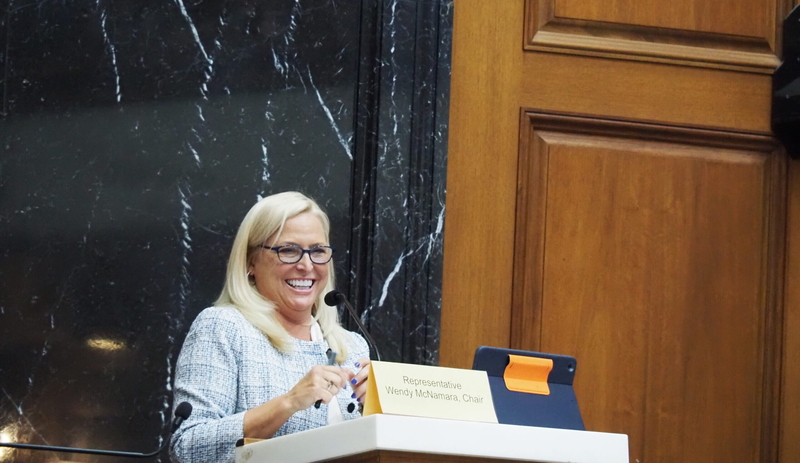
But committee chair Rep. Wendy McNamara, R-Evansville, said she has been working with the governor’s office and DOC to locate additional money for community corrections and problem-solving courts.
“I am exceptionally optimistic, but I know we can’t promise anything,” McNamara said. Restoring enough money to fund all the grant requests would require approximately $12 million, she added.
“As soon as a funding source is identified, hopefully that’ll all be resolved,” McNamara said.
Prison growth versus treatment needs
State prisons, meanwhile, are operating with little room to absorb additional growth. DOC officials told lawmakers the population is increasing consistently as sentences lengthen, more counties send people to the state system and courts work through cases delayed during the COVID-19 pandemic.
“While we are extremely supportive of this, we are the backside of the tough on crime approach, and we will always need the funding for this,” Stanko said.
The Reception Diagnostic Center, which processes people entering the state prison system, held 697 people despite having a maximum capacity of 695 as of Aug. 18, according to DOC’s presentation. The average processing time has fallen from about 45 days to approximately three weeks, but delays can leave state-sentenced offenders in county jails while awaiting transfer.
Story continues below.
The new Westville Correctional Facility is expected to open in mid-2027 and add close to 1,000 beds after accounting for the closure of most of the existing prison, Arnold said. Moving the population into the new facility is expected to take six months to a year.
But testimony throughout the meeting maintained that Indiana cannot build its way out of all the pressures facing its correctional system.
Grant County Judge Mark Spitzer, president of the Indiana Judges Association, said substance use and mental illness remain the two largest drivers of recidivism. Programs addressing those conditions require time and sustained funding, he said, but remain less expensive than incarceration.
“If you address that, it’s still going to be cheaper than sending them to prison, and it’s going to be longer lasting as well,” Spitzer said.
Indiana spends about $85.44 per day, or roughly $31,000 annually, to incarcerate one person, according to DOC data included in Spitzer’s presentation. The department is holding about 26,500 adult felons and operating above 95% of capacity.
The number of Level 6 felons in state facilities grew 22.3% between August 2024 and July 2026, reaching 1,925. Level 6 is Indiana’s lowest felony classification.
Level 5 felonies made up the largest single category in June, with 4,462 people incarcerated.
Courtney Curtis, assistant executive director of the Indiana Prosecuting Attorneys Council, cautioned against attributing the growth entirely to a tougher approach to punishment.
A 2022 law allowed courts to send more Level 6 felons to DOC, in part because state prisons could offer mental health and substance use treatment that was not available in some county jails or community programs, she said.
“If we don’t have local resources for mental health treatment and substance abuse treatment, then we are going to send those people where those resources exist, and they do exist in the Department of Correction,” Curtis said.
She described the state’s prisons, jails, courts and local supervision programs as parts of one interconnected system. Removing services at one point only moves people elsewhere, she said.
“We can’t remove programming and then just assume people will magically become sober or become mentally well,” Curtis continued. “The services, wherever they are located, is where we will send the people.”
Grant cuts reach local programs
The funding reduction has already eliminated grant support in some areas.
Pretrial services, jail treatment and prosecutor diversion programs each received funding in calendar year 2025 but received none in the 2026 and 2027 grant awards, according to a joint presentation by the Indiana Association of Community Corrections Act Counties and the Probation Officers Professional Association of Indiana.
Funding for court programs is projected to fall from $6.1 million in 2025 to $1.89 million in 2027, while probation funding is expected to decline from $3.66 million to $1.08 million. Community corrections awards will fall from $58.78 million to $49.95 million over the same period.
DOC officials said some county applications failed to clearly identify their priorities and some programs received little or no funding because they served relatively few or lower-risk participants.
Arnold pointed to one county seeking $160,000 to employ two people while putting only four people through its program. He did not identify the county.
McNamara later clarified that some local agencies did not mark a box identifying their priorities on the grant application. That did not necessarily mean the communities considered those programs unimportant, she said.
Local corrections representatives also challenged the suggestion that counties had failed to prioritize programming.
“We would disagree with the DOC statement made earlier that community supervision didn’t prioritize DOC funding for programming in our grants,” said Angela Morris, president of the Probation Officers Professional Association of Indiana and Johnson County’s court services director.
“They’re actually working. They’re using evidence-based programming,” Morris added of community supervision programs. “To say they’re not working, I would wholeheartedly disagree.”
Indiana has approximately 106,000 people under daily community supervision, Morris noted. That population alone would consume about 80% of DOC’s bed capacity if everyone were incarcerated.
Story continues below.
A statewide survey of local agencies found that the grant reductions have contributed to hiring freezes, higher caseloads, reduced drug screening, fewer treatment and peer-recovery services, tighter eligibility requirements and the closure of some residential programs.
“The need for supervision doesn’t disappear when the programs go away,” said Ashley Stevens, president of the Indiana Association of Community Corrections Act Counties and director of Rush County Court Services. “When community supervision loses capacity, more individuals are managed in more expensive parts of the correctional system, with less treatment and less programming.”
She added that Indiana’s justice reinvestment strategy was built on reserving prison beds for people who require incarceration while giving counties resources to safely supervise others in their communities.
“The trend we’re seeing today is not increasing crime or failing programs,” Stevens said. “The trend we’re seeing is decreasing investment.”
Sen. Greg Taylor, D-Indianapolis, pressed the committee to consider recommending restored funding for problem-solving courts, but McNamara declined to add a recommendation Wednesday. She said the committee could review the testimony and pursue the issue later.
“We know that we need to fund our problem-solving courts and our community corrections,” McNamara said. “We know that, but that’s not something we can fix today.”
Indianapolis, IN