GOP lawmakers call for more oversight of license plate cameras after string of misuses in Georgia
Aug 25, 2026 | 8:12 pm ET
Description
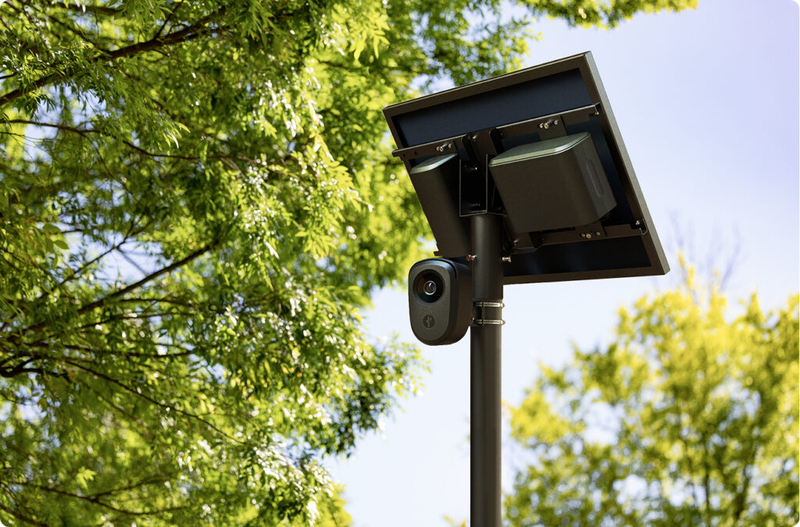
Flock Safety license plate readers are typically mounted on tall poles, with a camera and solar panel on top. The company says its technology is used in more than 6,000 communities across 49 states in partnership with thousands of law enforcement agencies nationwide. (Photo courtesy of Flock Safety)
A pair of influential Republican lawmakers are calling for greater oversight into the use of automatic license plate readers that critics say allow law enforcement officers to illegally surveil Georgia residents.
Sen. John Albers, a Roswell Republican who chairs the Senate’s public safety committee, said he is working with the Georgia Sheriffs’ Association and the Georgia Association of Chiefs of Police on a new task force to examine how best to address misuse of the cameras, which are manufactured by companies like the Atlanta-based Flock Safety.
“We have to be smart, we have to be balanced and we have to be thoughtful as we work together to both have both short and long-term solutions,” he said during a Tuesday press conference at the state Capitol.
In a letter to the state law enforcement groups, Senate President Pro Tempore Larry Walker, a Perry Republican, raised questions in response to “the rise in public concern.”
Walker wrote that “recent allegations of improper use – resulting in stalking, misidentification, and unjustified arrests – have understandably heightened privacy and accountability concerns for our constituents.”
Flock Safety tightens safeguards as states, cities question surveillance network
Automatic license plate readers, such as the ones made by Flock, work by capturing license plate data, along with other information like a car’s make and color, and storing that information in a searchable database. Law enforcement agencies that have contracts with Flock can use the database to track down stolen vehicles, locate missing people and solve other crimes.
However, the technology is not without controversy. According to the Georgia Bureau of Investigation, at least 14 people have been arrested and charged this year for misusing a state law that restricts use of the cameras to only official law enforcement purposes.
Albers cited instances of misuse in an op-ed he wrote calling for greater oversight of the technology. While law enforcement deserves effective tools for fighting crime, he wrote that “backing the blue does not mean ‘writing a blank check’ for government surveillance.”

He also wrote in the op-ed that he is working with the state law enforcement leaders to identify more ways to tighten up the system and left open the possibility of pursuing a legislative fix next year.
Flock CEO Garrett Langley recently announced that the company would be bolstering its safety guardrails, including lowering the amount of time that license plate data can be stored in a database from 30 days to seven, automatically suspending users who appear to be misusing the system and requiring police officers to input case number or specify what type of crime they are screening for when searching through the database.
But Christopher Bruce, the ACLU of Georgia’s deputy executive director, said he remains skeptical that the company’s new measures will go far enough to prevent misuse of the system.
Adopting laws that require municipalities with Flock contracts to be more transparent with communities about how their data is used and disclose any instances of misuse, Bruce said, could be one way to ensure that there is public accountability.
“You can have the right to privacy and the right to public safety. It doesn’t have to be compromised,” he said. “We can do this, but there has to be guardrails around surveillance.”
Atlanta, GA