U.S. Supreme Court lifts pause on Trump mail-ballot order
Description
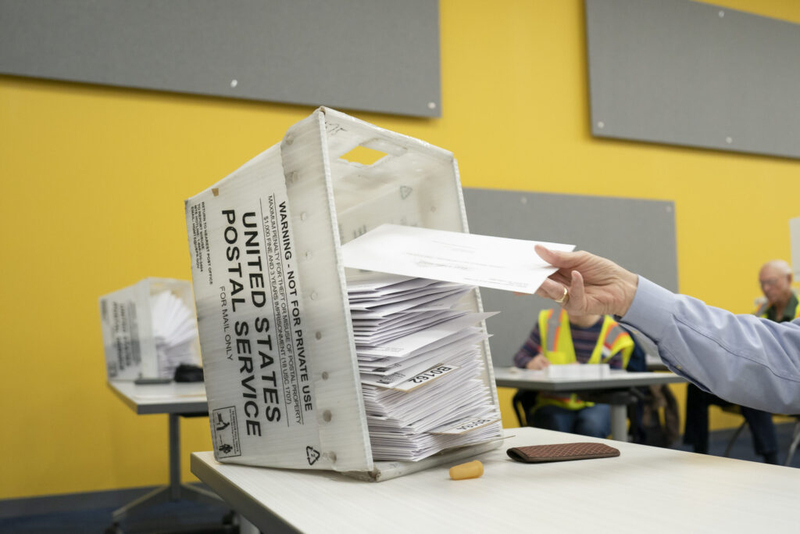
So far, 523,083 registered Democratic voters in Florida have requested vote-by-mail ballots, compared to 391,149 registered Republicans. An additional 217,849 Non-Party-Affiliated voters and 25,193 from other political parties have made such requests. (Photo by Allison Joyce/Getty Images)
WASHINGTON — With just over two months until the November midterms, the U.S. Supreme Court gave way Monday for President Donald Trump to have a hand in regulating mail-in ballots nationwide, a voting method he has falsely claimed is rife with corruption since he lost the 2020 presidential election.
In an unsigned emergency docket opinion, the court’s conservative majority wrote the Trump administration is likely to prevail on its argument that 23 Democratic-led states do not have standing to stop his executive order to change how the U.S. Postal Service processes mail-in ballots.
The majority justices also wrote that a lower court’s injunction is “causing irreparable harm,” but left open the possibility that the executive order could still be considered unconstitutional.
“The Court’s disposition of this application does not mean that any measure taken by the Government to implement the Order will necessarily be lawful. On that score, time will tell,” the majority wrote.
The legality of a Massachusetts federal district court order, which paused the executive order to overhaul vote-by-mail systems before the Nov. 3 midterms, will now be decided by the U.S. Court of Appeals for the First Circuit.
Justices Sonia Sotomayor, Elena Kagan and Ketanji Brown Jackson dissented.
In a lengthy dissent, Jackson wrote the ruling “needlessly injects chaos and uncertainty into the upcoming midterm elections.”
The principle of courts not altering voting systems too close to the election has been eroded, she said, amounting to a “Kafkaesque nightmare.”
“States administering elections and the voting public that relies on them to do so deserve clarity, not caginess or confusion,” she wrote.
Final rule issued
The March 31 executive order at the heart of the case in part directs USPS to direct the redesign of mail-in ballot envelopes, including adding a unique barcode. It also asks USPS to collect voters’ names and addresses from state elections officials and directs the U.S. Justice Department to investigate and prosecute state officials who violate the order.
The Postal Service issued a final rule Friday detailing how the process would be carried out.
Whether an overhaul of mail-in ballots for each state could be completed in time for the Nov. 3 election remains to be seen, as vote-by-mail documents are sent to voters well in advance of Election Day.
A federal district judge in Massachusetts chastised the Trump administration for sowing confusion and “creating” an emergency by noticing a rule Friday that the U.S. Postal Service will eventually require federally regulated mail-in ballot voting envelopes and state data.
A 95-page notice alerting that the final rule would appear in the Federal Register on Aug. 26 outlined justifications for federal requirements on states to redesign ballot envelopes and provide a list of recipient names and addresses to USPS. The final rule became effective Friday, according to the document.
The final rule runs contrary to U.S. District Judge Indira Talwani’s Aug. 11 preliminary injunction barring the federal government from changing states’ mail-in voting rules prior to the Nov. 3 midterm elections, the judge wrote in a brief order on the docket Sunday.
“Defendants did not file an appeal and did not seek, let alone obtain, a stay of the preliminary injunction,” Talwani wrote. “Nonetheless, on August 21, 2026, USPS issued its Final Rule, with an anticipated publication date in the Federal Register of August 26, 2026.”
Talwani was appointed to the bench by President Barack Obama in 2013 and unanimously confirmed by the Senate the following year.
Effective date delayed
The rule includes a provision that it will not be in effect for this year’s midterm elections if Talwani’s injunction is still in place, but the judge said it would still create significant confusion for voters.
The Trump administration asserted the rule would “have no effect on the rules themselves while the injunctions are in place, while ignoring the confusion that the publication will engender,” Talwani wrote.
It’s unclear what effect the final rule will have on the active litigation on the issue.
The federal government had appealed Talwani’s injunction because, it argued, Trump’s order could not be challenged until an agency published a final rule.
Groups want quick order
The voting rights advocacy groups, led by the League of Women Voters of Massachusetts, who sued President Donald Trump and administration officials over a March executive order overhauling mail-in voting procedures swiftly filed an emergency motion Saturday.
They urged Talwani to quickly enforce her injunction, and to order expedited responses from the administration, citing “immediate, ongoing, irreparable harm caused by Defendants’ violation of the preliminary injunction, and in light of these fast-approaching dates.”
“There are now only 73 days before the November 2026 election, and far fewer before mail ballots begin to go out,” they wrote.
The Trump administration appealed to the U.S. Supreme Court in late July a similar district court ruling against its mail-in voting restrictions order in a case brought by nearly two dozen Democrat-led states.
The states argued that the federal government has no constitutional role in election administration, that the executive order unfairly limited vote-by-mail, which some states use exclusively, and that an overhaul of ballot requirements this close to an election was unworkable.
High court appeal
In a supplemental brief filed to the Supreme Court justices Monday, U.S. Solicitor General D. John Sauer said the USPS’s rule issuance “underscores the need for relief from the district court’s improper, unripe injunction.”
“The Postal Service’s final rule imposes only modest requirements for preparation and envelope design for federal ballot mail — requirements that fall well within its traditional authorities to impose mailing standards for particularly sensitive types of mail,” wrote Sauer, who formerly worked as Trump’s personal defense attorney.
Democratic officials in 23 states — California, Massachusetts, Nevada, Washington, Arizona, Colorado, Connecticut, Delaware, Illinois, Maine, Maryland, Michigan, Minnesota, New Jersey, New Mexico, New York, North Carolina, Oregon, Rhode Island, Vermont, Virginia, Wisconsin and Pennsylvania — and the District of Columbia brought the suit challenging the executive order.
Twelve states with Republican attorneys general — Alabama, Missouri, Florida, Indiana, Kansas, Louisiana, Montana, Nebraska, Oklahoma, South Carolina, South Dakota and Texas — joined the appeal to the Supreme Court on the federal government’s side.
All States Newsroom content is free to republish. Read our republishing policy for more information.