Counties scramble to respond to data centers, setting moratoriums, a ban
Aug 10, 2026 | 6:53 am ET
Description
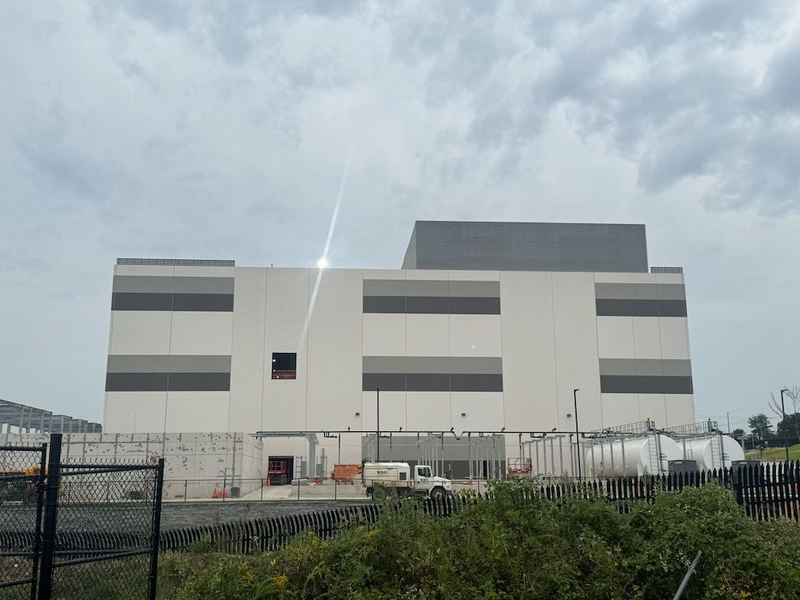
The Amazon Web Services Data Center in Springfield, Va., part of Northern Virginia's "data center alley" and one of many such centers in the Washington metropolitan region. (Photo by Peter Riccio/Capital News Service)
Bryan Cornell lives in a house he built on his grandparents farm in Harford County. His parents live next door, and his daughter is in the next house over.
When he first heard a rumor in April that a golf course behind his property was being considered as a potential site for a data center campus, “he panicked” and even weighed selling his home. But then, he decided to push back.
He quickly teamed up with Krissy Flatau, who lives across the street from the golf course, and together they formed Our Land, Our Home, Our Harford – a grassroots community organization that advocated against data centers in the county. Months later, in June, Harford County became the first in Maryland to completely ban the facilities.
“I couldn’t stand the thought of my kids never wanting to visit me, my grandkids never wanting to visit me because there would be an industrial site right across the street from me,” Flatau said.
Data centers have become a contested issue in recent years, and as local governments are facing more opposition to the facilities, many are taking time to understand how they should move forward. Currently, 13 counties have enacted temporary data center moratoriums, with two voting last week, and more counties are considering a pause.
Angie McCarthy is the clean energy campaign manager at Nature Forward and the founding chair of Marylanders for Data Center Reform, a coalition of 62 environmental and community organizations that aim to ensure data center development is done sustainably and ethically.
She calls the moratoriums a “natural reaction” to all of the concerns people have about data centers impact on things like the environment, noise, community infrastructure and public health.
Several Maryland counties, from Caroline on the Eastern Shore to Montgomery, the state’s most populous, have decided to pause data center development in recent weeks. Many counties say these moratoriums will give them the time to research the potential impacts of the facilities in their communities and issue appropriate regulations for them.
A statement from the Maryland Tech Council said local governments have a responsibility to examine how data centers fit in their communities, but that many of the concerns associated with the facilities are “misunderstood or vastly overstated.”
“Rushing to enact broad policies before the facts are fully examined risks foreclosing on a generational economic opportunity rather than regulating an industry on reasonable terms set by local governments,” the statement said.
Harford is so far the only county to impose a ban. County Executive Bob Cassilly proposed the ban in response to a proposed moratorium to develop “guardrails” on data center development, according to public testimony read to the council on his behalf in June.
Cassilly said he didn’t see a reason for a moratorium because the county had already been researching the feasibility of data centers and concluded that it did not have the electrical capabilities to power hyperscale centers. He said it would be “grossly irresponsible” to allow data centers when there’s not enough power to run them.
Cassilly said he expects other counties will eventually decide to ban the centers, given the state’s limited energy capabilities.
More data center proposals keep coming to Pennsylvania. So does the outcry.
“I don’t know what choices they have other than ‘Let’s inflate all the energy prices for all of our residents,’ which doesn’t seem like an appropriate thing to do,” Cassilly said. “People are already struggling with some of the highest energy costs in the country, so adding that burden doesn’t seem appropriate at all. To me, that’s just highly irresponsible to do.”
The Montgomery County Council voted recently to extend its current six-month pause on data centers to 18 months. County Executive Marc Elrich signed an executive order in June to approve the pause amid concern over a potential facility in Dickerson.
The 18-month pause was a compromise between a six-month moratorium first proposed by Council member Evan Glass and a two-year pause by Council members Will Jawando and Kristin Mink.
Glass said the extended pause will give the county more time to “get this right” and ensure that economic opportunities don’t come at the expense of the environment and the community’s needs.
“The worst thing you can do is try to rush because once it’s built and all these things are in place, you can’t go back,” Jawando said.
In Frederick County, County Executive Jessica Fitzwater signed an order July 1, pausing new data center permitting or approvals until the end of the year. The current moratorium also does not have any affect on previously approved projects.
Fitzwater created a data center pause and work group to provide recommendations for future development guidelines in June 2023, soon after coming into office. This came after developers purchased 2,100 acres of land in 2021 for a hyperscale data center campus in southern Frederick County.
“With the Quantum Frederick project, it just put us in a different position than some of the other counties who were trying to attract data centers,” said Council member Renee Knapp, who served on the work group. “We already had this really large project that we had to come up with regulations for.”
In December, the Frederick County Council voted to expand the data center zoning area surrounding the Quantum Frederick development to about 2,600 acres. Before this, 5,000 acres of the county’s industrial zoning area was available for data center development. While the change was designed to limit urban sprawl and confine the facilities to just that area, it was 1,000 acres beyond what the county’s planning commission previously recommended.
Data center frustrations cause upheaval in county primary elections
This decision prompted residents to pursue a ballot referendum on the issue, with organizers collecting more than 20,000 signatures. The county’s board of elections approved the measure, but the Maryland Supreme Court ruled on June 30 that it must remain off the ballot, after data center companies challenged the petition’s legality.
Fitzwater said the current pause will give the county time to answer residents’ questions and address their concerns about the developments. Frederick and several other Maryland counties with moratoriums are waiting to receive a study on the impacts of data centers that is due to Gov. Wes Moore and the General Assembly by Sept. 1.
“These projects that are being built now already have approvals, so there isn’t a mechanism to take away approvals that were already given,” Fitzwater said. “But, we can say we’re not accepting new applications or doing any new approvals while we continue to monitor the industry [and] see what the state impact analysis tells us.”
Council member Brad Young said that while he understands why Fitzwater issued the moratorium, he didn’t agree with the decision. He said the county had already gone through the process of getting public input and agreeing on county regulations.
He said he saw having data centers in the county as a way to relieve the tax burden on residential taxpayers and still find ways to support schools and the community.
“I was for limiting it to that one area, putting tough regulations on them and taxing the heck out of them,” Young said. “And I was, and am, still confident we did a great job with that.”
Taylor Frazier McCollum, a Prince George’s County-based advocate against data centers, and Cornell both said they felt moratoriums just give counties the opportunity to open the door for future data center development, despite significant community opposition.
“It’s a hot issue, and it crosses party lines,” Frazier McCollum said. “It’s a bipartisan issue. It’s something that people are concerned about. They don’t want their sleep disrupted. They don’t want to live near diesel generators or have gas plants turned back on to run a data center in the community.”
McCarthy said it’s important for counties to think about how they will move forward once their moratoriums end. She said this won’t be a “one size fits all,” and will have to look different for each county.
This could mean strict environmental regulations, heavily taxing developers and ensuring that money is reinvested back into the community. But, McCarthy said, if county governments and their residents can’t agree on what regulations to accept, it may be time to consider a permanent ban.
Advocates, like Frazier McCollum, Cornell and Flatau say they don’t want data centers in Maryland at all, and they plan to fight to make it happen.
“We’re definitely staying involved,” Cornell said. “We know the session’s coming up, and we’re not going away.”
Annapolis, MD