Governors and lawmakers say they’re getting serious about states’ rights
Aug 05, 2026 | 5:00 am ET
Description
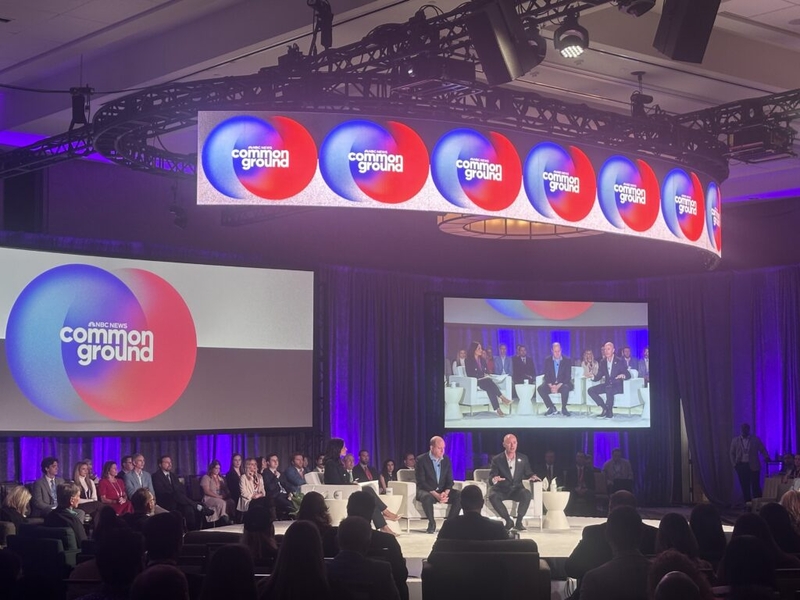
Kristen Welker, host of NBC’s Meet the Press, interviews Colorado Democratic Gov. Jared Polis and Utah Republican Gov. Spencer Cox during the summer meeting of the National Governors Association in Oklahoma City. Governors called for a rebalancing of state and federal power sharing. (Photo by Kevin Hardy/Stateline)
OKLAHOMA CITY — State leaders of both parties say the federal government — including the president — wields too much power, and they want to see more authority returned to the states.
Bipartisan groups of governors and state lawmakers held major gatherings in recent days where issues of state authority became a major focus. They agreed the federal government had grown too powerful and pushed for states to maintain control over elections, energy, education and other issues.
During President Donald Trump’s second term, state leaders have heightened focus on federalism, the uniquely American system created by the framers of the Constitution to share power between Washington, D.C., and the states.
But governors and lawmakers said it requires bipartisan cooperation across the states to reset the balance of power.
Utah Republican Gov. Spencer Cox said it’s easy for state leaders to champion states’ rights when the opposing political party controls the levers of federal power. But a truer test of federalism likely lies in how states approach it when their own party controls Washington.
“And that’s why I’m proud to have Republicans who still believe it even when the president is doing things that they want,” Cox told Stateline.
Cox, who was in Oklahoma City this weekend for the National Governors Association summer meeting, has long championed a rebalancing of state and federal powers. He and other leaders argue that a renewed focus on federalism could help lower the national political temperature. By shifting more political decisions to the states, some officials envision a nation less subject to blue-red swings that change the entire course of federal law enforcement, environmental policy and business regulation.
In Utah, state officials are looking to lead a national movement to bring more authority back to the states. Cox said too many political issues have become nationalized, driving vitriol and polarization as a sharply-divided Congress acts on few policy issues.
“That means that the president becomes even more important than they were ever meant to be,” Cox said, “and then these big elections every four years feel kind of life or death.”
Cox said recent U.S. Supreme Court decisions have empowered states. But he said liberal and conservative states alike must push to take more authority from the federal government.
“We have to demand it,” he said. “We have to talk to our members of Congress about it, let them know that we don’t want the feds playing such a major role.”
The bipartisan association of governors is in the process of updating its internal policies on federalism. Last revised years ago, NGA’s current policies speak about challenges such as unfunded mandates, in which the federal government requires states to meet new rules without providing money to achieve them.
States will shape America’s future as nation confronts a pivotal choice
The updated policy will address pressing issues such as artificial intelligence regulation — an ongoing state-federal conflict over jurisdiction — and the primacy of each state to control its own National Guard — an issue that sparked major concerns about state sovereignty last year.
The revised policy will remind governors of the inherent authority of states in pushing back against the federal government, said John Dinan, a professor and chair of the department of politics & international affairs at Wake Forest University in North Carolina. Dinan, a federalism scholar, is consulting with NGA on its federalism work.
Dinan said both political parties have leaned on federalism principles opportunistically over the years — depending on which party enjoyed national power. But now, he sees strong agreement between Republicans and Democrats to strengthen the role of states.
“It’s attracting interest from people across the ideological spectrum,” he said.
States say they should lead
In Oklahoma City, governors sought to showcase a bipartisanship that has nearly vanished in national politics.
Governors said their states could compete with each other, experiment with programs and adopt wildly distinct policies — without being divisive or disrespectful.
In particular, Oklahoma Republican Gov. Kevin Stitt and Maryland Democratic Gov. Wes Moore emphasized their close friendship. Moore wore cowboy boots as he assumed leadership of the national association from Stitt at the National Cowboy & Western Heritage Museum.
In opening the meeting, Stitt recalled President Abraham Lincoln’s second inaugural address, given near the end of the Civil War. The 16th president famously pushed for national unity by calling for “malice toward none” and “charity for all.”
“Think about that,” Stitt said. “After years of war, Lincoln didn’t focus on settling scores or getting revenge. He focused on putting our country back together. His commitment to unity saved our country.”
Democrats, Republicans alike focus on states’ rights as a way out of America’s political woes
Like Lincoln, Stitt said the nation’s governors don’t shy away from fractures and disagreements. They debate and share ideas, while also embracing the role of diverse policies across the states.
“When states lead, America succeeds,” Stitt said. “There’s not a one-size-fits-all for a country as diverse as America.”
As one example, several governors pointed to the recent dramatic climb in Mississippi’s student reading and language scores.
“Mississippi really turned the entire country around when it comes to the science of reading,” said North Carolina Gov. Josh Stein, a Democrat. “And that was because one state went out there and figured something else out and we’re now all aggressively copying it.”
Stein, along with Vermont Republican Gov. Phil Scott, have been working on revising the association’s federalism policies. Both of those states were among a coalition that recently sued the federal government over attempts to withhold federal disaster aid. Trump officials sought to condition more than $1 billion in funding on states moving away from electronic ballot counting ahead of November’s midterms.
“Which has nothing to do with disaster recovery and also offends federalism because elections administration is to be left to the states,” Stein said in Oklahoma City. “The federal government shouldn’t be dictating how states conduct their elections.”
‘We don’t want a king’
Just days before the governors met, thousands of state lawmakers assembled in Chicago for the National Conference of State Legislatures annual summit.
At that meeting, lawmakers of both parties also emphasized the important role of states in reining in a federal government they say has grown too powerful.
Michelle Woods, vice president of the state-federal affairs division at NCSL, characterized the current moment as one of the most consequential ever for state and federal relationships. She cited executive orders coming from the White House and upheaval in federal spending and policy.
As Trump looks to punish foes, Democratic states find ways to push back
“Federalism is no longer simply a constitutional principle that we’re going to debate,” she said during a panel discussion on the topic. “It’s the reality that state legislators are navigating every day.”
Maryland state Del. David Moon, the Democratic majority leader, kicked off his remarks on the panel noting how his state had to pivot to “basic debt collection” from the federal government at a time when it has sought to punish blue states and withhold previously approved federal funds.
Moon pushed for legislation in Annapolis this year, which Moore signed into law in April, that allows the state to place liens on federal property or withhold revenue payments to Washington if officials determine the feds are withholding funds in defiance of court decisions.
Despite current high-profile clashes with the feds, Moon said he was optimistic that the nation could return to more traditional state-federal relationships after Trump leaves office.
“I think we are witnessing an outlier moment with respect to federalism and some of these interesting expansions of federal power, “ he said. “…But the truth of the matter is, whether we get there is really determined by all of us.”
Utah state Rep. Ken Ivory, a Republican, said state leaders nationwide must start by educating themselves of the constitutional limits of federal power. He said orientation for newly elected lawmakers often teaches how to navigate their capitols or enroll in state insurance — rather than emphasizing the legal fundamentals.
“If we’re going to restore federalism, we have to know very clearly what state jurisdiction is versus the limits of federal power,” he said. “We have to know our powers to do that — to push back.”
Ivory leads Utah’s Federalism Commission, which lawmakers hope will connect state officials and agency staff from across the country to bring more authority back to the states. He said state Republicans and Democrats must stand together on states’ rights — even when they strongly disagree on individual state policies.
“We felt very strongly that if federalism is purely a partisan exercise, it’s not federalism, and it’s just seeking advantage, gaining advantage, and it actually undermines the concept,” he said. “And so, we kind of have a saying that we don’t want a red king or a blue king. We don’t want a king.”
Stateline reporter Kevin Hardy can be reached at [email protected].