Kansas voters put mark on competitive GOP, Democratic primaries for governor
Aug 04, 2026 | 2:00 pm ET
Description
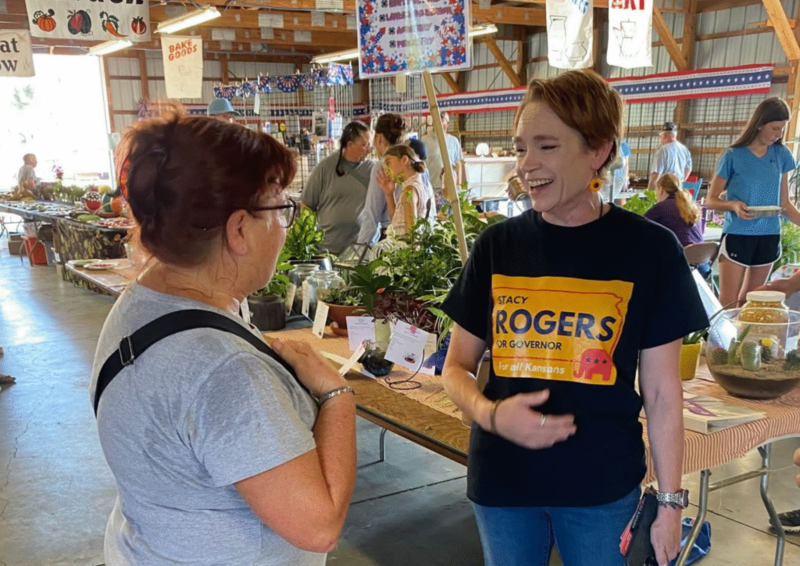
Stacy Rogers, a Wichita business owner and candidate for the Republican Party's nomination for governor, is competing in a seven-candidate primary Tuesday. Kansas voters also are responsible for selecting the Democratic Party's nominee for governor from among three options. In 2026, it's an open seat due to Democratic Gov. Laura Kelly being term limited. (Submitted)
TOPEKA — Stacy Rogers was the first to officially file as a candidate in the 2026 campaign for Kansas governor.
In a dark-horse bid for the Republican nomination launched in February 2025, Rogers defined herself as a Wichita business owner frustrated by politicians who depended on lobbying and campaign cash to bulldoze aside the interests of many Kansans. Rogers set herself apart from more prominent candidates by refusing to pay the $10,000 fee to participate in debates sanctioned by the Kansas Republican Party.
Rogers focused on a grassroots campaign drawing energy from retirees, farmers, teachers, business owners, veterans and others eager to share what they wanted of government.
“Their stories are different, but their hope is the same,” Rogers said. “They want a government that listens. They want leaders who keep their word. They want opportunities for their children and grandchildren. This campaign has never been about one person. It’s about all of us working together to restore confidence that our state government can once again serve the people.”
Rogers is among seven Republican gubernatorial candidates appearing on Tuesday’s ballot.
The list also includes Kansas Senate President Ty Masterson of Andover, former Johnson County Commissioner Charlotte O’Hara of Olathe, self-described underdog Nick Reinecker of Inman, Overland Park businessman Philip Sarnecki, Secretary of State Scott Schwab of Overland Park and Kansas Insurance Commissioner Vicki Schmidt of Topeka.
Schmidt, who completed two terms as insurance commissioner after serving in the Kansas Senate, said it was important voters understood they held outsized influence in primary elections because turnout was smaller than in general elections.
“I listened to a lot of Kansans this year,” she said. “The mom rationing a prescription because the grocery bill went up again. The town watching to see if its hospital makes it another year. That’s who I’m doing this for.”
Perception of the GOP contest has been shaped by President Donald Trump’s endorsement of Masterson, who has served in the Legislature for 20 years. Trump’s decision led to the surprising termination of former Gov. Jeff Colyer’s campaign.
As the primary wound to a close, the clashes between Masterson and Sarnecki intensified.
“Even President Trump gets bad advice sometimes,” Sarnecki said in an ad. “So, he has endorsed one of the career politicians who has driven Kansas into a ditch. It happens.”
In the Kansas Democratic Party primary, voters taking part in the gubernatorial election have the option of Overland Park Mayor Curt Skoog, state Sen. Cindy Holscher of Overland Park and state Sen. Ethan Corson of Fairway.
Democratic Gov. Laura Kelly endorsed Corson early in the race. The final chapters of this primary delved into questions about candidate electability and the governor’s role in tipping the scale against Holscher and Skoog.
While Holscher and Corson initiated their candidacies in 2025, Skoog waited until June to jump in. Skoog justified the delayed entry to a determination that Holscher’s political views would limit her appeal in November and that Corson struggled to gain traction in the primary.
Holscher offered herself as an anti-establishment candidate dedicated to funding K-12 public education, protecting communities from the data center craze, legalizing cannabis and restraining use of tax breaks to drive economic growth.
“I’m not attached to the establishment. I’m attached to working people,” Holscher said. “I’ll take on anyone, regardless of party, who stands in the way of lower costs, better schools and a government that works for everyday people. I won’t be bought by billionaires, bullied by special interests and insiders, or pressured by the political establishment.”
Corson, an attorney who worked at the U.S. Department of Commerce before entering the state Senate, said he was the only Democrat with a strategy for responsibly lowering property taxes. He would authorize a $250 vehicle registration tax credit for every vehicle registered in the state.
“We would freeze property taxes on even more of our fixed-income seekers,” Corson said. “We would bring back in the one-third of Kansans who rent into our property tax relief program.”
He promised to veto “pork” projects thrown into the state budget by the Legislature and reject bills designed to undermine abortion rights affirmed in a statewide vote in 2022.
Kansas voters have a tradition of cycling between Republican and Democratic governors. Kelly, the two-term Democrat, followed Colyer, who finished the unexpired second term of GOP Gov. Sam Brownback. Brownback won the governorship after departure of Democratic Gov. Mark Parkinson, who completed the last year of Democratic Gov. Kathleen Sebelius’ second term.
In 2022, Kelly dominated a two-candidate primary with 93% of the vote. She went up against then-Attorney General Derek Schmidt, who won the GOP nomination with 80% of the party’s vote. In the general election, Kelly won a second term by outrunning Schmidt by a margin of 49.5% to 47.3%.
Kelly prevailed in 2018 by winning a five-candidate primary in which she scored 51.4% of the vote. Her top competition came from former Wichita Mayor Carl Brewer with 20.1% and Josh Svaty at 17.4%. Then-Secretary of State Kris Kobach won the GOP primary against Colyer by 343 votes out of more than 250,000 cast. In the general election, Kelly secured 48% of the vote to Kobach’s 42.9%.
Topeka, KS