Ohio cities brace for possible uptick of ICE activity after protected status ends for Haitians
Jul 31, 2026 | 4:00 am ET

Description
Signs of support for Haitians in Springfield after temporary protected status for Haitians ended on July 27. (Photo by Megan Henry, Ohio Capital Journal).
Ohio cities with big Haitian populations are preparing for a possible uptick of United States Immigration and Customs Enforcement after temporary protected status for Haitians ended this week.
Carl Ruby, pastor of Springfield’s Central Christian Church, said he recently heard of a new tactic ICE is using in Springfield.
“I received a call from a leader in our community who said that what’s happening is Haitians in Springfield are getting letters asking them to report to Homeland Security and ICE down in Cincinnati,” he said.
“They’re asked to report in, and what I was told is that once they get there, they are asked to wear an ankle bracelet and report back in a month.”
The U.S. Supreme Court ruled last month that President Donald Trump can end legal status for Haitians who’ve fled the violence in their home country.
About 330,000 Haitians are living in the United States with Temporary Protected Status (TPS), a program that allows people from specific countries in conflict or facing natural disasters the chance to live and work in the United States for a set period of time.
About 30,000 Haitians with temporary status live in central Ohio and 15,000 Haitians live in Springfield, with a mixture of temporary protected status, citizenship, and other legal status.
“The federal officials are now telling us that they do not have any plans,” Ohio Gov. Mike DeWine, who was born in Springfield, told reporters on Wednesday.
“They’ve received no instructions to have any kind of raids in Springfield. Now that can change, but they did tell us they’ve heard nothing.”
Mike and his wife Fran DeWine help support the Becky DeWine School in Haiti, named after their late daughter, but the school had to close due to gang activity in 2024.
“It’s a mistake to say that (Haitians) can no longer stay in this country,” DeWine said.
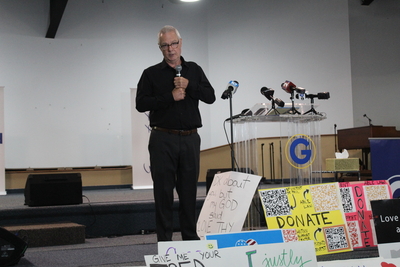
“I think that the people who have come here to work, the Haitians who came to Springfield, were filling jobs that had not been filled before. They are part of the resurgence of Springfield.”
Springfield Mayor Rob Rue said he has not received information from ICE about enforcement operations.
“I hope Congress will seize this opportunity to modernize our immigration system in a way that upholds the rule of law, strengthens our economy and reflects the values that have long made the United States strong,” he said in a statement.
Maqueli Eldredge, a paralegal at Legal Immigration Services in Dublin, anticipates an uptick of ICE activity as a result of TPS ending.
ICE detained more than 280 people in Columbus in December during Operation Buckeye.
“I’m afraid it might turn into that, but I hope not,” Eldredge said.
“We might see some large numbers, but it wouldn’t be as public as it was in December.”
She said ICE has changed their tactics from detaining people in public spaces like courthouses and in the streets to instead knocking on people’s doors and detaining people where they live.
Columbus Mayor Andrew Ginther called forcing Haitians back to Haiti “irresponsible and inhumane.”
“Our immigrant and refugee neighbors make positive contributions to our community through their unique perspectives, workplace contributions and participation in our economy,” he said in a statement.
“We cannot prevent federal operations from happening in our city, and federal officers do not communicate their plans with us.”
Ruby is asking ICE not to come to Springfield.
“We will encourage people to protest peacefully,” he said. “There are many who are willing to place themselves between ICE and people who are targets for detainment and deportation.”
Haitians were initially granted temporary protected status after Haiti’s earthquake in 2010 killed 222,570 people. The Biden administration extended Temporary Protected Status to Haitians in 2021 after the assassination of Haiti President Jovenel Moïse.
The U.S. Department of State currently has a Level 4 “Do Not Travel” advisory for Haiti “due to the risk of crime, kidnapping, terrorism, unrest, and limited health care,” according to the state department. A top security official and chief of staff to the nation’s defense minister was kidnapped last month.
“I’ve talked to families who are so afraid of going back to Haiti,” Ruby said.
“Rape is endemic in Haiti right now, and if all of the Haitians who are in Springfield who have been on TPS were sent back to Haiti, some of the teenage girls who have sat in our city schools next to our own children are probably going to be subject to that.”

Springfield experienced a shrinking population for decades as manufacturing jobs disappeared, but Haitian immigrants have grown Clark County’s workforce by more than 10,000 workers.
The Clark County city became a flashpoint in the 2024 Election when Trump and JD Vance spread racist lies about Haitian immigrants there.
Rev. Michelle Boomgaard of Christ Episcopal Church talked about the growth Springfield had because of the Haitians.
“We are seeing buildings long shuttered now open,” she said. “We are seeing new vibrancy in our communities.”
Deporting Haitians in Springfield would eliminate roughly $300 million in annual spending from Clark County, with an estimated economic loss projected to exceed $400 million.
Haitians also contribute millions of dollars in Columbus, said Yola Lamarre, an advocate with the Haitian Community Network.
“We’re going to see that impact because of this job loss,” she said. “We’re going to see the shortages in the healthcare industry and other industries that Haitians mostly populate.”
Haitians in Ohio lost their work permits when TPS expired on Monday.
More than 1,000 children born in Springfield with American citizenship have Haitian parents.
“I think that many of them are planning on taking their children with them, even if (the children) are U.S. citizens and have the protection,” Ruby said.
Haitian parents are now faced with the choice of leaving their children or taking them back to Haiti “where they could be kidnapped, raped, or murdered,” Ruby said.
“Imagine the dilemma that that is for mom and dad who love their kids, and that’s the situation that we have created for Haitian families right now, and it’s completely unnecessary.”
The Ohio Department of Children and Youth gave a grant to the Nehemiah Foundation and the Department of Jobs and Family Services to create a respite care network, said Tim Voltz of Champion City Church in Springfield.
“There would be temporary places for those children to go, so they wouldn’t end up in a facility or detained somewhere,” he said.
At least 18 families are part of the network, which can host children for up to 14 days at a time, Voltz said.
“It is not a permanent solution,” he said.
“It is only meant to provide a place for them while the state and the parents themselves and everyone tries to figure out how to reunite the parents of their children, or place them with kin. … The goal was to keep children from being shipped all over the state to foster care placements.”
The emotional burden is overwhelming for Haitian families, said Jimmy Pierre of Gospel Grace Baptist Church in Springfield.
“Parents worry about what the future holds,” he said.
“Some are having difficulty sleeping because they fear separation from their spouses or children. Many are dealing with anxiety, depression, and emotional exhaustion as they try to care for their families while living with uncertainty.”
Haitians can apply for asylum, but the Trump administration put an indefinite freeze on processing all asylum applications at the end of 2025.
About 4% of asylum cases are being approved, Ruby said.
“Applying for asylum isn’t really a realistic option,” he said.
At the federal level, the U.S. House voted in April to extend TPS for Haitians through 2029. The bill is now in the U.S. Senate, but the White House said President Donald Trump would veto the bill.
U.S. Senators introduced an identical bill last month.
“It’s time to put our ideology aside and focus on saving the lives of families,” Ruby said.
Follow Ohio Capital Journal Reporter Megan Henry on X or on Bluesky.

Columbus, OH