Arkansas private schools charge more than what vouchers cover
Nearly 57,000 students applied for Arkansas’ universal school voucher program, where any student in the state is eligible and can use that state funding towards private school.
However, there’s a gap between how much students are receiving and what private schools are charging. A study by the National Center for Research on Education Access and Choice showed private school tuition increased in states with universal voucher programs.
A report from the Arkansas Advocate found that the state followed that trend, where the average private school tuition among applicants is about $2,600 more than state funding. Some critics are concerned this could leave children behind in a state with one of the nation’s highest poverty rates, while the vouchers pull funds away from public schools.


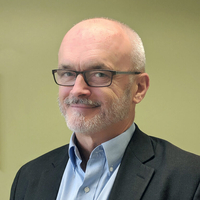
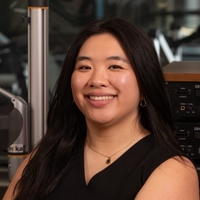
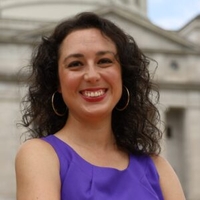
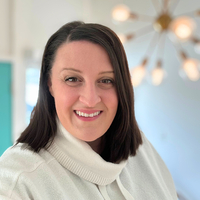
In Episode 39, you’ll hear from Arkansas Advocate Deputy Editor Antoinette Grajeda about how she combed through the data to break down the private school tuition costs.
You’ll also get a weekly news wrap-up from Evening Wrap newsletter writer, Danielle Gaines, with the latest on a pro-data center group behind a multi-state ad campaign, Diné community leaders protesting a Trump proposal to remove a mining ban and why a tattoo parlor is suing South Carolina.
Episode produced and edited by Mallory Cheng. Music for Stories From The States composed by David Singer.
Got questions? An episode idea? Email us at [email protected].
Subscribe to Stories From The States on Apple Podcasts, Spotify and Youtube.
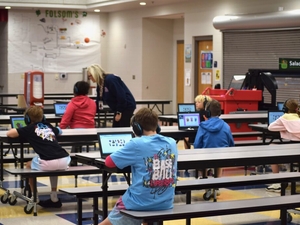
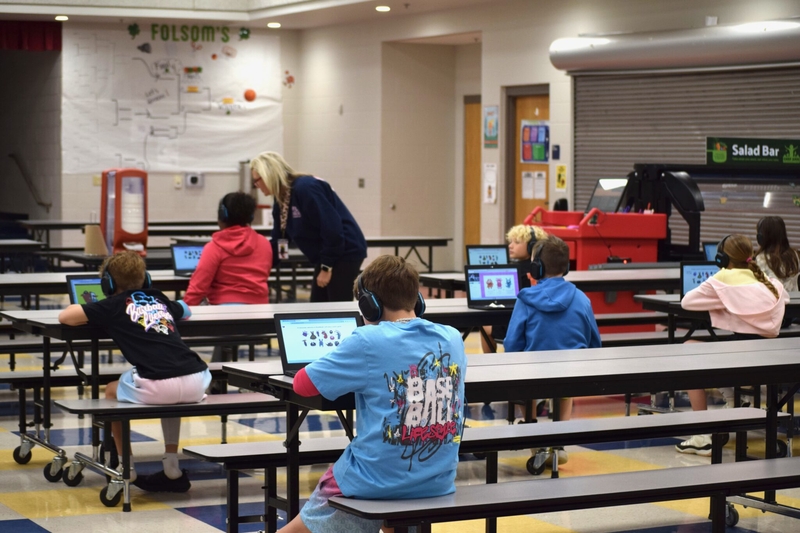
Photo: Students study on laptops inside an elementary school in Farmington, Arkansas on March 19, 2026. (Photo by Antoinette Grajeda/Arkansas Advocate)
Stories From The States is a production of States Newsroom, the nation’s largest state-focused nonprofit news organization, with reporting from every capital. At this pivotal moment in American democracy, our veteran journalists from all 50 states are reporting the consequences of government decision making. By zooming in on one story each week, Stories From The States contextualizes and gives a human voice to what is happening now.
Transcript was created using an automated software.
Chris Fitzsimon
This is Stories From The States. I'm Chris Fitzsimon. Here at States Newsroom, we know there's a lot going on around the country in every state capital. Thank you for being here. First, we're going to jump in with the news of the week from around the country. We'll look into a pro data center group behind ad campaigns in seven sta...
Transcript was created using an automated software.
Chris Fitzsimon
This is Stories From The States. I'm Chris Fitzsimon. Here at States Newsroom, we know there's a lot going on around the country in every state capital. Thank you for being here. First, we're going to jump in with the news of the week from around the country. We'll look into a pro data center group behind ad campaigns in seven states. We'll also talk about a group of Dené allotment shareholders and community leaders fighting against the Trump administration in New Mexico. They're trying to stop a mining ban from being lifted, and over in South Carolina, you can't get a tattoo if you're near a church. That's right, near a church. But a tattoo parlor is suing the state to try to change that. Then later in the show, we'll go to Arkansas, where a report from the Arkansas Advocate shows the majority of private schools there are charging more than what school vouchers can cover.
April Hough
I know that my school isn't looking to take money away from the public schools. We're just looking to serve families who the public school doesn't work for.
Chris Fitzsimon
We'll chat with Arkansas Advocate Deputy Editor Antoinette Grajeda about what she found, but first let's check on the news with our States Newsroom newsletter author Danielle Gaines, who writes the Evening Wrap. Hello, Danielle. It's been another interesting week.
Danielle Gaines
It sure has. How are you?
Chris Fitzsimon
I am okay. So I thought we were done with fires, the Canadian fires, and now there are fires in the United States that are causing problems.
Danielle Gaines
Yeah, we have some pretty big fires burning in the West, notably a 300,000 plus acre fire on the border of Oregon and Idaho that has prompted a state of emergency in Idaho. There are all sorts of air quality warnings urging people to be safe and and to really not be outside, especially near the fire, but also stretching all across the country at this point.
Chris Fitzsimon
And then the other little thing that's happening before we get into sort of the big themes of the week is everywhere I turn, there are people talking about the presidential election. I haven't voted in the midterms yet, so my head is spinning.
Danielle Gaines
Happy 2028. Yeah. So the Democratic National Committee, their Rules and Bylaws Committee, put forward a proposed calendar for the 2028 presidential primary. They want to put South Carolina first again. There was a big discussion about South Carolina or Nevada or New Hampshire, they stuck with South Carolina and chose another five states to go early in the election cycle.
Chris Fitzsimon
And New Mexico might this year have be in play or at least be high on the calendar.
Danielle Gaines
Yeah, New Mexico is in the mix. New Hampshire still ends up being in that kind of early run with Michigan, Nevada, and Virginia, and South Carolina went out in the committee discussions because they were talking about wanting to seize on voter momentum there following this decision to by the U.S. Supreme Court to gut the Voting Rights Act and the gerrymandering and kind of a real desire on the part of voters there to act, so but it's not final. They will vote later in August.
Chris Fitzsimon
They'll just keep talking about 2028 until it actually gets here. So..
Danielle Gaines
Yeah, exactly.
Chris Fitzsimon
All right, let's talk about the big themes of the week. I feel like almost every week there's something about data centers happening all over the country. I'm always amazed that when I see maps of data centers that are built or data centers are being constructed, it's amazing how many there are. But this week, one of the stories was, despite all the community groups opposing them, there's a there's a group fighting for them.
Danielle Gaines
Yeah. So I see so many headlines about data centers come across, and then the Oregon Capital Chronicle email came through, and it just had really provocative subject lines, so it said "data center astroturfing", and so I had to know more. So astroturfing, of course, is like an attempt by industry to make their messages look like a grassroots movement. And what our reporter found was that there are these ads being run in at least six states, and they are all near carbon copies of each other. They feature B roll of like a family cooking and a nurse and a business owner. They're all over the airwaves. They're all over the internet, and they all attempt to counter common critiques of data centers about their water use, energy, job creation, etc. And we found the names of the groups behind them. They are, if you want me to list them, they are kind of easy to remember. It's Oregon Connects, Indiana Connects, Connected Ohio, North Carolina Connects, Pennsylvania Connects, Texas Connects, and Virginia Connects.
Chris Fitzsimon
A lot of connecting.
Danielle Gaines
A lot of connecting happening. Yeah.
Chris Fitzsimon
A nd it also comes on the heels of, I guess, President Trump and some Republican governors trying to reassure people that they'll figure out a way not to let their energy bills increase. I think I may have told this before. I heard a national pundit the other day saying this could be the sleeper issue of the election on the state level because so many people are concerned about it.
Danielle Gaines
Yeah, so. There was this this movement for governors and utilities and other folks to take a pledge that consumers won't pay for the cost of data centers in the states where these are running. You know, it's notable that they're coming after a growing number of local governments and state lawmakers and others have expressed a desire for moratoriums or other laws that would slow data center growth.
Chris Fitzsimon
So far, I think New York, right, is the only state that has a statewide moratorium. But it feels like that word is also in a lot of the stories that people are considering.
Danielle Gaines
Yeah, it's definitely growing, and there was there was a near moratorium in in Maine this year as well, but that got vetoed.
Chris Fitzsimon
Well, another theme, not so much data centers, but still has to do in the environmental world. A lot of talk about mining, public lands, sort of what's happening in that area.
Danielle Gaines
Yeah, we've had some really great visual stories and graphics lately, and there was this like eye popper of a graphic out of New Mexico, and it was about the rapid rise of mining claims in the state. So, over the last four years, companies have staked 12,000 mining claims in New Mexico. Now, between 1912, when New Mexico became a state, and 2000, there were 4200 mining claims. So we are three times the number in the entire 20th century. So far this year, we have half the year left. There are 3450 claims staked. So this is a real boon on efforts to assert rights to extract resources from the land.
Chris Fitzsimon
Yeah, it's really interesting. And then the Trump administration obviously is trying to remove mining bans, is trying to open public lands. It feels like it is part of a theme.
Danielle Gaines
Yeah. So so the claims are explored. So claims are exploratory in nature, and you still have to get permits and stuff before you do drilling. But obviously, the Trump administration has said that they want to speed up all of that permitting process, and so companies are really seizing the moment and staking claims, and it's not just this is for underground minerals like uranium, copper, gold. But there was a protest in D.C. by a delegation of Dene leaders about oil and gas proposals around Chaco Canyon, which is a national park, it includes sacred and sacred indigenous lands. There were protests over that in New Mexico as well.
Chris Fitzsimon
And I believe the president said this week that if there are windmills, that's how you know there's a it's a failing nation. So I guess that sort of signals how what he thinks about renewable energy.
Danielle Gaines
Yeah, on the in the Chaco Canyon area, you know the Biden administration had put this like 10 mile buffer zone around the national park to stop oil and gas extraction, and the Trump administration wants to review that. They put that review out with like an extraordinarily short comment period. It was only two weeks, and that ended yesterday, and that was part of the complaint that you heard.
Chris Fitzsimon
I'm sure that this energy policy and data centers will be big issues in the election. So let's talk about some political news, some bizarre stories. I think Nebraska is one of the stranger ones.
Danielle Gaines
Yeah. Well, let me bring you all the way back to 2026, where you know we currently are.
Chris Fitzsimon
Please.
Danielle Gaines
And I had so many stories this week, labyrinthine stories about planted and sham candidates. So, you know, in Nebraska, the entire campaign season has been marked by allegations of planted candidates in the U.S. Senate race. So, most recently, the runner-up Democratic candidate has sued to force the Democratic Party to put a candidate, a party not candidate, on the November ballot. That is because the Democrat who won the primary dropped out in favor of the nonpartisan candidate Dan Osborne.
Chris Fitzsimon
Right. Who ran last time.
Danielle Gaines
Who ran last time and put up a good fight, and the Democratic Party is fighting against putting this person on the ballot as their nominee because they call him a DINO. They point to his prior support for President Donald Trump, an appearance at a training session for conservative candidates, and they call the lawsuit disingenuous. The Democratic candidate was also accused of being a plant in the primary season as well. By the way.
Chris Fitzsimon
It's so it's so confusing for of people who who don't live and breathe politics. Their their heads must be spinning in Nebraska.
Danielle Gaines
Yeah, and it's really interesting because the the party actually went so far as to say that they'll fight this all the way up to the U.S. Supreme Court if they need to. The idea that they have to be forced to replace the candidate with somebody who they call a DINO.
Chris Fitzsimon
And what about some other political news?
Danielle Gaines
Yeah. So, well, in Arizona, we had some great reporting about a quote-unquote sham Green Party candidates. They are running for governor and Secretary of State, and they have many many ties, which our reporters uncovered to the state's Republican campaign machine. They are getting public financing, which they have funneled to a brand new company based out of Nevada, which was originally incorporated with Republican operatives, and of course, in a state like Arizona, where you have so much going on, but a Democratic governor at the moment, it's viewed that the green any Green Party candidate could siphon votes away from her in her reelection bid.
Chris Fitzsimon
It's a little old news now, but the Alaska had a candidate with the same name, right.
Danielle Gaines
Alaska had the candidate with the same name. Maine had the late replacement of Graham Plantner on their ballot. It's really quite the season.
Chris Fitzsimon
Yeah, it's so confusing that it makes me want to know what one last thing is. I need something refreshing.
Danielle Gaines
Well, we'll start with a question. What year do you think tattoos became legal in South Carolina?
Chris Fitzsimon
Oh my gosh, 1960?
Danielle Gaines
2004! And in case you didn't know, they're still highly regulated. So our outlet there, South Carolina Daily Gazette, had this great story. It was about a New York-based tattoo company that wanted to host like a pop-up for tattoos, and these are these like new kind of fine line, very dainty tattoos. You can get them in a couple of minutes, and they wanted to host something in like a boutique hotel, and found out that you cannot in Charleston have a tattoo parlor within 1000 feet. 1000 feet. This is a big buffer zone. If you don't know really how far 1000 feet is...
Chris Fitzsimon
That's a long way.
Danielle Gaines
Yeah, from any church, school, playground, and it basically means that there are no tattoo parlors in downtown Charleston, and that he couldn't have this pop up event. So he has pursued a lawsuit to change the state law, saying it's a violation of you know free speech, and he was joined in the lawsuit by a couple because they say they wanted the right to tattoo their heads and necks. So a popular tattoo is to get a little dainty one behind your ear, and that is also illegal in South Carolina. So we will see how this plays out. There have been bills for years in South Carolina to kind of loosen up these very strict laws, but they always fail to go anywhere.
Chris Fitzsimon
That is so bizarre. Well, I can't wait to see now what next week brings. Danielle, it's always good to talk to you. Thank you very much.
Danielle Gaines
Thank you.
Chris Fitzsimon
To stay up to date on the latest news, you can subscribe to Evening Wrap, written every weekday by Danielle at newsfromthestates.com/subscribe. Over the last few years, some states have implemented universal school voucher programs to allow any student to use public money for private school tuition. A study by the National Center for Research on Education Access and Choice showed private school tuition increased in states with universal voucher programs. One of those states is Arkansas, where there's a big financial gap between private school tuition rates and what students are receiving from the state. The Arkansas Advocate's Antoinette Grajeda analyzed hundreds of school voucher applications from both students and the schools to put together all of this data. We'll hear from Antoinette in a moment.
Moses Esheit
At a time when so many communities are losing their local news outlets, States Newsroom is filling a gap. We are now the nation's largest state-focused nonprofit news organization, with reporters based in every state capital and Washington D.C. But we can't do it without your support. Your contributions allow us to produce award-winning journalism and deliver it to you for free, no pop-ups, no paywalls. This is a crucial time to support local journalism, and every bit helps. To give, go to statesnewsroom.com/donate.
Chris Fitzsimon
Antoinette Grajeda is the deputy editor of the Arkansas Advocate. Hi, Antoinette.
Antoinette Grajeda
Thanks for having me.
Chris Fitzsimon
Well, first, let's talk about what's going on with vouchers. For folks who aren't familiar with the Arkansas program, can you give us sort of an overview, like how many students are there? How does the program work?
Antoinette Grajeda
Sure. So the program was introduced in the 2023-2024 school year. It was phased in over three years with increasing eligibility. Last year was the first year it was open to everyone, and so that'll what is what will be happening next year as well. When I spoke to the Department of Education in June, at that point they had had around 57,000 applicants for next year. They're still going through and approving, you know, all of those and see who is eligible, not eligible. And I will say with the caveat that not everybody who even is approved uses it. Historically, they'll have more people that apply are accepted, and then you know they'll end up moving or going somewhere else doing something else, but. If say 57,000 folks are all approved and use that in fall, then that's going to be about 12,000 more than last year. So it's continuing to grow.
Chris Fitzsimon
Wow! And what's what is eligibility like? I mean, what what makes a student eligible?
Antoinette Grajeda
Living in Arkansas. That that is now the eligibility is if you're a K K through 12 student going to a private school, if you you can use it for being a homeschool student as well, and the eligibility is just being an Ark... living at Arkansas.
Chris Fitzsimon
That's different. A lot of states, although some are moving this direction, a lot of states seem to have income eligibility or some other eligibility in Arkansas. I guess that's why it's thought of as a universal voucher.
Antoinette Grajeda
Correct. So when it first started, you know, as I mentioned, there was increasing eligibility. So in some of the early years, it was like students with disabilities, first-time kindergartners. It expanded to things like children of first responders and things like that. So those were the limits in the first two years, but now there isn't. Those limits don't exist.
Chris Fitzsimon
And how much do most students get? How much are they eligible to receive?
Antoinette Grajeda
So according to the law, they'll get 90% of what is allowed for public school students. So we have per student funding, and so for next year, it's going to be around $7,200 per student, and they don't have to use all of that. It's just that's the max.
Chris Fitzsimon
So that means every time per student expenditure goes up for public school students, the voucher amount is also increased.
Antoinette Grajeda
Correct.
Chris Fitzsimon
How much is private school tuition? I guess it ranges wildly.
Antoinette Grajeda
It does range wildly. That was kind of what we were looking at with this particular story. So every summer we've been, you know, doing a public records request to get these applications from the schools, and then kind of combing through and seeing what tuition looks like. And so we got about 170 applications this year. More have applied since we did our analysis in June, but at that point, the average tuition was around $9800. So it's there's about a $2,600 gap between that max and then what the average tuition is, right? So in some places, you know, the the $7200 will cover everything, and others you still have a gap.
Chris Fitzsimon
Right. So it's not like every student receiving a voucher could go to the most expensive school in their community, unless they could come up with a lot of money on their own.
Antoinette Grajeda
Correct. So the most expensive school is upwards of $30,000. I I will also say, with the caveat of that school, they have indexed tuition, which means that students pay based on their income. So they kind of scale it down to like if you can afford the 30,000, you know, you're going to pay all of that, but if you can't, we'll adjust for you.
Chris Fitzsimon
How was it getting those records?
Antoinette Grajeda
It's always a little bit challenging. The Department of Education knows me at this point; they know I'm going to ask for this, and so they're very good about giving me the information. What was a little challenging this year is typically in the past when I've gotten the applications, they've been sorted by the schools this year. I got one file with hundreds, maybe 1000s of papers that were just not necessarily labeled. So there was a little bit of sorting that had to happen over a couple of weeks before I could finally figure out what I was looking for. And there was some back and forth between us and them trying to figure out what went where?
Chris Fitzsimon
Oh wow! Tell me how you started reporting on all this. It's such a great service and an interesting story. But what made you start doing this?
Antoinette Grajeda
I think my editor maybe recommended it the first year, and like rightfully so. I think it is a bit of a public service, even if it is a bit of a lift, because historically, private school tuition. A lot of these schools don't put the tuition on their website. You can go and look, and you can find all the great things about their schools and what they offer, the grades, and all that good stuff. But typically, when you get the to the tuition part, you click on it, and it's like, oh, give us a call or send us an email, apply, whatever, whatever. But with the voucher program, you're now using state money, public money, so it's now public information. But the Department of Education doesn't publish this information, right? And so we're able to kind of go through and sort it out in a nice little spreadsheet and share it with the public, so they can kind of comb through and see, like, oh wow, you know, like this school up here is $30,000, but over here, here's this little church, and it's $2,000. You know, like you can see the wide range that way. So it was definitely my editor's idea at the time, but I'm glad we've continued to do it because I think people have found it useful.
Chris Fitzsimon
Right. What was the most surprising, or was there something surprising? Has there been something surprising in this reporting?
Antoinette Grajeda
The most surprising thing for me this year was this smaller school that I talked to in the northeastern part of the state. They started actually before the voucher program a few years before them. They grew out of a a therapy business. They were helping students with disabilities, and they had parents that were coming to them saying, you know, my public school just can't really give my kid what they need. Can you start a school? You know, we come here for therapy, but can you start a school? And so it was this tiny school, and they have like 30 students max at this point, and so that's what they did. And so when the voucher program came around, they're like, okay, this will help us kind of cover our costs. But in talking to one of the administrators there this year, what I had noticed from looking at their application this year and their application last year is that they had lowered their tuition rates. And I asked them about that. I was like, "Hey, when you guys applied last year, it was like way more than what you guys said for this year. And they said, "You know, what happened was we were really realizing that one in five people are in poverty in this particular county, and so they're like we have to meet people where they are because we're genuinely trying to serve these students, and so we lower the tuition. And she's like, you know, the voucher still doesn't cover everything, but it's close, and even like the couple 100 bucks that are left over, our people can't really cover that.
April Hough
We really do have a niche clientele, and some are just they just don't have the funds, and we know that we know it going into it. And for us, for and I say us, I say for me and for the owners, it's never been about the money; it's been about the kids.
Antoinette Grajeda
I had reached out to them because in their application, I had seen that they were looking to start a scholarship, and I thought that was interesting because, like historically, a lot of the schools will offer you know discounts for multiple kids, or if it's tied to a church, you get discounts for being a church member, but I haven't seen people say, "Oh, we're trying to start, you know, a scholarship. So I thought that was that was really interesting to me. Is you know they're really going at it from like we're trying to do what we can. We're trying to bare minimum because I think the narrative that people are expecting, and I suspect it is happening in some places, is that people are gonna maybe charge more than they would have before because they have guaran, you know, guaranteed money coming in from the state.
Chris Fitzsimon
What about the the debate about this in Arkansas, in most states, and I wondered if it's the same there that the longtime supporters of traditional public schools believe this money is taken away from public schools, and that that these a lot of these voucher schools might be unaccountable. They're in a church basement. There's been stories off and on. ProPublica just did a big story about a school where there were a lot of problems because there's no oversight.
Antoinette Grajeda
There's been a lot of pushback from when the legislation was introduced. Folks have argued that they're concerned about it taking money away from the public schools, technically the money comes from different pot. There's different pots of money, right? So because of Arkansas was involved in many many years of litigation over school funding, and so because of that, we now have this whole thing called an adequacy process, where they determine that per student funding for public school students, and that's in a different pot of money, right? And so this money for the vouchers comes from a different place, but the program is increasing every year with participation and with money, and so that's a concern because opponents of the program had said, you know, we could be using that money to invest into the public schools and make them better and address some of the issues that we have said that we've had here, right? So that's been something for sure that people have been concerned about.
Chris Fitzsimon
Yeah, and what about the the schools themselves, the accountability and the regulation? How are they overseen? It is obviously a lot of money from taxpayers of Arkansas.
Antoinette Grajeda
Sure. So the there are ways for them to look at fraud, or if people are applying for things that they shouldn't be. And students that participate in the program are required to take a standardized test. It's not necessarily the same test as what public schools take. They get to choose basically what test they want to give them. We have an exam a few years ago. The ACT Aspire that we were using sunset, so the Department of Education to decided to create its own test, basically using I think it was Cambium was the name of the program, the company that they pulled some questions from to kind of align it more with the standards in Arkansas, and so that's some of the oversight. There was some pushback a few years ago with how the money was being spent. Something that got a lot of attention was, you know, the money could be used for, say, extracurriculars and things like that. And people got very heated about this one place that was advertising horseback riding lessons. They're like, oh, use your money here. You can come get lessons at our at our stable, and so there was a lot of people getting angry about that. So when legislators came back into session last year, because we do every other for legislative sessions in Arkansas, lawmakers to their credit did put some limits in place, right? That they're like, okay, you know, only a quarter of the funding can be used for extracurriculars because the purpose of this is for education. So those were some guardrails. This summer they approved a couple more new rules related to like team sports, and that was pretty controversial for a lot of folks. But essentially, if you have to try out for a team or traveling team, things like that, the money can't be used for that. But if there's a class or something that everybody can apply to, then like that's fair game. So they've tried to put some stuff in place to put those guardrails in on how the money's being used.
Chris Fitzsimon
Yeah and then actually the way the school operates, I guess, is like any other private entity that gets state funding. The oversight varies. I know the ProPublica had a story they mentioned in Arkansas school recently where there were some allegations of abuse.
Antoinette Grajeda
Yes, yes, the state is generally pretty hands off in terms of these private schools because it's still a private school. In the ProPublica reporting, they said you know the money to this particular school you know had been stopped for a time, and the person that was in charge wasn't there anymore. I know that that school has applied for the fall. In the last time I checked, with the Department of Education, they had been approved. So there has been some pushback since that that story came out. I'm not sure where that'll end up. There is a education committee meeting coming up in August. That I suspect that will be asked about by some lawmakers.
Chris Fitzsimon
Yeah, well, maybe we'll have you back to talk about that. Well, Antoinette, thank you so much. Thanks for this reporting, and thanks for being with us.
Antoinette Grajeda
Absolutely, thank you.
Chris Fitzsimon
Thanks for listening to Stories from the States. I'm Chris Fitzsimon. Mallory Cheng produced and edited the podcast. David Singer produced our theme music. If you liked what you've heard, please share it with someone you think might enjoy it and leave a rating and review. It means a lot to us to know what you think about the podcast, and it helps other people find us. To stay up to date on all the latest episodes, subscribe now to Stories From The States, a podcast from States Newsroom, available wherever you listen to podcasts. We'll talk to you soon.