Fauci pleads the Fifth to COVID questions by US Sen. Rand Paul at intense hearing
Jul 29, 2026 | 11:54 am ET
Description
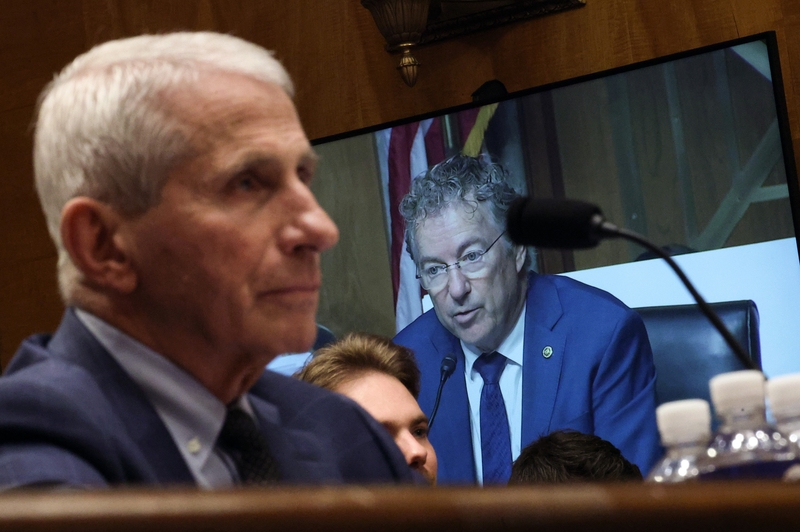
U.S. Sen. Rand Paul, R-Ky., is shown on a monitor as Dr. Anthony Fauci, left, testifies before the Senate Homeland Security and Governmental Affairs Committee on July 29, 2026 in Washington, D.C. (Photo by Kevin Dietsch/Getty Images)
WASHINGTON — Dr. Anthony Fauci, one of the nation’s most visible public health officials during the coronavirus pandemic, declined to answer questions from a U.S. Senate committee in a tense and confrontational hearing Wednesday, citing his Fifth Amendment rights.
Fauci said during a brief opening statement he believed Homeland Security and Governmental Affairs Committee Chairman Rand Paul, R-Ky., was trying to get him to make statements under oath that would lead to criminal charges.
“Given Senator Paul's obvious obsession with calling for my prosecution, his repeated slanderous comments about me, and recently his publicly releasing my unredacted personal diary aimed at embarrassing and intimidating me, the only conclusion I can reach is that the sole reason he is calling me before this committee is to get me to say something, anything that could vindicate his repeated public pledges that I end up, in his words, ‘behind bars,’” he said.
Fauci added that “any reasonable person who has followed his unhinged obsession with me would readily come to the same conclusion.”
“Therefore, although it pains me to do so, because of the respect I have for the legislative branch of government and my decades-long record of cooperating with Congress, under the advice of my attorneys, I will invoke my right under the Fifth Amendment of the Constitution, to refrain from answering your questions,” he said.
Fauci was a member of the coronavirus task force during President Donald Trump’s first administration and a chief medical adviser on COVID-19 during President Joe Biden’s term.
Repeated testimony
Fauci has testified publicly 13 times before Senate committees and 11 times before House committees since January 2020. This was the first time he declined to answer any questions from lawmakers.
Paul noted that former President Joe Biden pardoned Fauci for any actions he might have taken from Jan. 1, 2014 through Jan. 20, 2025. But he said that doesn’t cover any actions since then, including any statements to Congress that may not have been entirely accurate.
“A pardon may protect a person from criminal prosecution. It doesn't rewrite history,” Paul said. “It does not erase documents. It does not convert a misleading statement into a truthful one.”
Paul said the committee will hold a vote next week to hold Fauci in contempt for declining to answer questions under a subpoena.
“There will be repercussions to your refusal to testify today,” he said.
A member of Fauci’s legal team, seated beside him at the witness table, tried to speak several times but Paul refused to recognize him before having U.S. Capitol Police remove that lawyer from the room.
Paul then said for the record that Fauci would “still have the advice of the other half a dozen attorneys that he brought along today.”
Origins of COVID-19
Paul alleged during his opening statement that Fauci, who was the director of the National Institute of Allergy and Infectious Diseases when the pandemic began, didn’t give enough credit to theories the COVID-19 virus may have been created in a laboratory in China.
He asked Fauci a series of questions about the pandemic and the types of research the federal government funded leading up to the outbreak. Each time, Fauci responded, “On the advice of counsel, I respectfully decline to answer, based upon my rights under the Fifth Amendment of the Constitution.”
Homeland Security and Governmental Affairs Committee ranking member Gary Peters, D-Mich., sought to remind his Republican colleagues that when he ran the panel, there was a bipartisan effort to look into the origins of the pandemic.
“Rather than building on that work to strengthen our preparedness against future disasters, we are instead relitigating the past,” he said.
Peters raised concerns that the country would likely face another pandemic at some point and that lawmakers should focus their efforts on the future, making sure public health agencies have the staff and funding they need.
“COVID-19 exposed serious deficiencies in our nation's public health infrastructure. We know that. More than one million Americans lost their lives and this committee should absolutely continue to examine how we can better prepare our nation against future biological threats,” he said. “Those are the kinds of forward-looking, life-saving questions that will help our nation be better prepared to protect the health and the safety of Americans when the next emergency occurs.”
Peters then sharply criticized the Trump administration, saying officials' decisions on funding and staff have eroded the country’s safety net, including at the Centers for Disease Control and Prevention.
“The administration has hollowed out the public health workforce,” he said. “They have fired, pushed out and cut funding for public health personnel, shrinking the CDC workforce by a quarter.”
Fauci’s decision not to answer questions didn’t stop Republicans and Democrats on the committee from asking him questions and making lengthy statements throughout the three-hour hearing.
All States Newsroom content is free to republish. Read our republishing policy for more information.