Conservative public interest firm joins AI free speech election lawsuit
Jul 22, 2026 | 6:44 pm ET
Description
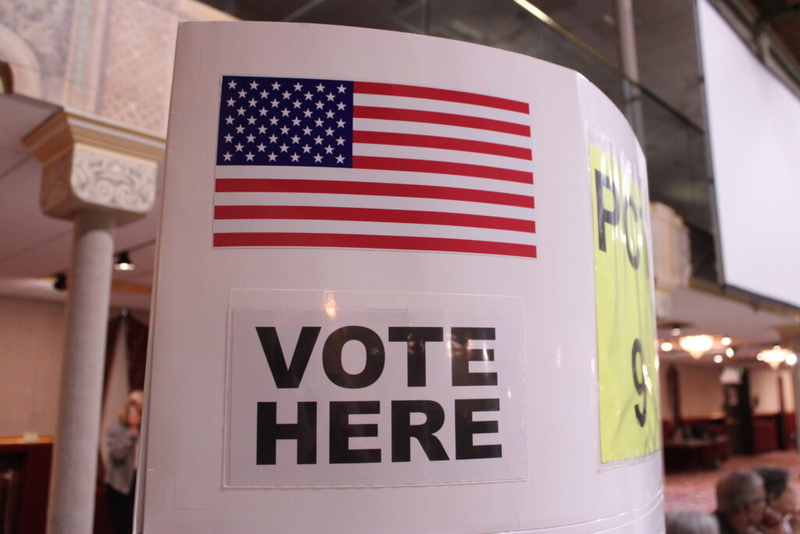
A sign noting where to vote by precinct is on display at the Helena Civic Center during a primary vote on Tuesday, June 2, 2026 in Helena, Montana. (Jordan Hansen / Daily Montanan)
A public interest law firm, the Hamilton Lincoln Law Institute, has joined a First Amendment lawsuit against a 2025 state law that limits artificial intelligence use in campaign materials.
Hamilton Lincoln Law said that it’s joining because of concerns about free speech restrictions.
The lawsuit is being brought by former Republican legislator Dan Bartel after Rep. Eric Albus, a Hi-Line Republican and former legislator Jennifer Carlson, running for a state House seat in the Bozeman area, filed a Commission of Political Practices complaint against an organization, Accountability in State Government, over mailers. Bartel is the treasurer of the political committee.
Albus and Carlson accused Bartel and Accountability in State Government of breaking a new state law that says generative AI content cannot be used with messages regarding political candidates or parties within 60 days of the start of voting in any given election.
The political committee ran mailers depicting each candidate with pride flags and buttons while accusing Albus and Carlson of using taxpayer money for a “woke agenda.”
The mailers used digitally altered photos of the candidates, adding the pride flags and buttons. Albus and Carlson said it violated a law that Democratic lawmakers had pushed for during the 2025 session.
That COPP complaint is pending while the law is challenged in Helena District federal court.
Hamilton Lincoln Law Institute, which describes itself as existing to “defend civil liberties” and “challenge government overreach,” filed a brief along with Bartel’s lawyer, Matthew Monforton, late last week. The firm is based in Washington, D.C.
The suit was initially filed on May 5. Both Monforton and Hamilton Lincoln attorney Adam Schulman said the law was a free speech issue.
“There is absolutely no reason why the government should be telling private citizens what they can and cannot say about their political opponents,” Monforton said Wednesday.
Schulman, whose organization has been involved in other generative AI lawsuits, said there’s angst around the technology, but that doesn’t mean it needs to be outright banned.
“When something’s unknown, you have to err on the side of speech until you can show that the market can’t respond to this by counter speech and other measures,” Schulman said in an interview, pointing to Elon Musk’s social media site as an example. “X is developing tools, community notes, and things like that. Things that are AI get flagged by private speakers rather than the government stepping in and prohibiting this.”
Meta — which owns both Facebook and Instagram — have also added labels to AI-generated content, but even so critics have still maligned parts of the company’s misinformation policy.
“Obviously AI is not very well understood, so there’s a lot of fear around the technology,” Schulman said. “Throughout history, that really hasn’t been different. The same thing was said about video games, comic books before that.”
Even so, there was legislative and national worry about the impacts of generated content that seems real — but isn’t — on voters ahead of the 2024 election cycle.
Those laws also came as discussion was swirling about digitally-altered videos and content used toward the end of the general election, as generative artificial intelligence tools took substantial leaps around that time in access, affordability, and realism.
The Cybersecurity and Infrastructure Security Agency, which is under the Department of Homeland Security, issued a report on AI in elections in January 2024 while President Joe Biden was still in office, ahead of the federal elections that year. CISA, created in 2018, is the nation’s main cybersecurity and cyberdefense agency.
“Malicious actors can use generative AI tools to reduce the costs and increase the scale of cyber incidents and foreign influence operations,” the 2024 CISA report says, going on to say generative AI can be used to create malware that evades cyber defenses.
It could also be used for “denial of service attacks,” which entails flooding websites with massive amounts of data, which overwhelm or stop them, which the report warns could include election sites. There’s also worries that the technology could be used to “deep fake” people, particularly their voices.
The CISA report added the techniques aren’t new, but they are now easier and cheaper to deploy.
“Malicious actors may also use generative AI to assist in deploying phishing and social engineering techniques, generating lifelike audio in any individual’s voice, creating highly realistic fake images, powering counterfeit social media profiles, and producing deepfakes to support influence operation narratives,” the report said.
Montana Democratic minority legislative leaders Rep. Katie Sullivan and Sen. Pat Flowers favored the new law because “we’ve opened the floodgates” as far as how generated artificial intelligence content is circulated. They said deepfake artificial intelligence use in elections should be outlawed.
But the law also has carveouts for media usage of broadcasting AI images for the purpose of “satire or parody,” which the briefs argue isn’t fair.
And it argues that even if there is misinformation, it’s still protected.
“False political speech is still protected speech,” the brief says, adding, “Elections have always been a noisy ruckus of misinformation. Because the Act regulates political speech for a reason other than avoiding corruption, it is unconstitutional.”
Helena, MT