New, easy-to-use tool will help you overcome the obstacle course our democracy has become
Jul 08, 2026 | 7:00 am ET
Description
Getty Images.
Ask most Minnesotans when they last had a say in their government and you’ll get the same answer: Once every couple of years we vote, then go back to our lives and hope it works out.
But the decisions that actually shape our lives don’t wait for Election Day. They happen constantly, at the city council, the county board, the Legislature, and in Congress.
What are my property taxes this year?
How much can my landlord raise my rent?
Can they build a data center in my city?
Are they closing my neighborhood school?
These questions get answered in ordinary meetings, on ordinary weeks, by people whose names most of us could not produce if asked.
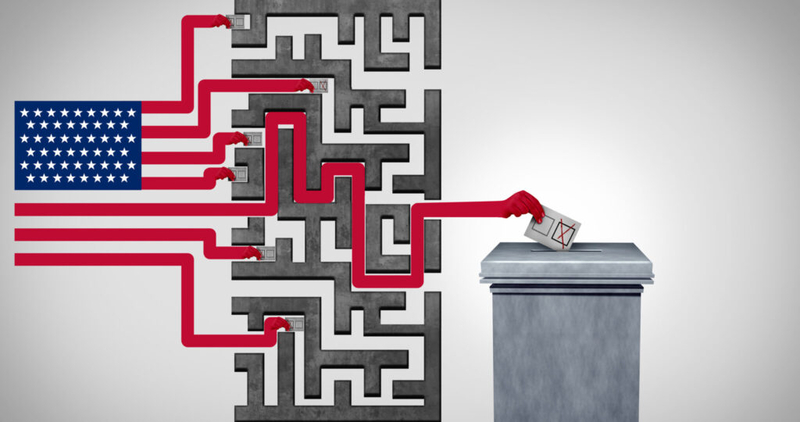
The problem isn’t that people don’t care. It’s that participating between elections has turned into an obstacle course, and most of us fail it for reasons that have nothing to do with how much we want to be heard.
Start with simply trying to find out what’s going on and what’s coming next.
To know what your government is about to do, you have to track several bodies at several levels, each with their own agendas, calendars and notices — none of which talk to each other.
If you do find the bill, you then have to decode it, because it is written in a language that seems designed to make you stop reading.
Then you have to catch it in time — before the vote, rather than after on the news.
After all that, you might not even know if your voice was heard, because it’s hard to track how your representative voted.
Each of those is a wall. Stacked together, they are why people opt out. Not apathy. Friction.
And it creates a quiet kind of inequality. The people who can run that obstacle course — the ones with the time, the legal fluency, and the access, i.e., the money — get to weigh in. The people who can’t, don’t.
The gap falls hardest on those already least likely to be heard: someone working two jobs; someone who doesn’t speak the bureaucratic dialect; someone who was never handed a map of how any of this works.
I am not a policy expert, but rather a Minneapolis resident who got tired of those walls, so I built something to take them down. It’s called Live Democracy.
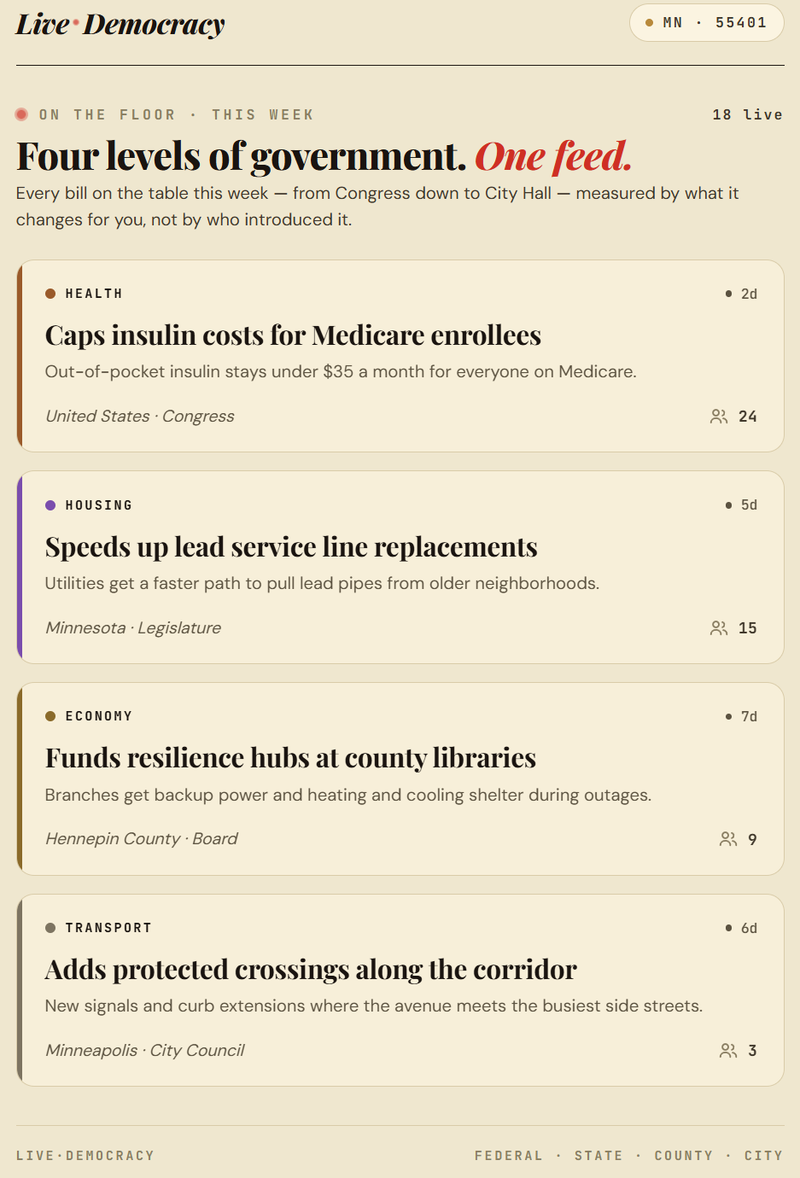
Live Democracy is direct democracy for the digital age. It takes the things you already do every day — scroll, like, share — and turns it into real political action. A clear position on a real bill, delivered to the people who represent you before they vote — all at your fingertips. This is infrastructure that should have been in place long ago.
Instead of hunting across sites and agencies, enter your zip code to see every city, county, state and federal bill that impacts you in one feed before it becomes policy.
Instead of legalese, each bill is summarized in plain language, with the official text linked when you want to read more.
(A quick word on how those summaries get written, because it’s the obvious question and most products would dodge it: the plain-language translation is done with AI. Live Democracy doesn’t use AI to flood you with content or manufacture engagement. It uses it for one job: turning deliberately impenetrable legislative text into plain language you can actually read. AI in service of access, not attention. To ensure this is clear, an AI confidence level is attached to every summary alongside the link to the full official source.)
Instead of making a trip to City Hall, you can say where you stand with one click from your phone.
After your representatives vote, you can see where they stood in relation to the district they are supposed to represent.
Live Democracy aggregates constituent positions in a district and electronically delivers directly to representatives’ offices. In Minneapolis, where I can see City Hall from my living room window, I print the results and hand deliver them to the city clerk’s office.
I created this site because I want to disrupt the system, even if only for one city right now, to prove the value in the Live Democracy model. None of this fixes democracy, and I would distrust anyone who told you a website could. What this can do is shrink the absurd distance between caring about a decision and being able to do something about it. The hope is to make the ordinary person’s voice a little louder, in a way that is proactive and actionable, not just opinions shared after it’s too late.

Saint Paul, MN