Following U.S. Supreme Court decision, Lombardo renews call for state ban on trans athletes
Jun 30, 2026 | 5:53 pm ET
Description
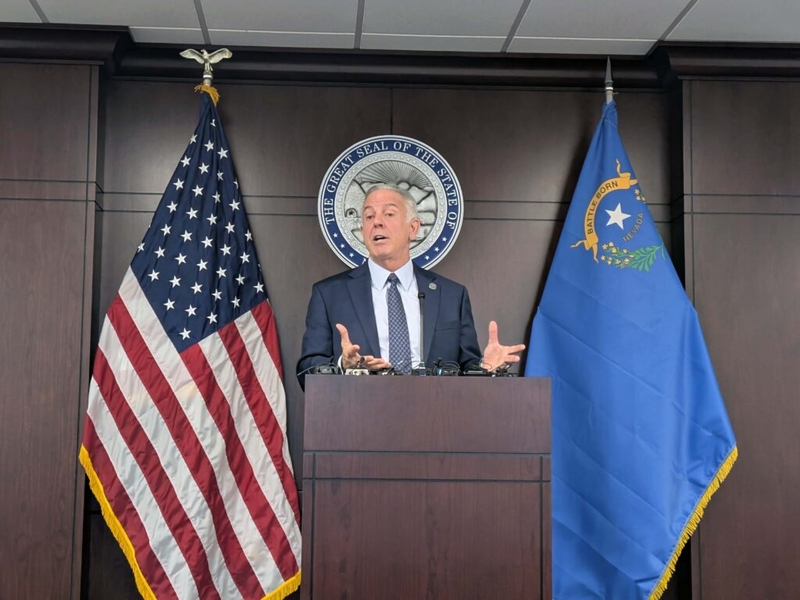
Gov. Joe Lombardo. (Photo: April Corbin Girnus/Nevada Current)
With the U.S. Supreme Court upholding state bans against trans athletes, Republican leaders in Nevada reupped their call for a similar ban in the Silver State.
In a 6-3 decision issued Tuesday, the nation’s highest court decided that Idaho and West Virginia laws banning transgender athletes from participating in women’s and girls’ sports do not violate the Equal Protection Clause of the 14th Amendment.
Nevada Gov. Joe Lombardo in a social media post Tuesday said the court decision “provides important legal clarity and affirms that states have the authority to protect fair competition in girls’ sports.” The first-term Republican governor called on the Democratic-controlled Nevada State Legislature to address the issue during the 2027 Legislative Session, saying they have the opportunity “to provide a permanent, common-sense solution.”
Lombardo at the beginning of this year announced he would lead a petition initiative to amend the Nevada Constitution to ban trans girls from competing in the sport divisions that reflect their gender identity. He, as other Republicans have, framed it publicly as an effort to protect girls and women, though privately touted it as something that would help voter turnout in his favor.
The proposed ballot measure was challenged in court by opponents, and the Nevada Supreme Court issued the final ruling June 18, finding the ballot measure legally sufficient. However, the following day, Lombardo announced the petition would not be moving forward, saying that the “legal delays and uncertainty surrounding this case have made it impossible to complete the initiative process in time for the 2026 ballot.”
The initiative petition process requires groups to submit 148,788 valid signatures, divided evenly between the state’s U.S. congressional districts. The deadline for submitting signatures was June 24.
In the statement announcing his ballot measure would not move forward, Lombardo called on state lawmakers to take action during the next regular session, which begins in February 2027. He vowed to bring the petition initiative back if lawmakers fail to do so.
Republican Lt. Gov. Stavros Anthony, who has made the issue of trans girls a top priority of his first term, similarly called on legislative action.
“It’s time for the Nevada Legislature to step up and pass into law a ban on biological males competing against females in all women’s sports in Nevada,” he said in a statement released by his re-election campaign.
Anthony in the 2025 Legislative Session introduced a trans athletes ban bill, which was deemed dead on arrival by Democrats. He also founded and promoted a “Task Force to Protect Women’s Sports.” The Nevada Commission Ethics determined that Anthony violated multiple state statutes as a part of that effort because banning trans girls from sports teams is a personal interest, not a professional interest related to the office of the lieutenant governor.
In a statement Tuesday, Anthony’s campaign suggested his task force lead to the Nevada Interscholastic Activities Association in April 2025 approving a policy requiring high school students to play in sport divisions that align with the sex listed on their original birth certificate.
The NIAA had previously, since 2014, allowed student athletes to compete in divisions that aligned with their gender identity. It is unknown how many trans kids competed under that policy. The NIAA does not collect data on trans athletes.
But the number is no doubt small. When Utah Gov. Spencer Cox vetoed a trans athlete ban in 2022, he noted the state had just four trans kids playing in high school sports and only one played against girls. (The Utah State Legislature overrode Cox’s veto. A legal challenge delayed the bill’s implementation until last year, but the ban is now in effect.)
Silver State Equality and other groups condemned the Supreme Court decision, arguing such anti-trans bills police gender and put all students at risk.
“These laws do not protect girls,” said Shelbie Swartz, executive director for Institute for a Progressive Nevada, in a statement. “They police them. Under Idaho’s law, any girl whose appearance or body does not fit someone else’s expectations could have her gender questioned, scrutinized, and subjected to invasive examination.”
Swartz added that the “regulation of youth sports should be up to governing bodies, not state-level politicians or the Supreme Court.”
Silver State Equality Executive Director André Wade in a statement said the “Supreme Court has opened the door to broader attacks on transgender students and weakened protections provided by Title IX and the Fourteenth Amendment.”
Las Vegas, NV