Minnesotans push back against the surveillance state
Jun 18, 2026 | 7:00 am ET
Description
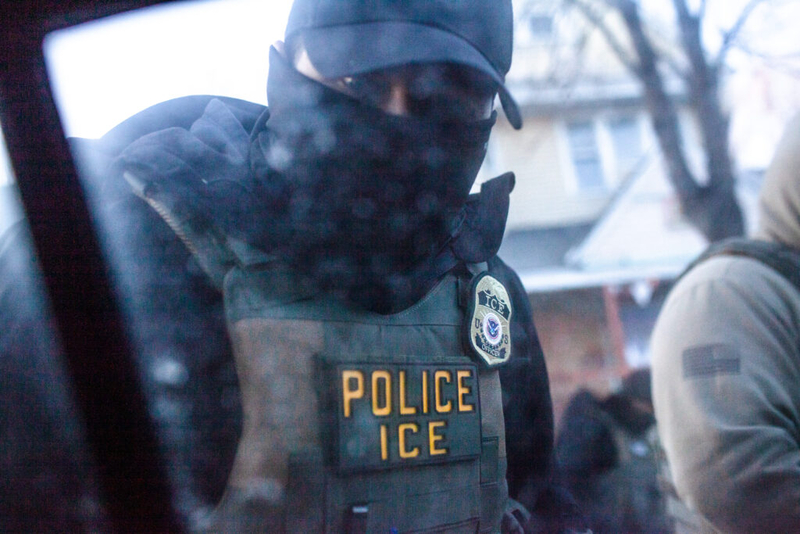
A masked U.S. Immigration and Customs Enforcement agent knocks on a car window in Minnesota on Jan. 12. (Photo by Nicole Neri/Minnesota Reformer)
A Richfield woman who says the U.S. government punished her for acting as a lawful observer during Operation Metro Surge told her story on Capitol Hill recently. Her June 9 testimony came with a warning that the Trump administration’s efforts to quell dissent threaten otherwise law-abiding Americans.
Nicole Cleland said her expedited airport security screening privileges were revoked after a confrontation with officers of the Department of Homeland Security during the immigration crackdown earlier this year.
She said believes the timing is suspicious and offered a warning: “If I can be punished for speaking out, anyone could be at risk,” Cleland told Democrats on the House Committee on Homeland Security.
Cleland testified alongside a civil rights attorney and two former intelligence professionals as Congress debates reauthorization of an increasingly controversial set of surveillance tools that critics say are ripe for abuse.
Section 702 of the Foreign Intelligence Surveillance Act gives federal agencies broad latitude to collect private communications of foreigners outside the United States. Those collections often include communications with Americans in contact with targeted individuals. The FBI, CIA and other federal agencies use these communications to conduct thousands of warrantless “backdoor searches” on Americans, in what the Brennan Center for Justice, a nonpartisan civil liberties group, calls a “gaping hole through the protections of the Fourth Amendment” and FISA itself.
The reauthorization vote failed last week, 198-218, as a number of Republicans joined Democrats in opposition, causing the law to expire. Republican House Speaker Mike Johnson brought it up using an expedited process that requires a two-thirds majority.
An annual certification from the court that oversees the program and won’t expire until March 2027 should allow intelligence agencies to keep collecting data, experts say. Congress will keep debating in the meantime.
The vote would have pushed the expiration of Section 702 until July 2. Many Democrats say they would refuse to vote for the reauthorization until President Trump selected a different nominee to replace current Director of National Intelligence Tulsi Gabbard after she leaves the post on June 30.
Shortly after Gabbard said she would resign, Trump tapped Bill Pulte, a real estate scion and current director of the Federal Housing Finance Authority who has no experience in law enforcement or intelligence operations. Pulte emerged as one of the Trump administration’s top attack dogs last year after using his position to spin up criminal allegations against perceived Trump enemies like New York Attorney General Letitia James and Federal Reserve governor Lisa Cook.
“As long as Bill Pulte and (FBI director) Kash Patel and people like that are running the show, we can’t continue to authorize this authority,” Rhode Island Democrat Seth Magaziner told the Homeland Security panel last week.
Following the failed vote, the House adjourned until June 23. Hours later, Trump swapped Pulte for another loyalist: Jay Clayton, U.S. Attorney for the Southern District of New York. It’s not yet clear whether Trump’s climbdown will be enough for lawmakers to reauthorize Section 702 when they return. Today, Trump said he would freeze Clayton’s nomination until Congress reauthorized Section 702 and approved an unrelated voter ID bill.
Vast and increasingly powerful surveillance apparatus
Though there’s no indication that federal agencies examined Cleland’s private communications without a warrant, the experts testifying with her said her situation is one of countless examples of the government using its vast and increasingly powerful surveillance apparatus for questionable ends.
Kia Hamadanchy, senior policy counsel for the American Civil Liberties Union, said that arsenal now includes “stingray” transmitters that can track nearby mobile devices; facial recognition tools that occasionally produce false positives; and apps that pull personal information from an array of commercial and government databases.
“(They are) looking to target activists and nonprofits under the banner of domestic intelligence,” Hamadanchy said. “The information that is available commercially would kind of knock your socks off.”
Cleland said she is certain the government turned these tools on her, even if she’s not sure exactly what information was gathered.
“I believe there’s a list — I believe there’s a lot of lists — and I’m pretty sure I’m on more than one,” she told lawmakers.
Luis Argenta, communications director for Unidos MN, a progressive immigrant rights group, told the Reformer that the federal government should not treat community members who peacefully observe and document law enforcement activities as a threat.
“Any effort to surveil, intimidate, or retaliate against lawful observers raises serious concerns and deserves public scrutiny,” Argenta said. “Even as media attention fades, the need for transparency, oversight, and protection of civil liberties remains as important as ever.”
New charges raise questions about surveillance
On Tuesday, federal prosecutors filed a slew of charges against 15 Minnesota members of a “direct action” group active during Operation Metro Surge. The charges included “conspiracy to injure or impede a federal officer” and stalking.
The case raises questions about the extent of the federal government’s surveillance activities and what capabilities it has to target dissidents. In a court filing, prosecutors said they had collected over 44,000 pages of written reports and photographs, 2.5 terabytes of surveillance camera and body camera footage, and 15 terabytes of messages exchanged by the defendants on Signal, the encrypted messaging app.
Catherine Ahlin-Halverson, staff attorney for the ACLU of Minnesota, decried the charges.
“Minnesotans have the right to observe, document, and peacefully protest federal overreach into our state and abuses against our neighbors,” she said. “We will continue to use every available means to defend people whose liberties are threatened and whose voices are suppressed.”
Cleland said she was observing federal law enforcement operations on Jan. 10 when U.S. Customs and Border Patrol officers stopped her car. The officers addressed her by name, told her she’d been identified with a facial recognition tool and said she could be arrested if she continued following them, Cleland said.
Three days later, Cleland received a letter saying the Global Entry privileges she’d had since 2014 had been revoked because she “no longer met program eligibility requirements.” She told lawmakers that she filed a Freedom of Information Act request to learn more about the process that led to the termination but has not yet received a response.
Cleland said the Jan. 10 incident and apparent retaliation for observing federal agents left Cleland shaken and reluctant to act as a lawful observer in the future.
Cleland testified hours after NPR reported on a “previously unpublicized” April letter to Congress from the former acting director of U.S. Immigration and Customs Enforcement. In it, Todd Lyons said ICE asserts broad authority to collect information on people suspected of interfering with its officers and may keep records on people who were not arrested, including “essential biographic and biometric information and situational details.”
Steven Cash, a former CIA officer who now leads The Steady State, said technological advances and a pliant judiciary make the federal surveillance apparatus far more potent — and menacing — than it was in the immediate post-9/11 period, when “we were filling boxes with reams of information we could do nothing with.”
Cash estimated at least 100 surveillance cameras tracked his movements as he drove to Capitol Hill from Maryland, each a potential data point for law enforcement.
“The world has changed,” he said.

Saint Paul, MN