Louisiana rejects Gov. Jeff Landry-backed amendments again
May 16, 2026 | 11:22 pm ET
Description
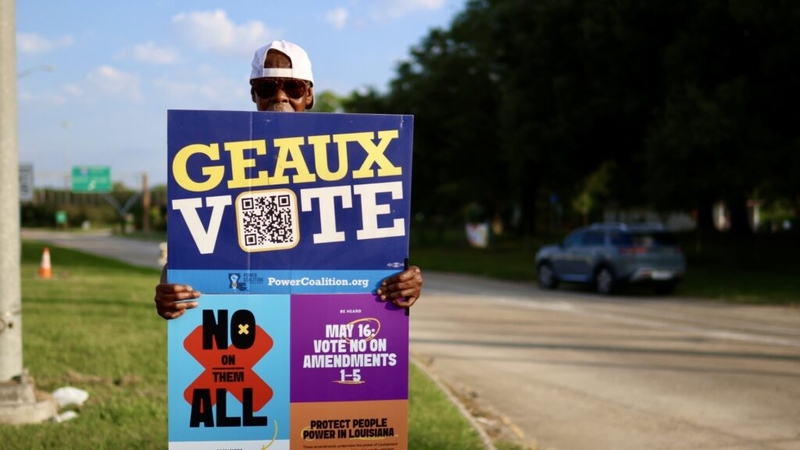
Eddie Hawkins of Scotlandville, a volunteer with the Power Coalition, holds a sign outside a Baton Rouge precinct urging voters to reject all five state constitutional amendments on the ballot Saturday, May 16, 2026. (Photo by Wes Muller/Louisiana Illuminator)
For the second year in a row, Louisiana voters delivered a stunning defeat to Gov. Jeff Landry by rejecting a slate of constitutional amendments he supported.
Landry backed four of the five amendments on Saturday’s ballot. His political organization, Protect Louisiana Values, devoted $1 million to a campaign to get them approved. They lost overwhelmingly by margins ranging from 16% to 56%.
The governor prioritized and personally campaigned to pass Amendments 3 and 4 specifically. They were part of a more dramatic budget and tax constitutional amendment package from Landry that also failed to pass last year.
Part of the amendment pushback this year likely stemmed from Black and Democratic voter anger at the governor. Black voters, who are the backbone of the Democratic Party in Louisiana, turned out in large numbers to participate in the election.
Over the past three weeks, Landry and Republican state lawmakers have outraged Democrats by postponing the state’s U.S. House elections so they could create a new congressional map that eliminates one of the state’s two majority-Black districts.
The governor suspended the races in response to a U.S. Supreme Court decision that declared the state’s existing House districts unconstitutional because of a racial bias.
Landry’s move infuriated Black voters and Democrats, who waited hours at the State Capitol this week to testify against the GOP’s favored map.
New Orleans elected leaders, who are predominantly Black and Democratic, are also in an escalating fight with the governor and his ally, Republican Attorney General Liz Murrill, over the elimination of an elected position that was supposed to go to a Black Democrat.
At the urging of Landry and Murrill, state lawmakers passed a new law to abolish the elected New Orleans clerk of criminal court’s job at the end of last month. The move blocked Calvin Duncan, a formerly incarcerated man who had won the seat with 68% of the vote, from taking the office earlier this month.
There was already a campaign to vote “No on All” amendments brewing before Landry postponed the U.S. House elections and pushed to eliminate the court clerk position. But organizers of the opposition said they capitalized on the recent surge in anger against the governor.
“All of those things are opening people’s eyes to the voter suppression efforts that have been taking place in this state for a long time,” said Sarah Omojola, who campaigned against the amendments as part of the Liberty and Dignity Coalition.
The backlash against Landry could have consequences for public school teachers and support staff, however.
If approved, Amendment 3 was meant to guarantee the educators a pay raise. It would have required the state to dissolve three education trusts funds to pay off employee retirement debt early for K-12 school districts and universities. The school districts would have been required to use their savings to give their teachers and support workers raises of $2,250 and $1,125, respectively.
Without the amendment passing, teachers and school staff now face a pay cut. Legislators had been giving them $2,000 and $1,000 annual pay stipends for the past three years, but Senate President Cameron Henry, R-Metairie, said they wouldn’t continue to do so if the amendment failed.
“If the public doesn’t vote to give [teachers] a pay raise, then that means they don’t want to give them a pay raise,” Henry said earlier this week.
The other amendments that failed included those to remove civil service protection from certain state jobs, create a new Baton Rouge-area school district, allow local governments to reduce or end business inventory taxes and raise the retirement age for judges.
Baton Rouge, LA