Community colleges plan for less property tax revenue growth
May 15, 2026 | 5:25 pm ET

Description
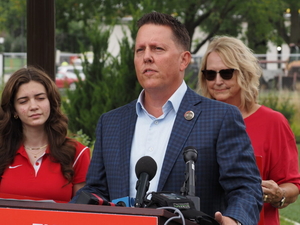
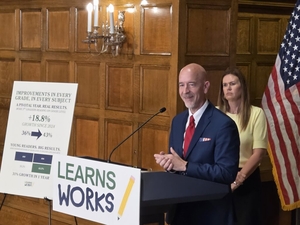
Rep. Steven Holt, right, speaks with Western Iowa Tech Community College students and faculty on March 3, 2026 at the Iowa Capitol. Legislation passed this session to change property tax caps and the 260E job training program are causing community colleges to start planning for less revenue growth. (Photo by Brooklyn Draisey/Iowa Capital Dispatch)
Iowa’s community colleges are bracing for less revenue from property taxes and shorter-term partnerships with area businesses as legislation passed just a few weeks ago awaits the governor’s signature.
In its 2026 session, the Iowa Legislature passed bills capping fixed-rate levies at 2% growth and making changes to the job training programs community colleges use to partner with businesses looking to train employees. Emily Shields, executive director of Community Colleges for Iowa, said financial impacts of property tax changes could come in as high as $30 million over the next five years.
These caps will affect community college general funds, Shields said, as wells as plants and equipment funds. She acknowledged that the system could have been facing a much larger financial impact if varied levies had seen changes like those happening to fixed levies.
“We have seen, on average, about 5% growth over the past few years, so capping that at 2(%) does have some impact on what we’re bringing in on those levies,” Shields said. “However, to your question, capping our variable levies was on the table, so that not happening is a much better impact for us.”
The organization looked back at the past five years of property tax collection at Iowa’s community colleges to estimate potential financial impacts in the future, and when taking into account the compounding effects of multiple years, $30 million in impacts over the next half-decade was what Shields said they found.
If variable levies had been included in the legislation, Shields said the impact would have been as much as $134 million. Variable levies held by community colleges are restricted by purpose, she said, one of which is insurance — a rising cost for institutions.
Shields said the system should expect to see a $4 million loss in one year, representing varying impacts on different community colleges depending on where they’re located and how local property taxes are set.
“That is not nothing, but certainly something the colleges can plan for and work with, and we’re really grateful for that,” Shields said.
Des Moines Area Community College and Iowa Lakes Community College are two institutions expecting a larger impact, Shields said.
DMACC Controller Ben Voaklander told the community college board of trustees in April that while property tax legislation had yet to be agreed upon, the college won’t see losses as much as a smaller base of growth in its fixed levy funds.
The 2% cap is better than the 1.75% he predicted at the time of the meeting, he said, but growth will be restricted to between $250,000-$300,000, limiting future revenues and necessitating more caution from officials when determining what projects to invest in.
“Each $1 of tuition generates about 250,000 at the college, so when property taxes this year went up 900,000 that helps to soften the tuition increase,” Voaklander said. “But going forward that’s going to be a little more difficult, because we’re not going to see any sort of larger growth in our property tax revenue, it’s going to be pretty much set at that right between that 250 to 300,000 for the next several years.”
Tuition increases to offset reduced property tax revenue growth was a concern of the board of trustees in April, but Voaklander said the college isn’t going to “put this on the backs of students.” The college will instead continuously look for ways to be more efficient. Construction and dealing with deferred maintenance are two areas where the college will need to budget carefully and be more strategic about addressing problems or new opportunities, he said.
Melissa Haukap, director of continuing and professional education at Iowa Lakes Community College, didn’t provide exact numbers on property taxes for the college but said it is a funding source for program delivery, and college leaders know balancing fiscal responsibility of tax dollars with college needs is a “key emphasis” of what they do.
“I think the biggest concern in rural areas is just access to funding sources and knowing the impact that that has for employers and our workforce in this region, and having accessibility to high quality training that they need,” Haukap said. “But we’ll be able to plan for and make adjustments to ensure that we can do our best to still provide that training that’s needed in our region to help support the local industries.”
Community colleges glad for continuing 260E program
Another change coming for community colleges after the legislative session relates to new job training programs they enter into with businesses through bonds.
While current contracts made through the state’s Industrial New Jobs Training (260E) Program are funded with 10-year bonds, Iowa Lakes Community College Industry and Business Training Consultant Atkinson said new bonds will be limited to seven years. Administrative fees are also changing from 19.5% to 15%, which Atkinson said will reduce revenue but in a way that the college can account for and work around.
“We were able to negotiate with the governor and the Legislature around some things that we think will improve the program,” Shields said.
Shields added that she is looking forward to the process of reviewing the 260E program this year.
Community colleges have held concern for the program since a study group in October 2025 recommended its sunsetting. College and business officials spent their annual “day on the hill” telling lawmakers about the benefits of these partnerships for both parties, as well as the state, and spoke against the program’s elimination in a legislative subcommittee. Voaklander commended businesses across the state for expressing their concerns to the Legislature, saying it helped keep the program alive.
College officials were happy to see the program survive the session, and that their present partnerships will not be affected. Over the past 10 years, Atkinson said, Iowa Lakes has sold a bond each year, amounting to $13.3 million in training dollars. Business leaders were also glad for the program’s continuation.
“In the smaller communities like ours, businesses want to grow, but it’s always a challenge to have opportunities to fund their training, to fund their growth, and 260E has been a great component to help do that,” Atkinson said.
It’s also vital for the students having their employer’s support to gain new training and skills, Atkinson said, and if the 260E program ends up going away, he said it will “significantly impact the number of students we get, especially from the companies.”
Another directive in the legislation is to have a study group scrutinize the program this year and come up with recommendations as to possible further changes. The study group will be made up of community college officials, administrative representatives, lawmakers, businesspeople and others involved in economic development, Shields said.
Atkinson said the study group will look at the legislative language, Iowa code, the rules that surround it and the definition of “what a new job is” in crafting recommendations, all of which he believes will make the program stronger.
“Collaboration and support of our local economies is central to everything that we do, and we have a longstanding history of meeting those regional training needs that exist and collaborating with business, and that’s something that won’t change,” Haukap said. “It’s something that we’ll work through together, and adjust to the funding that’s available.”
Des Moines, IA