Supreme Court strikes down Louisiana congressional maps in case with national implications
Apr 29, 2026 | 11:40 am ET
Description
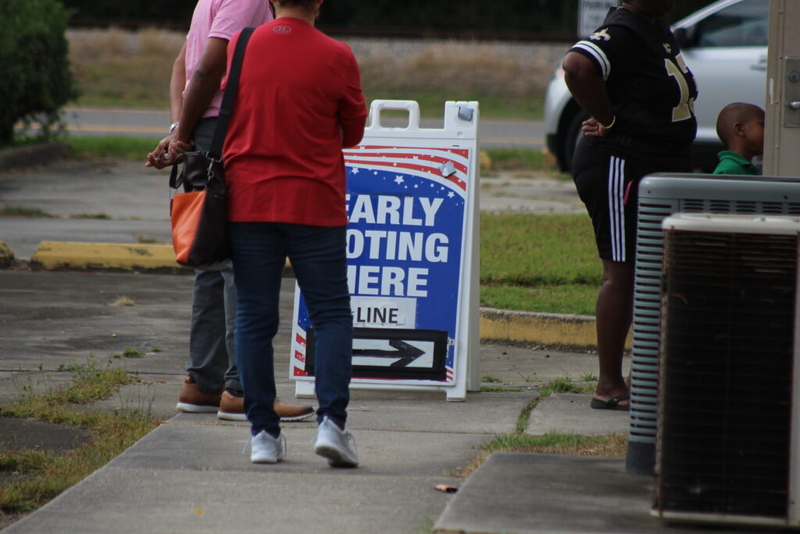
East Baton Rouge Parish, Louisiana, voters stand in line at an early voting location in 2022. Louisiana Gov. Jeff Landry has suspended Louisiana’s May 16, 2026, party primary elections for six U.S. House districts — after early voting had begun — following the U.S. Supreme Court’s decision to throw out the state’s existing congressional map. (Photo by Wes Muller/Louisiana Illuminator.)
The U.S. Supreme Court struck down Louisiana’s existing congressional map Wednesday as an unconstitutional racial gerrymander in a ruling that may have implications for core tenets of the Voting Rights Act.
“Allowing race to play any part in government decision-making represents a departure from the constitutional rule that applies in almost every other context,” Justice Samuel Alito, who was appointed to the court in 2005 by President George W. Bush, wrote for the majority opinion. “Compliance with Section 2 thus could not justify the state’s use of race-based redistricting here. The state’s attempt to satisfy the Middle District’s ruling, although understandable, was an unconstitutional racial gerrymander.”
Read the opinion below.
The three liberal leaning justices dissented from the majority opinion, adopted on a 6-3 vote along ideological lines. They accused the majority of dismantling Section 2 of the Voting Rights Act, which prohibits voting laws or procedures that purposefully discriminate on the basis of race, color or membership in a language minority group.
Political leaders have previously indicated the decision will not affect the 2026 midterm elections as Louisiana is already too late in the electoral process to adopt new maps, though Louisiana Attorney General Liz Murrill told reporters Wednesday the legislature still has time. That would come with significant complications, as early voting for the May 16 congressional party primaries begins Saturday.
Louisiana Secretary of State Nancy Landry, who oversees statewide elections, issued a statement saying lawyers within her agency were analyzing the opinion. She noted that justices remanded the case back to the federal court in Louisiana’s Western District, leaving her limited in what she can save about active litigation.
Michael Li, senior counsel for the Brennan Center for Justice, has followed the case since its inception. His progressive organization that follows redistricting issues throughout the country.
“While the Supreme Court didn’t declare Section 2 unconstitutional and left it in place, it modified what you have to do to win a Section 2 case in ways that will make it much harder or impossible for voters of color to use,” Li said.
U.S. Rep. Troy Carter, D-New Orleans, blasted the ruling in a statement.
“Today’s decision by the Supreme Court is a devastating blow to the promise of equal representation in our democracy,” Carter said. “This ruling is about far more than lines on a map — it’s about whether Black Louisianians will have a meaningful opportunity to make their voices heard.”
“For decades, the Court’s majority has steadily chipped away at the Voting Rights Act of 1965. The consequences of this decision are immediate and severe: the hard-fought progress that led to the creation of two majority-Black congressional districts in Louisiana is now in jeopardy,” Carter added.
Justice Elena Kagan, who was appointed to the court in 2010 by President Barack Obama wrote “the court’s decision will set back the foundational right Congress granted of racial equality in electoral opportunity.”
Right-leaning justices on the court had previously expressed interest in limiting or banning the consideration of race in the redistricting process.
The case in question, Callais v. Louisiana, challenges the legality of a second majority-Black congressional district that the Louisiana Legislature, with a Republican majority, drew in 2024. Lawmakers configured that map in response to a federal court ruling over a version of the districts created in 2022 that directed the state to enhance minority voting power based on the Voting Rights Act. Louisiana has six seats in the U.S. House of Representatives, but only one favored a Black candidate before 2024 in a state where nearly a third of the population is Black.
The new district created in 2024 is currently held by U.S. Rep. Cleo Fields, D-Baton Rouge.
“If you tell me I have to be white to serve in Congress from Louisiana, I can’t do nothing about that,” Fields said in a press conference after the ruling.
While the ruling does not invalidate the Voting Rights Act, it does undermine a legal tool minority voters have used for decades to challenge election maps they believe unfairly dilutes their voting power by requiring Section 2 challengers to take state’s political goals into consideration.
In the 2024 special legislative session in which lawmakers adopted the existing map, state Sen. Glenn Womack, R-Harrisonburg, said his primary goal was to provide political protection to U.S. House Speaker Mike Johnson, R-Benton, Majority Leader Steve Scalise, R-Jefferson, and Rep. Julia Letlow, R-Start, the delegation’s sole woman member.
Li, the Brennan Center’s redistricting attorney, said drawing a majority Black district that voted for Letlow, a conservative Republican who is currently running for U.S. Senate with President Trump’s endorsement, would be impossible.
“When you look at everything they do cumulatively [in the opinion] it makes [Section2] functionally unusable,” Li said.
The Callais case was originally slated to be decided in 2025. But in a rare move, the court scheduled a second round of arguments, posing a new question for parties to answer: Did the Louisiana Legislature’s creation of a second majority-Black district violate the 14th or 15th amendments to the U.S. Constitution?
The 14th Amendment, in part, covers representation in Congress, and the 15th Amendment prevents citizens from being denied the right to vote based on their race.
After the court posed new questions, Louisiana Attorney General Liz Murrill, who had previously defended the 2024 map, effectively switched sides and argued against the consideration of race in the redistricting process.
“The Supreme Court has ended Louisiana’s long-running nightmare of federal courts coercing the state to draw a racially discriminatory map,” Murrill said in a statement after Wednesday’s ruling. “That was always unconstitutional — and this is a seismic decision reaffirming equal protection under our nation’s laws.”
Murrill said she would continue working with the legislature and Gov. Jeff Landry to provide guidance as Louisiana works on adopting its next map.
Louisiana Senate President Cameron Henry, R-Metairie, and House Speaker Phillip DeVillier, R-Eunice, said they are meeting with state leaders to determine next steps in a statement. Sen. Caleb Kleinpeter, R-Port Allen, who chairs the senate committee that oversees redistricting, separately sent the same statement.
There are several redistricting bills filed that could be considered this session, though lawmakers would be in a time crunch to craft amendments to the bills and get them through the entire legislative process before the session ends June 1. Lawmakers would also have the option to approve new maps next year.
Other states are also expected to move quickly to take advantage of the ruling, both to recraft their congressional seats but also to take advantage of the court’s new interpretation on race to potentially narrow minority representation across state legislatures, judiciaries and other elected bodies.
A projection by Fair Fight Action, a progressive voting rights group based in Georgia, found that Republicans could ultimately secure up to 19 seats in the U.S. House of Representatives nationally because of the ruling. At the state legislative level, Republicans could gain up to 200 seats.
This is a developing story
Baton Rouge, LA