The impact of federal funding on civil legal aid in South Dakota
Mar 08, 2026 | 12:12 pm ET
Description
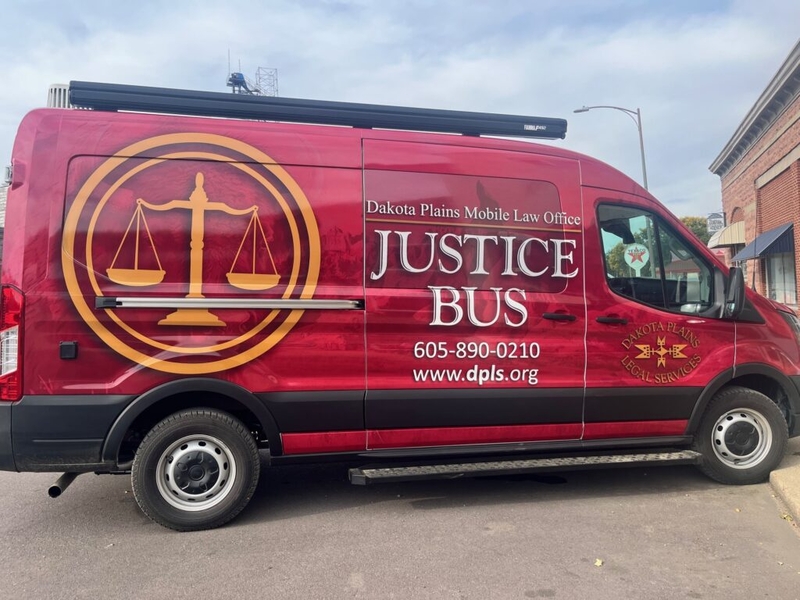
The Justice Bus launched in 2025 to help provide legal aid to South Dakotans living in legal deserts. (Courtesy of Unified Judicial System)
Every year, millions of Americans face life-altering civil legal crises such as eviction, domestic violence, or losing custody of a child. Despite tireless efforts from South Dakota organizations, 92% of civil legal crises faced by low-income individuals still go unaddressed due to chronic underfunding. Funding from the Legal Services Corporation is essential to South Dakota’s legal aid organizations’ staying operational and serving the state’s most vulnerable residents.
In September, Dakota Plains Legal Services helped a domestic violence survivor obtain a divorce that had been pending for nearly four years. The husband had evaded service, moved out of state, and made it impossible to finalize the divorce. Dakota Plains refiled the case in the wife’s current county, located the husband’s address, and successfully served him with the necessary papers. Without the help of Dakota Plains, the wife may not have been able to move forward and finally be free from a life-threatening situation.
Cases like this are not uncommon. Family law matters, divorces, custody disputes and protection orders make up most of the work handled by South Dakota’s legal aid organizations. In 2024, approximately 57% of East River Legal Services’ cases were family law-related, and 25% were housing-related. Approximately 32% of Dakota Plains’ cases were family-related and 14% were housing-related. Each one represents a life changed and a barrier to justice overcome.
The importance of legal aid is made stark by the imbalance in eviction cases. Landlords have an attorney in 83% cases. Tenants have legal assistance in 4% of cases. This gap of underrepresented tenants leaves families in demanding situations.
Dakota Plains has helped individuals avoid eviction by contacting their landlords and establishing agreements. Without the assistance of the Dakota Plains staff, these individuals would have faced eviction on their records, making it difficult to put a roof over their family’s heads. Federal funding from the Legal Services Corporation is helping South Dakota legal aid organizations keep people and families off the streets and in safe homes.
The Legal Services Corporation is a key national funder of 133 civil legal aid programs. The corporation has been funding these crucial services for low-income Americans since 1974. In South Dakota, the corporation distributes federal support to East River Legal Services and Dakota Plains Legal Services. In 2025, South Dakota received nearly $2.7 million in civil legal aid funding to be distributed between the two organizations. As a result of this funding, South Dakota legal aid organizations helped over 7,000 people, including children, facing civil legal crises.
A legal needs assessment was conducted in South Dakota, in partnership with East River and Dakota Plains. The study revealed that nearly one in five civil cases between 2018 and 2021 were rejected, leaving people without access to legal help as they navigated the civil court system.
A rejection can take many forms, including not meeting the poverty threshold, insufficient funding, inadequate staff due to funding constraints, and case priority policies. The rejections stem from South Dakota’s inability to financially support its legal organizations, leaving our vulnerable population feeling abandoned. The poverty threshold is generally set at around 125% of the poverty line. For a family of four, qualifying for legal aid often means earning less than $39,000 annually.
Western South Dakota legal aid group survives assessment and keeps its funding
Legal Services Corporation funding impacts South Dakotans every day. A Sioux Falls woman had lived in the same apartment for 17 years. She always paid her rent on time and relied on a housing voucher that kept her afloat. She had a medical setback, which caused her to fall behind on rent. Her landlord filed for an eviction. The woman was terrified of losing her home and the voucher that kept a roof over her head. This eviction could have ended both of those.
She reached out to East River Legal Services for help, and an attorney stepped in. The attorney contacted opposing counsel, and both sides reached an agreement. The agreement allowed the landlord to receive payments on a payment plan and to waive all late fees and attorney fees. Thanks to East River Legal Services, the eviction was dismissed. The woman was able to keep her voucher, remain in the home, and avoid the devastating impacts of an eviction.
Although it might seem like a large amount, $2.7 million in funding is insufficient to meet the legal needs of vulnerable South Dakotans. Increasing federal funding by even 10% nationwide would have a significant impact on South Dakota. The Legal Services Corporation website has created a funding calculator that shows how increased funding can impact your state. In South Dakota, this increase in funding would help roughly 988 more people, solve 742 civil legal problems, provide 246 more individuals with access to legal information and self-help resources, and help 309 more children.
Applications for legal assistance have continued to rise in recent years. East River Legal Services received over 3,000 applications for assistance in 2025. This was an increase in applications over 2024. The people of South Dakota have stepped in to help close the justice gap for their community members, and it is deeply appreciated by those who receive services, but more is needed. Increasing the federal funding is essential to maintain access to justice for vulnerable and underrepresented populations in South Dakota.

Pierre, SD