Record-breaking numbers head to the emergency room for carbon monoxide poisoning
Mar 02, 2026 | 5:00 am ET
Description
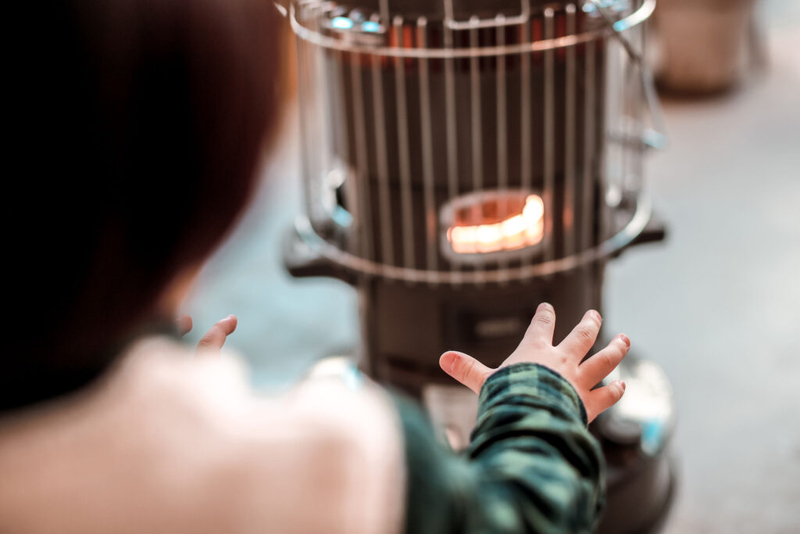
Running kerosene or gas-powered devices indoors can produce carbon monoxide that, if not vented properly, can lead to carbon monoxide poisoning and possible death. The number of emergency room visits for carbon-monoxide poisoning this year has exceeded previous years. (Photo by FF Hong/iStock Getty Images Plus)
A record-breaking number of Marylanders have landed in the emergency room this winter due to exposure to carbon monoxide, as cold temperatures lead people to seek warmth in unsafe ways.
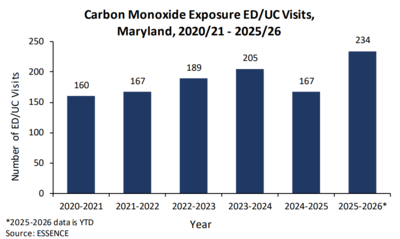
So far this winter, there have been 234 trips to the emergency room or urgent care due to carbon monoxide poisoning, according to the most recent state health data, more than any of the last six cold seasons for which data is publicly available.
And the “cold season,” which runs from November through March, is not over yet.
Health officials say it’s crucial to keep up with safety measures to prevent additional hospital trips or even deaths due to the “silent killer” that is carbon monoxide poisoning.
“When it gets colder, people do use more heat,” said Clifford S. Mitchell, director of the Maryland Health Department’s Environmental Health Bureau. “And anytime they use more heat, we want to make sure that they are looking at preventing carbon monoxide exposure.”
According to the Centers for Disease Control and Prevention, carbon monoxide poisoning kills more than 400 people in the United States each year and sends more than 100,000 people to the emergency room.
The odorless invisible gas is known as a “silent killer” because people who have been exposed may not know it immediately. Meanwhile, they’re breathing in the gas that is depriving them of oxygen, which can quickly become deadly.
Instances of carbon monoxide poisoning tend to rise in the winter due to people using gas-powered appliances or fire in their homes while keeping windows closed, shutting off ventilation.
“It won’t be a surprise that as people are trying to escape the cold, they’re often looking at sources of heat that can produce carbon monoxide,” Mitchell said. “Any source of combustion – whether it’s a kerosene stove or a wood fire, all of those can produce carbon monoxide any time … and it is very, very dangerous.”
The Maryland Cold-Related Illness Surveillance Report runs weekly from November through March. The current report captures data through Saturday, Feb. 21, so does not capture the most recent cold snap from early last week. That data will be available Wednesday. But the latest data shows the previous high for emergency room or urgent care visits, 205 in the 2023-24 cold season, was passed two weeks ago.
Mitchell said that the particularly chilly cold snaps this year have likely led to unsafe heating practices – such as using a generator indoors or not properly ventilating while using gas appliances.
“Your red blood cells have hemoglobin in them, which carries oxygen to every part of the body, every cell of the body. That carbon monoxide competes with oxygen … it pushes all of the oxygen away,” Mitchell explains. “You won’t know it, and at the same time, it will starve your body of oxygen.
“You are suffocating, except you don’t know that there is carbon monoxide in the air,” he said.
Initial symptoms of carbon monoxide poisoning are mild – headaches, fatigue, nausea and “just feeling off,” Mitchell said. But without intervention, “that can progress, very quickly, to death.”
Serious cases of carbon monoxide poisoning require hospitalization, sometimes requiring a medical device called a hyperbaric chamber to receive oxygen therapy. But mild exposure can be reversed by just stepping outside to get fresh air.
“The good news is that if you leave the environment, then you can recover rather quickly,” Mitchell said. “If you have very mild symptoms, the most important thing is to get fresh air and to avoid further exposure to the carbon monoxide.
The Department of Health reports that emergency room visits overall are up this winter.
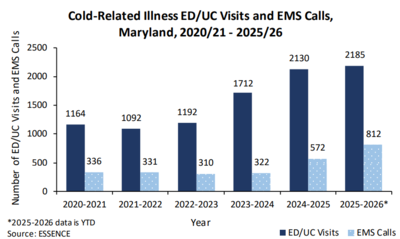
During the 2025-2026 cold season so far, there have been 2,185 emergency room or urgent care visits for hypothermia and other cold-related illnesses, another six-year high. Calls for emergency medical services are also at historic highs this year.
So far, 60 people have died from cold-related illnesses this year, only 15 fatalities behind last year’s record of 75 deaths.
While temperatures may begin to warm up soon, Mitchell says Marylanders should keep up safe practices for heat and gas-powered appliances during the remaining cold days of the season.
“Most effective means of preventing carbon monoxide exposure is not to produce it in the first place,” he said. That means using combustible items as intended – such as generators and charcoal grills outside, rather than bringing them into the house or garage.
“We always worry about things like people turning on their cars in their internal garages,” he said. “Because they shut the door, you will get carbon monoxide through the house as a result of that car running in a closed garage. Same thing with kerosene heaters.”
Mitchell also said that carbon monoxide detectors are “absolutely critical.”
“They should be in two locations … one is near the combustion source, because that will go off first, and then the other is in the living space,” he said. “Especially living spaces for people who are especially at risk, for example, the children’s bedroom.”
Lastly, he urges everyone to make sure their appliances are installed and ventilated properly. He noted that natural gas-powered dryers have led to carbon monoxide poisoning due to poor ventilation.
And if there is concern that there is a carbon monoxide leak, people should just leave the area, Mitchell warns.
“Opening windows, sticking your head out the window, leaving that space,” he said. “Those are critically important, because people can progress very quickly from a mild headache to unconsciousness to death.”

Annapolis, MD