Indiana committee advances crypto ATM ban, weakened pension investment bill
Feb 11, 2026 | 12:18 pm ET
Description
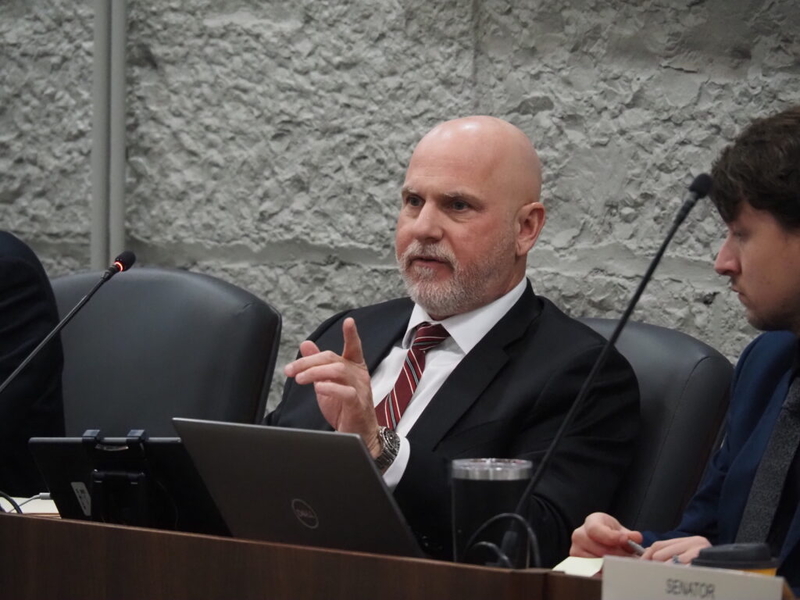
Sen. Scott Baldwin, R-Noblesville, leads a committee meeting on Wednesday, Feb. 4, 2026. (Photo by Leslie Bonilla Muñiz/Indiana Capital Chronicle)
Hoosier lawmakers on Wednesday pushed their attempt to regulate digital currency kiosks — commonly known as cryptocurrency ATMs — into an all-out ban. They also walked back legislation letting crypto into public pension investments.
House Bill 1116 previously would’ve required kiosk operators to get licensed, verify customers’ identities and operate under strict limits on transaction amounts and fees. Operators at last week’s hearing complained the measure would drive them out of business in Indiana, while law enforcement and retiree witnesses warned of the kiosks’ roles in devastating scams.
Now, crypto ATMs could be outlawed entirely — as soon as this month — if the legislation becomes law.
“We’re never in the business of putting anybody out of business. That’s not our goal here, in the state of Indiana,” said Sen. Scott Baldwin, R-Noblesville. But, he added, “I can think of no legitimate reasons, no substantial legitimate reasons,” to warrant the kiosks.
Indiana lawmakers consider crypto pension investments, ATM scam crackdown
“I think these kiosks have a strong propensity to be … havens for money laundering, and havens for tax evasion,” said Baldwin, who leads the Senate’s financial institutions panel.
Baldwin’s amendment, which was accepted in a bipartisan 7-0 vote, ditches the regulations in favor of banning the operation of crypto ATMs in Indiana.
Under the updated bill, operating a kiosk would be an illegal deceptive act. The state’s attorney general could sue the operator and the owner of the property on which the kiosk is located.
Courts could make violators forfeit the kiosks to the state, along with the amount of money collected from users. They could also be required to pay the attorney general all costs associated with the investigation.
Baldwin said he can “transfer money that I’ve paid taxes on into crypto” using his phone, “so I don’t want the crypto folks to think that we’re trying to kill crypto.”
The bill itself advanced in a 6-1 vote. It would be effective upon passage. Lawmakers plan to wrap up work this month, but the governor has several days to sign approved bills into law.
AARP Indiana, which advocates for Hoosiers 50 and older, cited scam victims in thanking lawmakers.
“The fraud occurring at these machines is not slowing down — in fact, it’s accelerating,” said Legislative Director Ambre Marr in a statement to the Capital Chronicle. “AARP is deeply concerned about the growing level of fraud committed through crypto kiosks, and we commend the General Assembly for actively seeking solutions and considering multiple ways to ensure older Americans are protected from having their life savings stolen instantly by thieves. We are grateful that lawmakers are paying close attention to this issue and are dedicated to addressing it.”
But operators professed “shock.”
One, Illinois-based CoinFlip, noted it’s been doing business in Indiana for eight years, generating “hundreds of thousands of dollars in tax revenue” for the state and paying more than $1.5 million in rent to kiosk hosts.
“We share the same consumer protection goals as Indiana’s legislature and have successfully worked with policymakers in 17 other states to pass smart, effective legislation that targets bad actors, without limiting responsible consumers’ access to the digital economy,” a spokesperson said. “We are shocked to learn that the state of Indiana would eliminate an entire industry based on a lack of understanding of digital assets and the services we already provide to 17,000 Hoosiers around the state.”
The committee also accepted an amendment to remove a key pension investing provision from House Bill 1042. It previously would have allowed the state to invest public retirement plan assets into crypto exchange traded funds.
“Frankly, we just need to work on it over this next year. That product is not doing extremely well,” said author Rep. Kyle Pierce, R-Anderson. “I do think if we’re going to allow one side to invest, the defined contribution side, we shouldn’t just leave the other side out to dry.”
The proposal still would allow members of certain plans to choose self-directed brokerage accounts offering crypto investment options. The committee discussed, at length, another amendment removing those provisions, but Baldwin decided not to call it.
“You have an individual choice” in that case, Pierce emphasized, as opposed to the plans for which the state handles investment decisions.
The panel advanced that bill in a 6-2 vote, along party lines. Baldwin said lawmakers would “continue to talk” and, if necessary, do another amendment on second reading.
Update: This article has been updated with statements from AARP Indiana and CoinFlip.

Indianapolis, IN