Maine considers shoring up rights for wrongfully detained immigrants
Feb 10, 2026 | 7:27 pm ET
Description
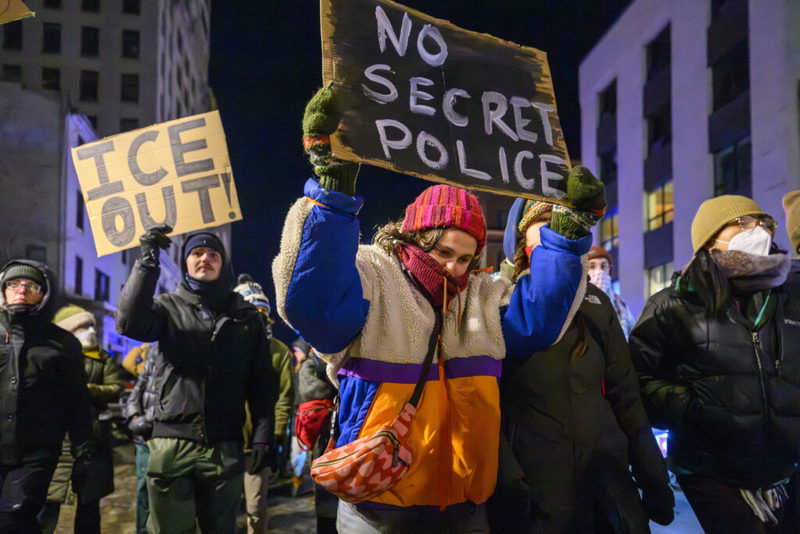
Rally on Monument Square in Portland in protest of ICE arrests of immigrants on Jan. 23, 2026. (Photo by Jim Neuger/ Maine Morning Star)
Maine lawmakers are considering shoring up a legal remedy for people who are erroneously detained, in response to numerous such occurrences during President Donald Trump’s second term so far.
“The simple concept we propose is that there should be consequences for bad behavior,” Senate Assistant Majority Leader Jill Duson (D-Cumberland) told the Judiciary Committee when introducing her bill on Tuesday.
LD 2176, which has nine Democratic co-sponsors, would execute that concept in two parts. First, it would specify that if someone is unlawfully detained during an immigration enforcement action, they can fight back to recover damages and attorney fees under the Maine Civil Rights Act. Second, it would provide $2 million to civil legal service providers who have expertise in immigration law and are representing people wrongfully detained by U.S. Immigration Customs and Enforcement.
“This one appropriation is a modest investment in protecting the rights and liberties of our most vulnerable neighbors,” Duson said. “The tactics we’ve seen used by federal immigration authorities in their enhanced enforcement operations, both in Maine and across the nation, breach the promise and spirit of our inalienable rights.”
Immigration arrests have been increasing since Trump began his second term, mostly of people without criminal convictions, but detentions became acutely visible last month when ICE launched a large-scale operation in the state.
While claiming more than 200 arrests during that surge, the Department of Homeland Security has provided little information about who they apprehended. Meanwhile, reporting has uncovered several examples of people detained despite following lawful immigration processes and having no criminal records.
While heightened enforcement appears to have subsided, it hasn’t stopped. That was made clear earlier Tuesday, when U.S. Customs and Border Protection conducted a raid of a bus transporting workers in Skowhegan. Witnesses reported 17-19 people taken into custody, according to the Maine Immigrant Rights Coalition.
In general, Maine’s community ICE watch hotline has seen an uptick in the number of calls from rural areas of the state.
“We worry this may indicate the start of a new phase of enhanced enforcement activity in the state that began with the surge in January,” said Mufalo Chitam, executive director of the coalition, which runs the hotline. “Suddenly, disruptive enforcement actions in communities like Skowhegan leave families, workplaces, and communities in crisis.”
The people detained are at the mercy of the Trump administration, which has been accused by federal judges of willfully disregarding court orders, violating due process and using prolonged detention as a tool to get people to voluntarily leave the country. The administration has detained U.S. citizens as well as reversed long-standing policy by detaining immigrants who don’t pose a danger to the community or a flight risk.
Effects linger, fear remains one week after apparent end of large-scale ICE operation in Maine
Duson said her bill “is not an attempt to undermine or abolish any law enforcement agencies,” but would rather “affirm that law enforcement officers must conduct themselves within Maine law.”
However, it currently has a glaring hole.
The bill creates a legal cause of action when there has been an “unlawful deprivation of personal liberty,” but it provides no definition for that term.
Some committee members and the Maine Department of Corrections raised concern about how broadly such a term could be applied, while Duson said she’d leave the specific definition up to the committee.
“It is unclear what a ‘deprivation of personal liberty’ is and who is determining if it was unlawful,” said Jill O’Brien, director of government affairs for the corrections department, testifying neither for nor against the bill. “It’s not clear if deprivation of liberty is limited to someone detained or arrested or if it would also apply to someone already serving a sentence in prison or jail. It’s also not clear if deprivation of personal liberty would apply to someone already in prison, whose privileges may be restricted as a matter of discipline.”
Few people testified during the public hearing, which was hours delayed due to long Senate and House chamber sessions, but no one spoke against it.
Pointing to the Legislature’s history of routinely clarifying the Maine Civil Rights Act to ensure that it serves its ultimate purpose, the American Civil Liberties Union of Maine said that the clarification the bill offers is vital because unlawful deprivation of a personal liberty is at the core of the writ of habeas corpus, the constitutional right that ensures people the right to challenge their imprisonment in court.
“This bill does not create new rights or expand the Maine Civil Rights Act,” said policy fellow Alicia Rea, on behalf of executive director Molly Curren Rowles. “It seeks to provide that clarity about how it operates so that courts, law enforcement and the public can understand what the remedies available are.”
As policy director of the youth-led Maine Youth Power, Eli Durand McDonnell regularly speaks with young people throughout the state. While priorities often range based on a given community’s needs, these days he said he’s heard a lot about the same issue: “fear of ICE’s violent immigration crackdown and the seemingly complete immunity with which they operate.”
Durand McDonnell said he and others in the group “need to see that our leaders are doing what they can to protect Maine residents and to protect our civil liberties, not just today but for generations to come. LD 2176 would create some of those protections.”
Augusta, ME