Whitmer signs off on school cell phone ban set for next fall
Feb 10, 2026 | 4:00 pm ET

Description
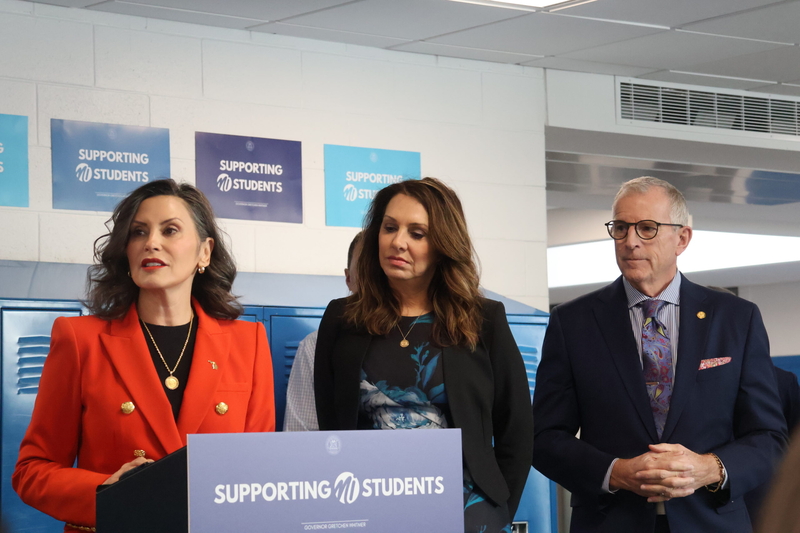
Michigan Gov. Gretchen Whitmer poses with students, educators and administrators after signing legislation barring students from using their cell phones during instruction time. Feb. 10, 2026 | Photo By Kyle Davidson/Michigan Advance
Marking off a priority that she first shared in her 2025 State of the State Address, Michigan Gov. Gretchen Whitmer put her signature to a set of bills to ban cellphones during instruction time in Michigan classrooms.
With control of the Legislature split between Democrats and Republicans, Tuesday’s bill signing marked a rare moment of bipartisanship amidst what has largely been a fraught legislative session.
Developed by Rep. Mark Tisdel (R-Rochester Hills) and state Sen. Dayna Polehanki (D-Livonia) House Bill 4141 and Senate Bill 495 require school districts to develop and adopt a policy banning the use of cell phones during instructional time and to set protocol for how and when students are allowed to use their phones during an emergency.

The ban would not apply to devices owned by the district, basic cell phones, district-owned devices, medically necessary devices, and devices used for special education accommodations and instructional uses at the teacher’s discretion.
The bills are a part of a multi-year effort for Tisdel, who first introduced a cell phone ban in 2024, and reintroduced the policy on the same day as the 2025 state of the state.
‘A world of difference’: Teachers, parents increasingly back cell phone bans in Michigan schools
“It takes a lot of time and effort and patience and a willingness to work together and to make some compromises and changes to improve the final product, and I think we’ve come out with a very good bill,” Tisdel said, noting that he was looking forward to seeing how the bill would impact student education in the upcoming school year when the ban is implemented.
Polehanki, who spent 20 years as a high school English teacher before her time as a lawmaker, said it’s difficult and disruptive for teachers to focus on lessons while monitoring phone use.
“Now we have the weight of a state law, you know, behind I think what everyone can agree upon is that cell phones don’t belong in the classroom during instruction,” Polehanki said.
She also noted that the law allows schools to implement stricter policies if they wish.
Alongside concerns of classroom disruptions, Whitmer noted that cell phone use can bring other concerns, including decreased attention spans, issues with cyberbullying, and increased cases of depression and anxiety stemming from excessive smart phone and social media use.
Most candidates for Michigan governor back bipartisan K-12 cell phone ban bills
She also acknowledged the state’s poor literacy ratings, with the state ranking 44th in the nation in fourth grade reading on the National Assessment of Educational Progress.
“I’m sure you all know that we’ve been falling behind when it comes to literacy, and I’ll have a lot more to say about this in my upcoming state of the state in two weeks,” Whitmer said. “Literacy is not just a Michigan problem, it’s a U.S. problem. It’s everywhere.”
While the state can make investments into new curriculums and teacher training, those changes won’t be effective if students aren’t paying attention, Whitmer said.
“Ending phone use during class time is common sense and is a step we need to take to fight back against addictive evolving technology that prevents kids from reaching their full potential,” Whitmer said.
Lansing, MI