Republicans push citizenship questions at hospitals as ICE enters medical facilities
Jan 27, 2026 | 9:39 pm ET

Description
Federal agents block in and stop a woman to ask her about another person’s whereabouts on Jan. 19, 2026, in south Minneapolis. (Photo by Nicole Neri/Minnesota Reformer)
Even as health care workers criticize the incursion of federal immigration agents in medical spaces as dangerous for patient welfare, Republican lawmakers in Arizona want to force hospitals to ask patients about their citizenship status.
The proposed legislation would require hospitals that accept Medicaid — virtually every hospital in the state — to include a question about a patient’s citizenship status on intake paperwork.
Similar laws in Texas and Florida have prompted people to delay critical care for fear of being detained, despite assurances from GOP lawmakers that answering is optional and no identifying information is shared with federal authorities. The Arizona proposal also makes answering voluntary, and prohibits hospitals or the state health department from collecting personally identifying information.
Rep. Ralph Heap, who sponsored the legislation, framed it as nothing more than a data gathering effort during a Jan. 26 hearing of the bill in the House Health and Human Services Committee. The Mesa Republican said it would help the state pinpoint exactly how much is spent on “undocumented care,” and help lawmakers identify ways to best support the hospitals that shoulder the costs.
Republicans have long relied on unfounded assertions that immigrants are draining publicly funded assistance programs, like Medicaid, to justify both anti-immigrant policies and more restrictive eligibility requirements. Last year, the Trump administration defended its decision to gut Medicaid, in part, by claiming without evidence that it aimed to disenroll millions of immigrants.
The truth is that undocumented people have almost no access to government-funded health care.
Federal law outright forbids undocumented people from receiving coverage under the low-income health insurance program and strictly limits when immigrants with legal status working towards naturalization can apply for Medicaid, which in the Grand Canyon State is called the Arizona Health Care Cost Containment System. Some states, like California, operate state-funded health care programs for eligible immigrants. Arizona is not among them.
For the most part, undocumented people rely on emergency rooms to get help. And research indicates that even that is used sparingly: Studies show that both lawfully present immigrants and those without legal status visit doctors offices and emergency rooms at lower rates than citizens. To comply with federal law that prohibits hospitals from turning patients away, Medicaid funding covers some emergency situations for uninsured people, including immigrants. The majority of that funding goes towards labor and delivery costs, and represents less than 1% of all total Medicaid costs.
Democratic lawmakers on the committee that considered the proposal to interrogate the citizenship status of Arizonans seeking medical help appeared unconvinced by Heap’s claim doing so is the most effective way to identify state costs.
Rep. Alma Hernandez, D-Tucson, posited that gathering information on how much uninsured medical care the state pays for might be more helpful, because immigrants number among the uninsured. The rate of uninsured Arizonans is higher than the national average. In 2024, 10.3% of people living in the Grand Canyon State had no health insurance, compared to 8.2% nationally.
Hernandez questioned the bill’s focus on citizenship status, saying it would only inspire fear among the state’s immigrant residents and convince them to stay home when they need help.
“Is there really no other way to get that data from uninsured individuals without having to ask someone whether or not they’re undocumented?” she asked.
But Heap was adamant that questioning a person’s legal status is an integral part of the data collection, because it’s important to identify the specific burden immigrants incur on hospitals. He pointed to a report from Texas officials that claimed $1 billion was spent last year in immigrant health care costs as proof that Arizona should look more critically at its own hospitals.
Experts, however, have accused the reports of failing to account for the number of people who refuse to answer potentially being citizens and not comparing its results with the total number of uninsured Texans. The state has the highest uninsured rate in the country.
Multiple health care worker groups lodged their opposition to the Arizona proposal, including the National Nurses Organizing Committee, which represents more than 150,000 nurses across the country; the Health System Alliance of Arizona, the largest hospital health system in the state; the Arizona Hospital and Healthcare Association, which advocates on behalf of of all the state’s hospitals; and the Maricopa County Medical County Association, the state’s oldest medical association.
Dr. Uzma Jafri, a local family doctor, attended the hearing to urge the committee to reject the bill. She warned that it would create a chilling effect among undocumented Arizonans and said she had already seen how detrimental anti-immigrant policies can be to health care during the aftermath of 2010’s SB1070, the state’s notorious “show me your papers” law.
“The same unit where I delivered up to 10 babies an hour dropped to three, sometimes none,” she said. “ICE vehicles were parked outside of the hospital to intimidate patients and absolutely impeded the care of women and babies.”
Rep. Nick Kupper, R-Surprise, waved away concerns that adding a question about citizenship to hospital intake paperwork could increase ICE enforcement activity near emergency rooms. There’s nothing that could be done, he reasoned, to prevent ICE agents from entering hospitals, and the questionnaire itself is separate from whatever enforcement actions they decide to engage in.
A day after Trump took office, he revoked a Biden-era directive that forbade ICE agents from carrying out arrests near “sensitive” areas, including churches, schools, courthouses and hospitals. Since then, agents have unnerved doctors and patients in New York City, Los Angeles and, most recently, in Minneapolis and St. Paul, where they’ve even gotten into shouting matches with staff over patient welfare.
While Republican legislators dismissed the fear that the bill could prompt ICE enforcement activity, similar concerns were raised during discussions of a near-identical proposal last year. Opponents at the time worried that the reporting requirements in the bill could eventually be used by ICE agents to identify which hospitals have the highest number of immigrant patients, allowing them to target patients.
The bill directs hospitals to compile a report of responses, including the number of people who reported noncitizen status or declined to answer, to the Arizona Department of Health Services every 30 days. The reports could not include any names or personally identifying information. The state health department, in turn, would be required to deliver an annual report to the governor and legislative leaders that aggregates the number of hospital admissions and emergency room visits by patients who either identified as undocumented or refused to answer and analyze the impact of undocumented people on hospitals.
Rep. Patty Contreras, D-Phoenix, said she is wary of compiling information about citizens that might later be weaponized by the Trump administration’s mass deportation campaign.
“With this administration, we just cannot trust that it will not go someplace else,” she said, while explaining her vote against the bill.
Last year, the Trump administration requested the personal data of Medicaid recipients across the country. Nearly a dozen states filed a lawsuit to block that request, but the courts have since greenlit ICE’s use of basic Medicaid information, like birth dates, addresses and phone numbers, to identify people who may be eligible for deportation.
With a party line vote of 7-5, the Republican-majority committee gave the bill the approval to be considered by the full House of Representatives.
It is likely to make it to the governor’s desk, but is destined to meet her veto stamp. Last year’s proposal also netted only Republican support and was quickly rejected by Gov. Katie Hobbs, who has been critical of anti-immigrant legislation, preferring to increase funding for law enforcement agencies and border communities over wading into immigration enforcement.
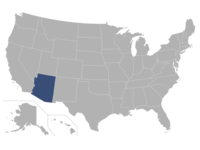
Phoenix, AZ