College presidents on corporate boards can draw schools into controversy. It happened at Clemson.
Dec 22, 2025 | 6:00 pm ET
Description
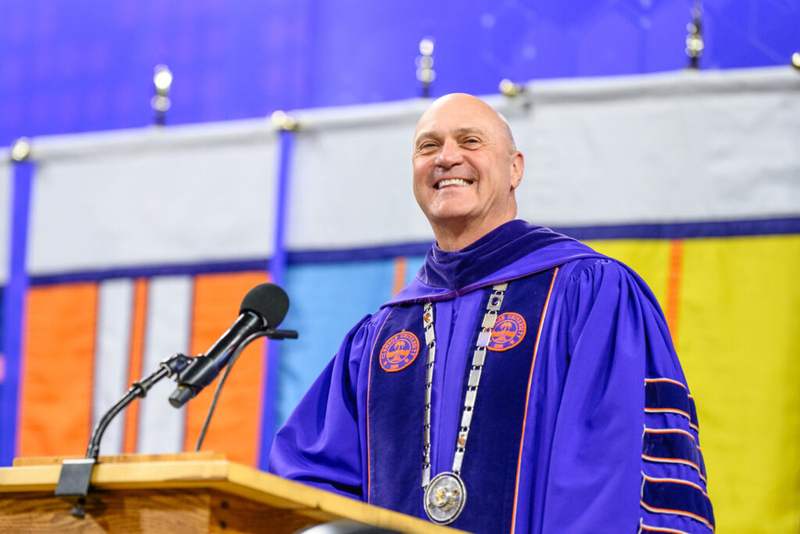
Clemson University President James Clements announced Dec. 9, 2025, that he's retiring after 12 years at the school's helm, effective Dec. 31. (Photo courtesy of Clemson University)
Clemson University’s soon-to-retire president, Jim Clements, stands out as the only South Carolina public college president to sit on a corporate board.
The chief executive of the Upstate college, until recently, sat on the board of two publicly traded companies: a homebuilding firm and a bank.
He’s been on the board of Greenville-based United Community Banks since 2020. It’s his seat on other one — United Homes Group, formerly Great Southern Homes — since 2022 that brought public questions about his role and a potential conflict of interest. He resigned in October, along with all but the company’s founder. Other board members who left the company included former Gov. Nikki Haley, who also sits on her alma mater’s board.
Combined, those jobs netted Clements as much as $484,000 in 2023 (the most in one year), largely in stock options, according to filings with the federal Securities and Exchange Commission.
That’s on top of his Clemson salary. He was set to receive up to $1.5 million annually in total compensation through 2031, as per his contract extension approved last year.
College presidents on corporate boards
But it’s not unusual for college presidents, of both public and private universities, to take positions on corporate boards.
Jim Finkelstein, a George Mason University professor who has researched corporate board work since the 1990s, conducted three surveys over the course of about a decade of the top 120 to 130 research universities in the country. His team consistently found between 35% and 40% of those schools surveyed had a president who served on a corporate board.
“These corporate board seats can be very lucrative,” he said.
Across the Southeastern Conference, at least six public college presidents held a corporate board position while leading their respective universities. That does not, however, include the University of South Carolina, the only Palmetto State school in the 16-member sports conference.
None of the presidents of public colleges in the Atlantic Coast Conference, which includes Clemson, appeared in a search of Securities and Exchange Commission records.
These outside relationships can sometimes blow back on the school when interests of the colleges and corporations collide, as Clemson and Clements found out this past fall.
Clements’ connection to United Homes drew criticism from members of the Oconee County Council when the company started pushing a large subdivision in the county, not far from Lake Keowee.
Council Chairman Matthew Durham argued United Homes and its founder Michael Nieri, a Clemson alumnus and large donor, were profiting off the Clemson area’s population growth driven, at least in part, by the school.
“That’s one of the dangers of presidents serving on corporate boards,” Finkelstein told the SC Daily Gazette. “When corporations get into trouble, the president of the university becomes involved.”
For example, former Ohio State University President Gordon Gee was drawn into the legal troubles of coal miner Massey Energy Co. following a 2006 fire that killed two men at one of the company’s West Virginia mines.
Gee resigned from the mining company board in 2009. At that time, he held 28,000 shares of company stock and had been paid about $219,000 for his work on the board.
And in 2016, two University of California campuses received criticism following reporting of conflicts at the top. In San Francisco, the CEO of the medical school’s hospital sat on the board of a medical device company that earned millions in contracts from the hospital system. And at the Davis campus, the college chancellor also sat on the board of DeVry Education Group, a for-profit college operator.
Following those controversies, the California college system’s governing board started requiring chancellors to get approval before joining no more than two corporate boards.
What’s changed?
In the 1950s, Finkelstein said, college presidents earned far less than the contracts inked today. To help with recruitment of university leadership, corporations headquartered in college towns often offered up board seats to presidents to supplement their income and as a gesture of goodwill.
Today, Finkelstein suspects, companies are doing it because of the prestige a university president brings.
Rarely, he said, does a college president have expertise particular to those corporations.
Finkelstein said most of the college presidents he talked with as part of his surveys reported joining the boards as a way to build connections and fundraise. However, there is no factual proof that companies give more to the universities in return, he said.
“Where there is even an appearance that there might be some overlap between the university and that company, it can raise concerns with conflict of interest,” Finkelstein said.
Yet, beyond limiting the number of positions held and requiring prior approval, Finkelstein said college boards across the country have done little else to shut down the practice.
At the University of South Carolina, the president is expected to inform the Board of Trustees of any plans to join an outside corporate board, but there’s no specific policy, spokesman Jeff Stensland said. Neither President Michael Amiridis nor long-time former President Harris Pastides held board positions, according to filings with the state Ethics Commission.
Clemson, Coastal Carolina University, Lander University and Francis Marion University all go a step further: Clauses in their presidents’ contracts require permission of the college governing board. And those contracts stipulate that the outside board seats do not interfere with the president’s official duties.
Winthrop University and South Carolina State University have no stipulations.
The state’s other public universities did not respond to questions from the SC Daily Gazette.
Finkelstein said many colleges have policies requiring permission, but boards generally go along with a request.
“No one does a thorough check of whether the university is doing business with this company,” he said.
Development controversy
In the case of Clemson and United Homes Group, both the college and the company denied that the homebuilder benefited from the connection to the university or used it to put pressure on the county to approve development plans. United Homes Group even tried to distance itself from the project in statements to The Post and Courier, though emails included public records appear to come from company addresses.
The company had sought to build a mix of single family homes, apartments and a satellite Clemson location on 600 acres, located about 5 miles northeast of the school, near Newry Mill. An early marketing plan called for 5,200 housing units. But in a letter to the editor, one of the developers said a later plan came in at less than 3,200 units over a 20-year span.
From a string of emails provided in response to a public records request and published online by the council chairman, it does appear Clements sought to recuse himself.
“Because the President sits on the Board of Great Southern Homes’ parent company, he has asked not to be involved, however, does have an awareness of the opportunity,” the school’s vice president of external affairs and board advisor wrote in a January 2024 email to the president’s chief of staff, chief operating officer, chief financial officer and a member of the school’s real estate and development office.
Still, those members of the college’s senior management team interacted with the company over the course of at least a year, even flying on a company plane to tour a similar development near Purdue University in Indiana.
In another January 2024 email to Clemson’s vice president, members of United Homes Group staff wrote they considered the school’s participation “mission critical.”
After the trip to Indiana that month, Clemson staff met with employees of the homebuilding company on campus and at the Oconee County site at least four times later that year.
“Clemson is very interested in exploring the potential opportunity,” the school’s real estate vice president wrote in an April 2024 email.
Asked about the controversy, Clemson said last month it “routinely reviews economic development proposals.”
“At no point has the University provided funding for, partnered on or endorsed the planning or construction of any residential development related to this proposal,” reads the statement to the SC Daily Gazette and other outlets.
“As is standard practice, an administrative team conducted a preliminary review to assess the multi-use concept’s potential economic and community impact,” the statement continued. “After completing its due diligence, the University decided not to pursue the economic development initiative … Clemson values its longstanding relationship with Oconee County and remains focused on its mission of education, research, public service and statewide economic development.”
November 2024 is the last time Clemson staff met with the developers. It was at that meeting that the school stepped away from the proposed project.
Resignations
Then, in October 2025, the entire board of United Homes Group, including Clements and Haley, resigned after Nieri refused to step down as executive chairman and the company’s stock bottomed out. Three board members signed a letter saying “existing management team is better suited to help the Company navigate the current market environment and address the Company’s operational challenges without Mr. Nieri serving as Executive Chairman.”
Clements and Haley each submitted separate resignations. Both cited a desire to focus on their professional obligations.
Less than two months later, Clements surprised the public with an unexpected announcement he would retire at the end of the year. The board appointed Provost Bob Jones as interim president as it begins a national search for a new chief.
Clements remains on the board of United Community Banks. A company spokesperson said the company was unable to meet the Gazette’s deadline for a comment on his role there.
“As Clemson University selects and transitions to a new president, the Board of Trustees is conducting a thorough review of leadership expectations and governance practices,” a statement from the school reads. “This review includes evaluating policies related to service on corporate boards.”
Meanwhile, Clements, age 61, has opted to take a sabbatical, which can last up to one year, and return to teach at Clemson.
Under the terms of his contract, he will continue to draw his $1.2 million presidential salary for a full year, regardless of how long his sabbatical lasts. After that he will be a fully tenured professor in the college of engineering and receive a salary equal to the average of the university’s three highest-compensated faculty members. That could top $450,000 annually, according to the online database of state-paid employees in South Carolina.
Clemson maintains Clements’ retirement is not in any way related to his positions on the corporate boards.
Editor’s note: This article has been updated with additional information from a letter dated Dec. 22, 2025, from Clemson University to members of Oconee County Council.
Columbia