Maine considering more ways to push back on Trump’s deportation agenda
Dec 19, 2025 | 4:46 am ET
Description
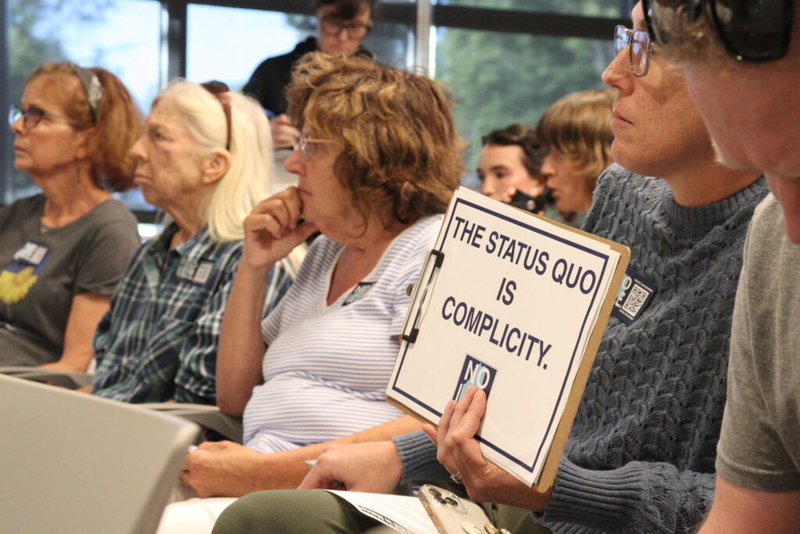
About 120 people attend the Cumberland County Board of Commissioners meeting on July 21 in Portland to urge the county jail to stop housing people for federal immigration authorities. (Photo by Emma Davis/ Maine Morning Star)
While commending the passage of a law to limit local involvement in federal immigration work, lawmakers and immigrant rights groups say those restrictions are vital but only one step in guarding against rights violations in Maine.
When the Maine Legislature’s next session begins in January, lawmakers are slated to take up new proposals focused on protecting against erroneous detentions, preventing immigration enforcement in places like schools and hospitals, and clarifying language to ensure jails can refuse to detain people on behalf of federal authorities.
Originally proposed in collaboration with the restrictions that passed, another bill that seeks to limit local-federal collaboration by banning official contracts with federal immigration authorities will also be returning.
While immigration is a federal matter, states have tried in various ways to intervene since President Donald Trump began his second term and launched a mass deportation agenda, with federal agents using aggressive tactics to meet record arrest numbers and in some cases bypassing due process.
Some states have expanded local authorities’ ability to assist in the president’s effort, while others have limited it.
Maine joins the latter after Gov. Janet Mills announced earlier this week that she will allow a new law that sets specific restrictions on when local authorities can collaborate with federal immigration agencies.
But there are also other ways lawmakers and advocates are pushing for the state to set limits, including shoring up individuals’ rights against possible violations by federal entities and challenging the current use of jails to house immigration detainees.
“Our ultimate goal is not having pockets of protection,” said Crystal Cron, founding director of the mutual aid organization Presente! Maine, which is helping craft one of the new bills, “but knowing that we are truly safe in this state that we call home.”
New proposals
During Trump’s second term, there have been instances of people being erroneously detained and deported. A proposal from Senate Assistant Majority Leader Jill Duson (D-Cumberland) seeks to prevent that from occurring in Maine by creating a right to emergency review.
“The way that federal immigration enforcement has been conducting itself has been extremely concerning to my constituents in Portland and people across Maine,” Duson said. “My goal with this proposed bill is to protect public safety, require due process and respect individual rights. I firmly believe that these three things can be true at the same time.”
Duson’s proposal, the text of which is still in the works, aims to use the state judicial system to provide relief for people lawfully present in the U.S. who have been swept up by immigration authorities.
“There is a lot of concern that federal immigration enforcement is more focused on meeting quotas than protecting constitutional rights,” Duson said. “Regardless of where you stand on immigration issues, I think we can all agree that no hard-working person who stops at the Home Depot or drops their kid off at school should be disappeared from their family and wrongfully held in custody.”
In September, a parent was detained by U.S. Immigration and Customs Enforcement after dropping off their child at a Portland elementary school.
Among the many changes the Trump administration has made to immigration enforcement was revoking the “sensitive locations” policy, which previously protected certain areas — such as schools, hospitals and places of worship — from immigration enforcement.
One of the new proposals Maine lawmakers will consider next session targets that change.
A bill sponsored by Rep. Ellie Sato (D-Gorham) seeks to add state level protections in those scenarios. Like Duson’s bill and other new legislation, the text of this proposal titled, “An Act to Improve Constitutional Protections Against Unreasonable Search and Seizure in Public Schools and Public Health Facilities,” is currently being drafted.
Sato declined to comment on the details of her proposal at this time, but other lawmakers and immigrant rights advocates described it as a key priority.
The session that begins in January is the second year of the state’s two-year legislative cycle. Legislation in the second session is limited to budgetary matters, bills from the governor, and proposals considered emergency in nature by the Legislative Council, which is composed of the ten elected members of legislative leadership.
Legislative leaders rejected a proposal from Rep. Grayson Lookner (D-Portland) that sought to prohibit law enforcement from wearing masks that conceal their identities. Across the country, immigration agents have been seen wearing masks during raids and while detaining people, which had generally not been seen previously.
Another of the new bills accepted targets a particular nuance in state law that has come up in debate over whether Maine jails are required to hold people on behalf of federal immigration authorities.
Split over views on immigration detention, Cumberland County commissioners postpone vote
Unlike many other states, Maine doesn’t have a dedicated ICE facility, which means local jails are relied on for detentions. Since the spring, the public has been calling for the Cumberland County commissioners to cancel the county jail’s contract with the U.S. Marshals Service. It’s been in place since 2010, paying the county $150 per day per federal detainee.
Over the summer, the Maine Department of Corrections issued a memo stating that their interpretation of current law is that Maine jails must hold people for federal law enforcement officers. This statute has also been cited by Cumberland County Sheriff Kevin Joyce when contending that he’d still be obligated to hold immigration detainees regardless of what happens with the contract.
“That’s been one of the biggest barriers for our commissioners — doubts about whether action at the county level will even carry weight,” said Cron with Presente! Maine, whose organization has been a part of the group calling for the board of commissioners to terminate the agreement.
Bill sponsor Sen. Rachel Talbot Ross (D-Cumberland) did not respond to requests for comment, but Cron said Presente! Maine is helping craft the legislation, which she hopes will demonstrate that the original intent of the law was not to obligate jails to hold detainees on immigration offenses.
During commission meetings, some have argued ending the contract would only result in people being detained farther away from their family and legal counsel. But Cron argues that thinking is flawed.
As Maine Morning Star reported back in April and attorneys say remains the case, the majority of immigration detainees in Cumberland County Jail are not residents of nor were they arrested in Maine. Most were transferred to the facility from out of state, and they are often quickly transferred out, too.
Federal authorities may move people for any number of reasons — space, staffing — but legal experts say regardless of intent, this movement creates chaos and makes it more difficult for legal counsel to advocate for their clients and for families to keep in touch.
That is the broader system Cumberland County Jail is a part of, Cron said.
“We’ve heard a lot of language about, ‘Oh well, my hands are tied’ and ‘this is the way things are done,’” Cron said. “As community members, as lawmakers, we need to work together to figure out how to make policies and laws align with our values and what we will allow within communities, and not the other way around.”
Returning proposal
Two of the most hotly debated bills last session were introduced in tandem, offering a two-pronged approach to prevent local and state police from taking on the work of federal immigration enforcement.
LD 1971, now slated to become law, set limits regardless of formal partnerships with federal authorities. The other, LD 1259, would explicitly prohibit state and local law enforcement agencies from entering into contracts with federal immigration enforcement authorities, such as 287(g) agreements.
“This win for LD 1971, this promise that it will go into law is absolutely a vital step. It’s a huge win,” said Rep. Ambureen Rana (D-Bangor). “But, there is still work to be done.”
Rana, the sponsor of LD 1259, says her bill is still needed. She plans for it to remain the same, though noted she’s open to adjustments as long as its intention isn’t altered.
Elsewhere in the country, participation in ICE’s 287(g) program has been growing since Trump revived it to bolster ICE’s capacity by deputizing local police officers to detain immigrants, an authority otherwise generally reserved to federal authorities. The program was discontinued in 2012 due to the discovery of discriminatory practices such as racial profiling.
GOP lawmakers in Maine attempted to make it illegal to restrict compliance with immigration enforcement earlier this year, but that proposal failed.
Wells Police Department was the only Maine agency that opted to join, but the department later ended its contract in October after continuous public opposition.
Absent official agreements, police in Maine have still looped federal immigration authorities into routine work, such as traffic stops, which have resulted in drivers, passengers and people who later arrived at the scene being detained for alleged immigration violations.
Augusta, ME