Feds drop appeal in SNAP shutdown case as lawsuit continues in Rhode Island
Dec 08, 2025 | 3:30 pm ET
Description
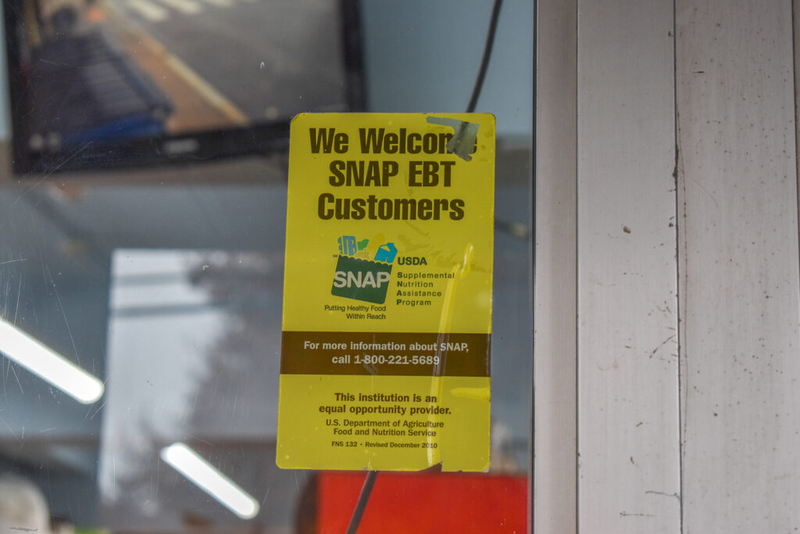
A sticker welcoming SNAP recipients seen on the door of La Familia Meat Market in Providence’s Silver Lake neighborhood. (Photo by Christopher Shea/Rhode Island Current)
Boston’s First Circuit Court of Appeals on Friday dismissed the Trump administration’s appeal of a Rhode Island judge’s Nov. 6 order directing the U.S. Department of Agriculture (USDA) to fully fund the Supplemental Nutrition Assistance Program (SNAP) while the federal government remained closed.
The call to drop that appeal was made by the administration itself, according to the two-page judgment.
A USDA spokesperson declined to comment, citing ongoing litigation for Rhode Island State Council of Churches v. Brooke Rollins still before Chief Judge John J. McConnell in Providence. The spokesperson referred additional inquiry to the U.S. Department of Justice, which did not immediately respond to request for comment.
The 43-day federal government shutdown ended on Nov. 12. Even before the president signed the package ending the longest shutdown in U.S. history, the USDA promised federal food benefits would resume within 24 hours of the government reopening. The administration then withdrew its request that the U.S. Supreme Court halt McConnell’s order requiring full food stamp payments.
“The case was dismissed because of the government reopening,” Democracy Forward Press Secretary Amahree Archie, whose national group represented some of the 20 plaintiffs in the case, confirmed Monday morning.
But that does not mean the overall lawsuit against the Trump administration is moot, said Kevin Love Hubbard, an attorney representing the plaintiffs for the Lawyers’ Committee for Rhode Island representing the plaintiffs .
Hubbard said the lawsuit targets the administration’s attempts to revoke waivers that existing SNAP recipients have from new work requirements mandated under the One Big Beautiful Bill Act.
McConnell on Oct. 31 issued a temporary restarting order (TRO) demanding that all previous work requirement waivers must remain valid after their initial termination.
Waivers had allowed states and municipalities to show USDA evidence that certain areas had limited job opportunities, exempting people from work requirements necessary for food assistance. The lawsuit notes plaintiff cities of Providence, Central Falls, and Pawtucket each received waivers in March 2025 that were valid through Feb. 28, 2026.
“We’re in the posture where the existing TRO remains in place on the waivers question while the federal government figures out what they want to do,” Hubbard said. “The question is whether they’re going to continue to litigate and convince Judge McConnell not to issue more permanent relief on that front.”
The Trump administration chose not to tap into contingency funds to continue SNAP benefits during the shutdown. But after the coalition of communities and nonprofits filed suit in Rhode Island, McConnell gave the federal government two options: Cover partial benefits through a $5.5 billion contingency fund or other reserves, or pay for a full month tapping into additional revenue sources such as the Child Nutrition Program.
The USDA initially chose the latter option. But McConnell issued a clarifying order to fully fund the program, which the administration then appealed in Boston and before the U.S. Supreme Court.
The Republican-led legislative package that reopened the federal government fully funds SNAP, and children’s nutrition programs, including subsidized school breakfast and lunch, and the availability of food during summer school breaks.
In addition to the three Rhode Island cities, the named plaintiffs include national groups and cities such as Baltimore; Columbus, Ohio; Durham, North Carolina; New Haven, Connecticut; and Albuquerque, New Mexico. The Dr. Martin Luther King, Jr. Community Center in Newport, East Bay Community Action Program, United Way Of Rhode Island, Federal Hill House Association and Amos House are also plaintiffs.
Providence, RI