R.I. federal judge orders Trump to fully fund SNAP; USDA wastes no time filing appeal
Nov 06, 2025 | 5:11 pm ET
Description
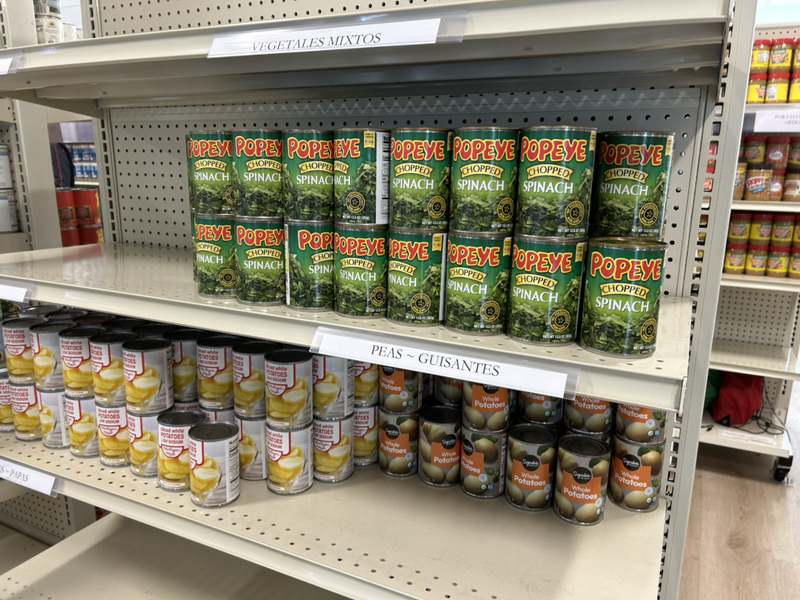
Shelves of canned goods await clients before the opening of the food pantry at the Dr. Martin Luther King Jr. Community Center in Newport on Thursday, Oct. 23, 2025. (Photo by Janine L. Weisman/Rhode Island Current)
The U.S. Department of Agriculture (USDA) must use available contingency funds and other allocated emergency subsidies to restore the full $9 billion in November food stamp benefits by Friday, a Rhode Island federal judge ruled Thursday.
An hour later, the USDA filed a notice to appeal McConnell’s decision.
Chief Judge John J. McConnell, Jr. expressed his displeasure with President Donald Trump’s administration for its failure to comply with his Oct. 31 order to pay for partial Supplemental Nutrition Assistance Program (SNAP) benefits using emergency money during a Zoom hearing.
But in court filings, Patrick A. Penn, USDA’s Deputy Under Secretary, had argued that making partial payments would result in weeks, if not months, of delays.
“If that continued to be the case, then the administration was required under this court’s order to immediately make the full payment for November SNAP benefits considering the finding that irreparable harm would occur,” McConnell said.
“Just to be clear, irreparable harm means harm to families, elderly and children and others that cannot be undone. The evidence shows that people will go hungry, food pantries will go empty and needless suffering will occur. That’s what irreparable harm means.”
About 42 million people who receive SNAP benefits, including 145,000 Rhode Islanders, have been without benefits since Nov. 1, as the ongoing government shutdown leaves the program unfunded.
“Last week, SNAP benefits lapsed for the first time in our nation’s history,” McConnell said. “This is a problem that could have and should have been avoided.”
On Oct. 30, a coalition of cities and nonprofit organizations filed a lawsuit against USDA Secretary Brooke Rollins to force the government to pay SNAP after November funding dried up. The Trump administration had refused to use contingency funding to keep SNAP funded, something his administration did during his first tenure in 2019.
The USDA filed its appeal of McConnell’s decision shortly after 5 p.m., a little over an hour after the hearing ended, in Boston’s U.S. Court of Appeals for the First Circuit.
McConnell filed his written order around 6:15 p.m.
‘A state problem’
At the start of Thursday’s hearing, McConnell gave both parties 15 minutes to rehash their arguments in court, but most of the half-hour long hearing was consumed by the judge’s own arguments that the federal government had betrayed the terms of the order he issued from the bench Oct. 31 and in writing a day later.
The feds had two options: Fund SNAP fully for the month of November, or “expeditiously resolve the administrative and clerical burdens” that would block payments from going out later than Wednesday, McConnell’s original order prescribed.
The number of viewers watching the court’s livestream on YouTube climbed steadily upward over the half-hour, from about 261 to 570, coinciding with an increasing sternness from McConnell. Early in the hearing, McConnell noted that neither his staff nor Tyler Becker, the U.S. Department of Justice attorney, were getting paid during the shutdown. But McConnell’s patience lessened and at one point he told Becker to “time out.”
Becker maintained from last Friday’s hearing that the issue was one which hinged on funding. “This all comes from Congress not having appropriated funds” for SNAP, he said.
“This is a state problem,” Becker said about states’ inability to get the partial SNAP funds out on time, and he noted that states were parties to a lawsuit in Massachusetts’ federal court, but not this case, Rhode Island State Council of Churches vs. Brooke Rollins.
While McConnell said he did not think the feds had acted “in bad faith,” he added, “Nothing was done consistent with the court’s order to clear the way to expeditiously resolve it. Maybe it’s a state problem, maybe not.”
Whether the responsibility fell upon states or not was irrelevant to the harm that would come to hungry people, McConnell said.
“It’s likely that SNAP recipients are hungry as we sit here,” he said.
McConnell cited Trump’s social media post on Tuesday saying he would cut off all SNAP benefits unless U.S. Senate Democrats voted to reopen the government.
USDA previously said on Monday it would partially subsidize the program, but states were left to calculate a new funding formula for partial benefits. On Tuesday, the feds first erroneously cited that it would furnish recipients with 50% of their typical benefits; new court filings a day later stated up to 65% of full benefits would be funded.
Additionally, USDA’s guidance Tuesday noted that 30% of a household’s net monthly income would be subtracted from the reduced benefit allotment. That would have resulted in some recipients receiving no benefits at all. The additional layer of number crunching also meant states were slowed in their attempts to dispense benefits.
Minutes before the hearing, Gov. Dan McKee announced that state officials threw away their calculations for partial SNAP payments ordered by the courts last week and started over after receiving new guidance from the Trump administration late Wednesday night.
“Despite these ongoing changes from the USDA, our team at the Rhode Island Department of Human Services is working urgently to complete calculations in compliance with the latest federal guidance,” McKee wrote.
McConnell said because the government did not “expeditiously resolve” the stemmed flow of benefits that came from having to set up partial payments, USDA will need to make the full payments by Friday. The money will come from the existing contingency fund available for SNAP — which, in its partial satisfaction of the request, the agency said it could not exhaust — plus money from Section 32, a flexible USDA fund that has also been used to sustain the Special Supplemental Nutrition Program for Women, Infants, and Children (WIC) during the shutdown.
The feds had argued that use of Section 32 would deplete the money for Child Nutrition Programs, but McConnell countered and said that, even if $4 billion was diverted to SNAP for the month of November, there would still be enough money to fund the Children’s Nutrition Program through “May and beyond” of next year.
“After creating this SNAP crisis, President Trump and his administration continue to present states with unnecessary barriers in implementing these critical benefits swiftly,” McKee said. “These funds should have been released long before the court order, with a single, straightforward set of guidance that ensured recipients received the maximum benefits possible.”
Four reasons why
McConnell outlined the four reasons why the federal government had been “arbitrary and capricious” in its fulfillment of his first order.
First, the government knew that partial payments would cause delays, he said — that contradicted a resolve to get the payments out in an expedient fashion.
Second, the feds had conflated Section 32 funding with Child Nutrition Programs, which are not the same, McConnell said, and third, the feds’ arguments that SNAP would eliminate funds for child nutrition was mathematically wrong.
“It is also implausible that such a transfer would be a permanent loss,” McConnell said.
Child nutrition also played into McConnell’s fourth reason. The feds had invoked such rationale in an “entirely pretextual” way, McConnell said, citing Trump and his administration’s own public statements regarding the political motivations behind the refusal to release funds.
Hunger response
The SNAP case provoked a strong reaction from Lt. Gov. Sabina Matos, who has spearheaded multiple pieces of grocery legislation in recent years.
“President Trump’s lawyers couldn’t defend his illegal hoarding of SNAP benefits, and the court has affirmed that there are funds available that the administration is choosing not to use,” Lt. Gov. Sabina Matos said in a statement Thursday afternoon, prior to the court hearing. “Now, they’re fighting in court to distribute as little money as they can to hungry families. We need to unite as Rhode Islanders and reject these appalling displays of greed.”
Matos noted that there are over 900 retailers in Rhode Island who rely on SNAP, which includes nearly 200 locally-owned grocery stores. SNAP money can account for “as much as 60% of food sales in low-income areas,” she added.
“On average, those businesses redeem $25 million each month in benefits,” Matos said. “That money has simply disappeared from our local economy.”
Matos encouraged SNAP retailers to share data with her office, which is gathering data amid what she called the “truly unprecedented” cessation of SNAP benefits. She said she is concerned about the effect the loss of SNAP may have on Rhode Island’s retail grocery market, which is among “the least competitive” in the nation.
Meanwhile, the Rhode Island Community Food Bank, which distributes food statewide across a network of 137 affiliated pantries and other agencies, has raised an additional $1.2 million atop its normal budget, according to spokesperson Kate MacDonald.
The organization has also purchased an additional 991,000 pounds of food to be distributed to its member agencies in the coming weeks, MacDonald added.
The United Way of RI’s helpline for food assistance has recorded a 150% increase since October, according to spokesperson Michael J. Cerio.
The Rhode Island Foundation, the state’s largest philanthropic outfit, announced Thursday ahead of the hearing that it has begun distributing the $1 million it pledged last month to seven community action program agencies across the state which provide food to people. It is also distributing $150,000 via its Basic Human Needs grants.
Lindsey Haynes-Maslow, a professor of health policy and management at the University of North Carolina at Chapel Hill, advised in a press briefing Thursday on SNAP that recipients load up on non-perishable items amid the uncertainty.
“I would start recommending, as much as you can, be stocking up on non-perishable foods: Canned goods, frozen items,” Haynes-Maslow said. “I get really concerned just looking at my calendar…Thanksgiving is in a few weeks from now. This is a huge time when our charitable food system is already overwhelmed.”
Editor-in-Chief Janine L. Weisman contributed reporting to this story.
- 6:37 pmUpdated to include appeal filed by USDA in Boston, McConnell's written order, and reactions.
Providence, RI