SC’s state utility enters negotiations on deal to restart failed nuclear project
Oct 24, 2025 | 6:25 pm ET
Description
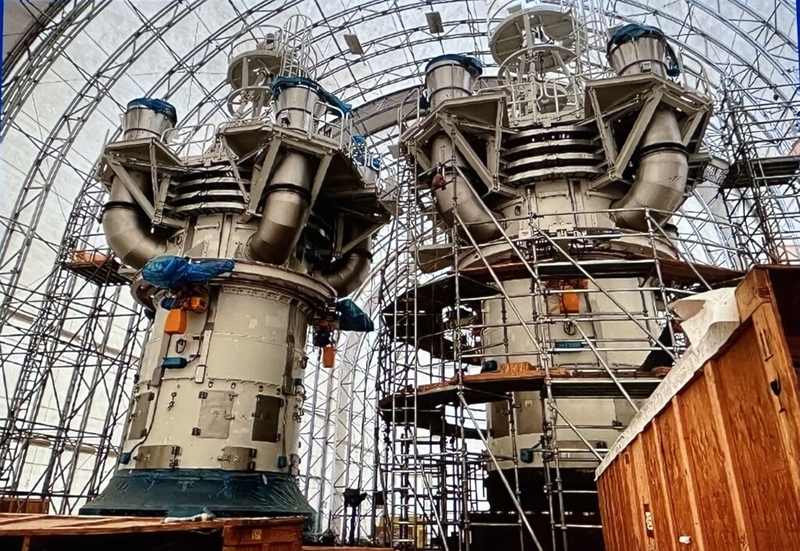
Nuclear reactor assemblies pictured Sept. 12, 2024, in storage at V.C. Summer nuclear site near Fairfield. (Photo courtesy of S.C. Nuclear Advisory Council)
COLUMBIA — South Carolina’s state-owned utility is entering negotiations with a New York investment firm to finish partially built nuclear reactors abandoned eight years ago.
Santee Cooper’s governing board voted unanimously Friday to allow the power company’s management team to officially begin negotiating with Brookfield Asset Management on an agreement to restart construction of the failed expansion project at the V.C. Summer nuclear plant in Fairfield County.
Brookfield, which boasts a $1 trillion global investment portfolio, was among more than 70 companies to express interest after Santee Cooper put a call out nine months ago. It was a partner on one of 15 proposals Santee Cooper ultimately reviewed.
Negotiations will continue over the next six weeks, CEO Jimmy Staton said. Santee Cooper will name the other partners on the project at a later date.
Santee Cooper did not make public the potential terms of the deal, expected to be valued in the billions.
But Staton said Santee Cooper would use any cash proceeds it may earn from the agreement to pay down debts still owed on the abandoned nuclear facility. Customers could also benefit from the power the reactors would produce if finished.
In June, Staton told the Daily Gazette customers shouldn’t expect to see the debt come off their power bills, but his earlier predictions have changed.
“I feel pretty confident that our customers will realize some fairly significant value, both rates wise and otherwise, in this process,” Staton told reporters after Friday’s meeting.
Santee Cooper and the now defunct South Carolina Electric & Gas started construction on the two first-of-their-kind nuclear reactors alongside an existing unit near rural Jenkinsville in early 2013. But the project was riddled with delays, cost overruns and fraud that led to multiple federal convictions of former executives.
Final executive punished for VC Summer failure to spend at least 10 months in prison
The utilities abandoned the plant’s expansion in 2017, but not before jointly spending $9 billion on the reactors that never produced a single megawatt.
Santee Cooper’s share of the debt was $3.6 billion, which customer continue to pay for on their monthly bills. Those payments could continue, in part or in full, through 2032, depending how much money Santee Cooper can secure for a buy down in any final deal with Brookfield.
If the two companies manage to ink a contract, Staton pledged that Santee Cooper customers will face no new costs associated with the project. All of that will be borne by Brookfield, as well as big tech companies, such as Google or Meta, that could buy the nuclear power a finished plant would generate.
“We’ve protected the rate payers of South Carolina, and quite frankly, I think we’ve shifted the paradigm of how nuclear energy gets built here in the United States,” Staton said.
After the firms mothballed the reactors eight years ago, SCE&G’s parent company, SCANA, collapsed. The reactors’ designer, Westinghouse, spiraled into bankruptcy.
Virginia-headquartered Dominion Energy bought up SCANA.
Dominion is not part of the deal, so it won’t at all pay down debt saddled to its 800,000 South Carolina customers. They’ll continue to pay over the next 14 years for $2.3 billion worth of debt from the abandoned expansion.
Here’s how much SC power customers are still paying for a failed nuclear project
And it was Santee Cooper’s potential new partner, Brookfield, that took over Westinghouse in 2018.
To restart construction, Santee Cooper and Brookfield will need to find a construction firm. Westinghouse, which remains a part of Brookfield’s investment portfolio, won’t be the builder this time, Staton said.
It will take a year or more of due diligence, licensing and permitting before any construction on the inactive plants can restart, Staton added.
Among the funds Brookfield manages is a portfolio focused on clean energy and decarbonization. Earlier this month, the firm announced it had raised $20 billion for the effort.
The move to restart V.C. Summer follows calls by Gov. Henry McMaster earlier this year for a “nuclear power renaissance” in the state.
Sen. Graham on SC’s proposed nuclear reboot: ‘We’re going to finish these reactors’
And U.S. Sen. Lindsey Graham of South Carolina has vowed his support for the effort, which will ultimately have to make its way through the federal regulatory process.
Staton also pointed to a May executive order signed by President Donald Trump, which calls on the Department of Energy to prioritize approvals for 10 large-scale nuclear reactors under construction by 2030.
“South Carolina is going to have number one and number two in that process,” Staton said. “You have placed South Carolina in the epicenter of the resurgence of nuclear in the United States.”
Still, nuclear power projects are expensive and take years to complete.
Vogtle Electric Generating Plant, operated by Southern Co. in Georgia, started construction around the same time as V.C. Summer. Work on the expansion wrapped up last year. Today the site is the nation’s largest nuclear plant, with four reactors.
But adding the two newest reactors cost more than $30 billion, more than twice the initial estimates.
Columbia