Apple Pickers Are Still Waiting for Promised Union Protections
Oct 01, 2025 | 11:19 am ET
Description
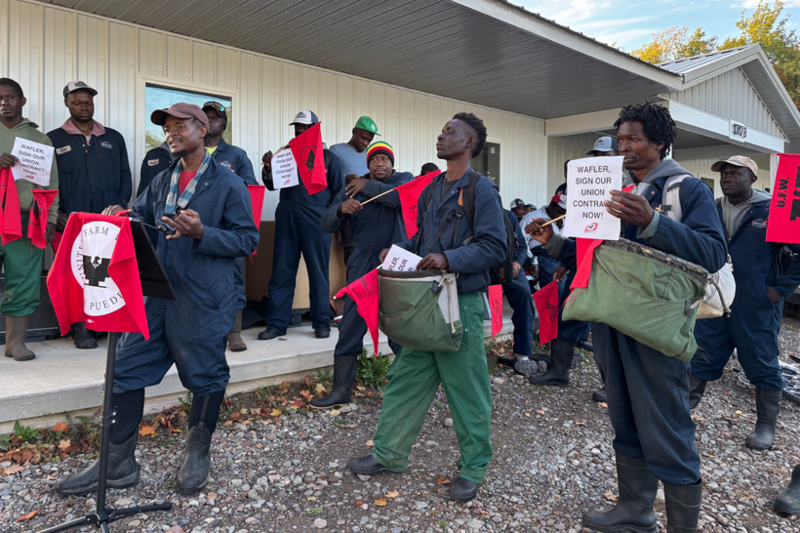
Workers at a September 23 press conference urging Wafler Farms to sign their union contract waved red flags displaying the United Farm Workers logo and its characteristic black eagle. / Julia Rock
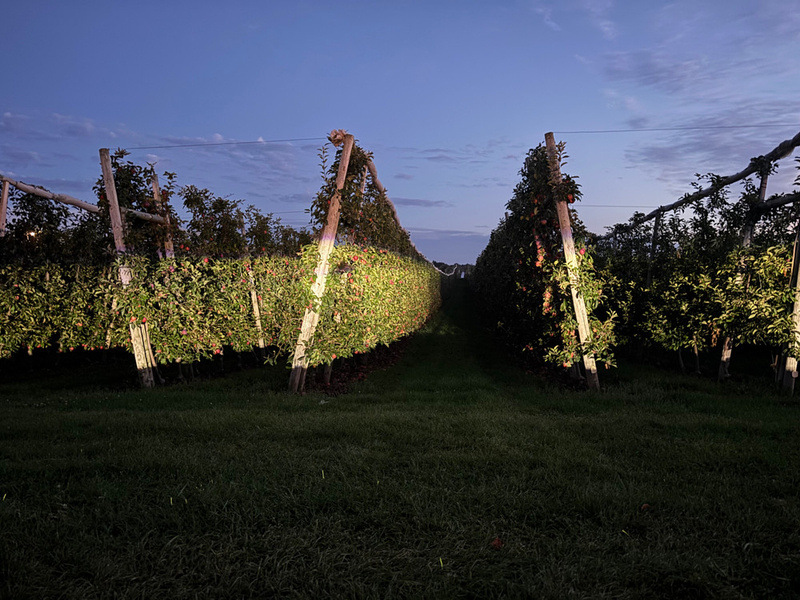
As the sun began to set last Tuesday over long rows of apple trees on Wafler Farms in Wolcott, near Lake Ontario, workers wearing rain boots and coveralls and carrying canvas baskets returned from the fields to a cluster of bunkhouses.
Dozens gathered in front of one of the houses, chatting and passing around red flags displaying the United Farm Workers logo and its characteristic black eagle. A few workers held up flyers that read: “Wafler, sign our union contract now!”
A state-appointed arbitrator imposed a union contract at the farm five months ago, at the beginning of the growing season. Workers had just arrived from Jamaica to plant saplings, and thought the new contract would grant them higher pay, benefits, and job security.
Now, the apple harvest in New York is reaching its peak, workers will return home in November, and Wafler Farms still isn’t following the contract. Instead, the farm sued to overturn it, and in July, a judge temporarily blocked the contract from taking effect while the suit proceeds.
“Imagine harvesting fruit that feeds America, yet being told that we don’t deserve the protections that are already written in law,” said Mario Ming, one of the farm workers, from a podium where everyone had gathered. “This is our reality.”
It’s Ming’s fourth season on the farm. Through a visa program called H-2A, he and the approximately 150 other men currently working there travel to Wolcott for part of the year from their homes in Jamaica.
Ming has two children back home. In Jamaica, he bakes cakes for a living, but the pay is far lower than what he earns in the United States. The H-2A program’s minimum wage is comparable to what skilled professionals such as nurse practitioners earn in Jamaica, he said.
But when he’s in Wolcott, he’s in the fields for nearly 11 hours a day, five days a week, plus half-days on Saturdays.
During those long days, workers walk up and down the rows of apples, followed by a machine that carries bins of picked fruit and sets a backbreaking pace. It monitors their work and notifies supervisors if they slow down or make mistakes. “They’re grading you while you’re picking,” Ming said: “If there’s a bruised apple, if there’s a stem on the apple, if there’s a leaf,” workers may be punished.
The port-a-potties in the field, Ming said, are in “deplorable condition.” Workers are afraid to speak up about issues like the risks of inhaling pesticides, which have sent some to the doctor.
“There is a culture of fear,” Ming said, but “if someone doesn’t speak up, it’s going to keep happening.”
Wafler workers unionized in 2022, a few years after New York granted farm workers the right to collectively bargain. Although their boss has fought them every step of the way, including suing to dissolve the union, workers were optimistic when they returned to Wolcott this spring with a new contract in hand.
But throughout the season, they continued to earn a below-contract wage, they did not receive retirement benefits, and the farm changed some working conditions — such as rules about clocking in for the day — without the union’s input.
The contract’s protections and benefits became even more critical after President Donald Trump made changes to the H-2A program this summer. His administration stopped enforcing Biden-era labor protections, including against retaliation, and proposed lowering the program’s minimum wage.
Owen, another worker, has been returning to Wafler for the past 10 years, but he’s recently been weighing whether it’s worth continuing. He asked New York Focus to use only his first name for fear of retaliation.
Recently, one longtime worker fell ill and had to return to Jamaica; without the retirement benefits outlined in the union contract, he went home “with no pension, with nothing,” Owen said. Workers who return season after season for years or even decades often have no retirement savings, a particularly hard blow because H-2A workers do not receive Social Security benefits.
Jacob Wafler, the farm’s co-owner, disputed the claim that workers have received medical attention for pesticide exposure, and he said that the farm’s port-a-potties are cleaned regularly. He also said the farm offers retirement benefits, but declined to answer a question about what they entail; the United Farm Workers said the farm has not responded to a request for information about the benefits.
Last week, another worker learned that his daughter back home in Jamaica had drowned. The worker wondered if he might have been able to save her had he been home and not in New York, Owen said.
“We leave our wives and kids at home in Jamaica to do this rejected job,” said Owen, referring to the fact that farm owners can only hire workers on H-2A visas if they first attempt and fail to hire US citizens.
“They would rather sue the union than give us the contract,” Owen continued. After this season, he said, sweat dripping from his forehead, “I don’t think it’s worth it.”
Albany