Don’t let Nevada’s wild highways close
Sep 30, 2025 | 7:59 am ET
Description
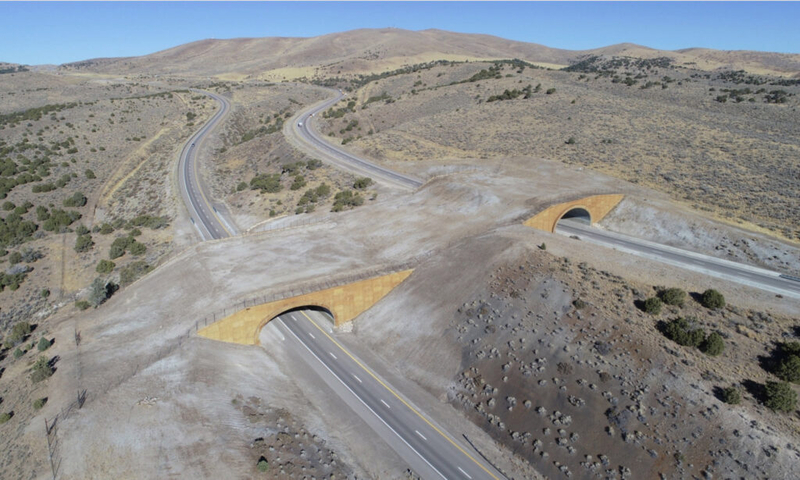
In 2019 the Nevada Department of Transportation won an award from the American Association of State Highway and Transportation Officials for wildlife overpasses at Pequop Summit on I-80 (NDOT photo)
In Nevada, migration is as old as the land itself. Long before highways and fence lines, mule deer crossed snowy passes, pronghorn streaked across sagebrush basins, and bighorn sheep traced rocky ridges in search of water. These movements are not just instinct. They are survival, woven into the fabric of our ecosystems.
That fabric is starting to tear. Highways slice through winter range. Fences hem in open basins. Housing tracts and mine sites rise where seasonal forage once grew. Ancient routes that kept wildlife, and the systems we rely on, alive for generations are disappearing.
The Nevada Department of Wildlife’s 2025 Statewide Wildlife Connectivity Plan is the most ambitious effort yet to stop that unraveling. It maps where animals move, identifies the barriers in their way, and lays out how to restore the broken links. It is grounded in science, rooted in collaboration, and, if fully funded and acted on quickly, capable of reversing years of fragmentation.
Connectivity is not just about wildlife. It is about clean water from healthy watersheds. It is about fewer drivers swerving to avoid a deer in the headlights. It is about hunting and fishing traditions that depend on thriving herds and native fish runs. Lose connectivity, and you lose all of these.
We have already seen what works. At Pequop Summit on I-80, a single wildlife overpass cut collisions by nearly 80 percent. In other states, targeted underpasses have brought entire elk herds back to historic ranges. The lesson is simple: give wildlife a way through, and they will take it.
But here at home, some corridors are already hanging by a thread. In the East Humboldt Range, mule deer trying to reach winter habitat face four lanes of highway and a maze of fencing. Every season, more are lost to collisions or pushed into marginal terrain. Without intervention, this corridor could vanish entirely.
Our challenges are bigger than any one crossing. Nevada is growing fast. Renewable energy projects are critical for confronting the climate crisis, and this plan can guide developers to low-impact sites that keep migration routes intact while still advancing clean energy goals. Mining, roads, and even recreation can chip away at migration corridors until they are nothing but lines on an old map. Once that happens, they are almost impossible to restore.
This plan matters because it can prevent that outcome but only if it moves from paper to action. That will mean prioritizing the most threatened corridors, integrating climate resilience into every project, and holding agencies to timelines and results. It will mean working with Tribes, ranchers, and local communities who have managed these lands for generations. And it will mean steady funding so momentum does not stall after the ribbon cuttings.
Nevada still has what many states have already lost: vast, connected landscapes where wildlife can move freely across seasons and generations. That is a gift and a responsibility.
If we get this right, future Nevadans will still watch mule deer crest a snow-dusted ridge, still glimpse pronghorn racing the horizon, still see native trout running in clear mountain streams. Children will grow up in a state where the wild is not a memory in photographs but a living, breathing presence.
If we fail, those sights will fade, and the loss will be permanent.
Our wildlife is still on the move. How long they can keep moving depends on what we choose to do now.
Las Vegas, NV