‘Too many people dying:’ Speakers describe loved ones’ ordeals in Alabama prisons
Jul 24, 2025 | 8:01 am ET
Description
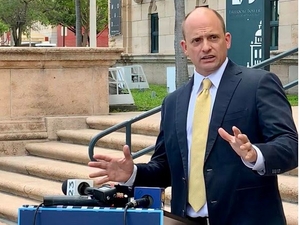
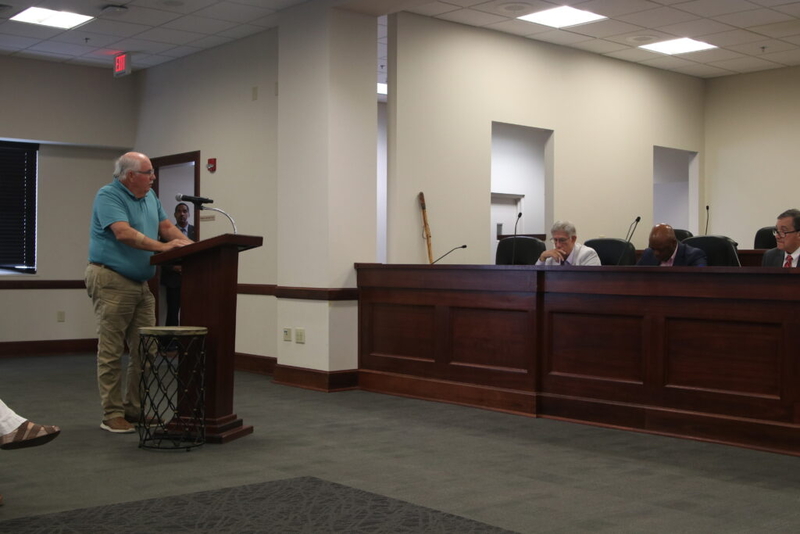
Tim Mathis addresses lawmakers on the Joint Prison Oversight Committee meeting on Wednesday, July 23, 2025. Mathis spoke about his son, who was killed in Elmore Correctional Facility in June 2024. Members heard from several speakers about the harrowing conditions in Alabama’s prisons. (Ralph Chapoco/Alabama Reflector)
Advocates, experts, formerly incarcerated individuals and family members of those behind bars Wednesday described an Alabama prison system that kept inmates in a state of terror and a parole system that robbed inmates of hope.
Speaking to the Legislature’s Joint Prison Oversight Committee meeting in the Alabama Statehouse, witnesses described rampant drug use by those incarcerated in the state’s prisons; trafficking of illicit substances by corrections staff; constant extortion demands by people in prison against one another, and violence perpetrated by both staff and those in the custody of the Alabama Department of Corrections.
“There has got to be some change,” said Tim Mathis, whose son Chase was killed in Elmore Correctional Facility in June 2024. “There are too many people dying. A lot of people here still have loved ones there. Mine is gone. There is nothing I can do for him, as much as I try and as much as I pray and cry over it. I am mad. I am not going to become unmad until something is done about this.”
Witnesses also said low parole rates have hurt morale among those in prison.
Speaking to the committee, Colleen Howell said former Alabama Board of Pardons and Paroles Chair Leigh Gwathney accused her of lying about her son Corey’s efforts to rehabilitate himself after she spoke on his behalf at a parole hearing.
“She bombarded us and told us that our son was lying to us,” Colleen Howell said. “She said our son was lying to us and that he was not in the program. She was belittling us, chewing us out.”
Her son, she said, was granted parole after the board initially denied it.
“Chairman Hal Nash shared his vision for a fair board while also maintaining the Board’s paramount duty of public safety,” the parole board said in a statement. “Board Members Darryl Littleton and Gabrelle Simmons have been committed to this same vision.”
Alabama’s prison system remains one of the most deadly in the nation. The ACLU of Alabama estimated that almost 280 people died while in the custody of the Alabama Department of Corrections in 2024. Alabama Appleseed, a criminal justice reform organization, estimated that there were 325 deaths in the state’s prisons in 2023.
The ACLU of Alabama reported that 46 of those deaths were due to overdoses and correctional staff was a factor that contributed to the deaths. The report states that another 77 people died from natural causes whose cause is unknown.
“The presence of illegal drugs is a challenge faced by correctional systems across the country,” the ADOC said in a statement. “ADOC is committed to enforcing our zero-tolerance policy on contraband and works very hard to eradicate it from our facilities. ADOC’s Law Enforcement Services Division and K-9 Division have made numerous arrests of civilians and staff introducing contraband into the prisons and has committed numerous resources to eradicate the crimes inside the prisons. However, more resources are needed to continue efforts to enhance public safety to citizens, staff, and inmates.”
The deaths were concentrated in a handful of facilities, the ACLU report states. According to the report, 36 people at the Kilby Correctional Facility in 2024. The report said 35 people died while incarcerated at the prison in St. Clair County, and that 34 people passed away at Limestone Correctional Facility in Limestone County.
‘Make sure at least our loved ones are safe’
Speakers during Wednesday’s public hearing spoke of the harrowing conditions within several of the state’s prisons.
Yolanda Williams, whose husband is incarcerated at Fountain Correctional Facility for a parole violation, said the overcrowding and state of the facility’s pipes are concerning.
“My husband is in a dorm in G.K. Fountain Correctional Facility that houses 80 men, but in that dorm, there’s a total of 150 men with seven to nine fans,” she told the committee.
Williams said her husband, a maintenance worker, works on pipes under the prison that are so corroded you can see human waste going through them. She said the waste goes through the plumbing system in the prison as well.
“The pipes were supposed to be, at one point, iron and now they’re visible where you can see feces every time someone flushes the toilet or urine every time someone uses the urinal,” she said. “Even just getting in the shower, turning the shower on, and feces are coming out through the overhead shower. That is deplorable.”
Williams said getting more health care workers in the prison and doing regular checks on the facilities should be a priority to help make prisons better.
“Get more health care workers in the prison because if there’s 100 men to one health care worker, the health care worker needs help,” she said. “Reach out to outside sources, fire marshals, have them go in to make sure that these buildings are cohabital. Make sure at least our loved ones are safe if there is an environmental issue.”
Colleen’s son Corey Howell, 29, was incarcerated in Alabama’s prison after his probation was revoked after he was sentenced for four years after he was convicted of illegal possession of marijuana and Xanax. Howell said he saw violence and drug use at Kilby and Ventress correctional facilities, where he was incarcerated. After being transferred to Staton Correctional Facility, Howell said he saw “my enemy” there.
“I went to tell the warden,” he said. “The warden tells me, ‘Go outside and die.’ He did not care whatsoever.”
The ADOC confirmed that Howell had been transferred.
“On October 15, 2024, there was an incident involving Howell and another inmate at Staton Correctional Facility who was transferred to Staton in May 2024 – prior to Howell,” ADOC said in a statement. “After ADOC staff resolved the October 15th incident, the other inmate was then validated as an enemy of Howell, and, on October 16, 2024, that inmate was moved to another correctional facility. Howell remained at Staton until his release on June 23, 2025.”
Parole complaints
Complaints about the parole board surfaced throughout the proceedings. Gov. Kay Ivey earlier this month declined to reappoint Gwathney to the board, selecting Hal Nash, a former corrections deputy from Jackson County, to become chair of the board.
On multiple occasions, Rep. Chris England, D-Tuscaloosa, requested feedback from several speakers regarding newly-published parole guidelines. One section dealt with re-entry and how the guidelines consider those who submit a housing and job plan.
“What it requires is for people who are incarcerated to find housing and find a job while they are in prison,” said Carla Crowder, executive director of Alabama Appleseed. “It is extremely difficult.”
She suggested subtracting points for those who find housing and a job, thereby increasing their chances for parole.
“That is something that could be easily remedied in these guidelines,” she said during the meeting.
Editor’s Note: This story has been updated to include statements from the parole board and the Alabama Department of Corrections.
Montgomery