‘People really want to put Trinity in the past:’ Q&A with professor and author Myrriah Gómez
Jul 17, 2025 | 4:02 pm ET
Description
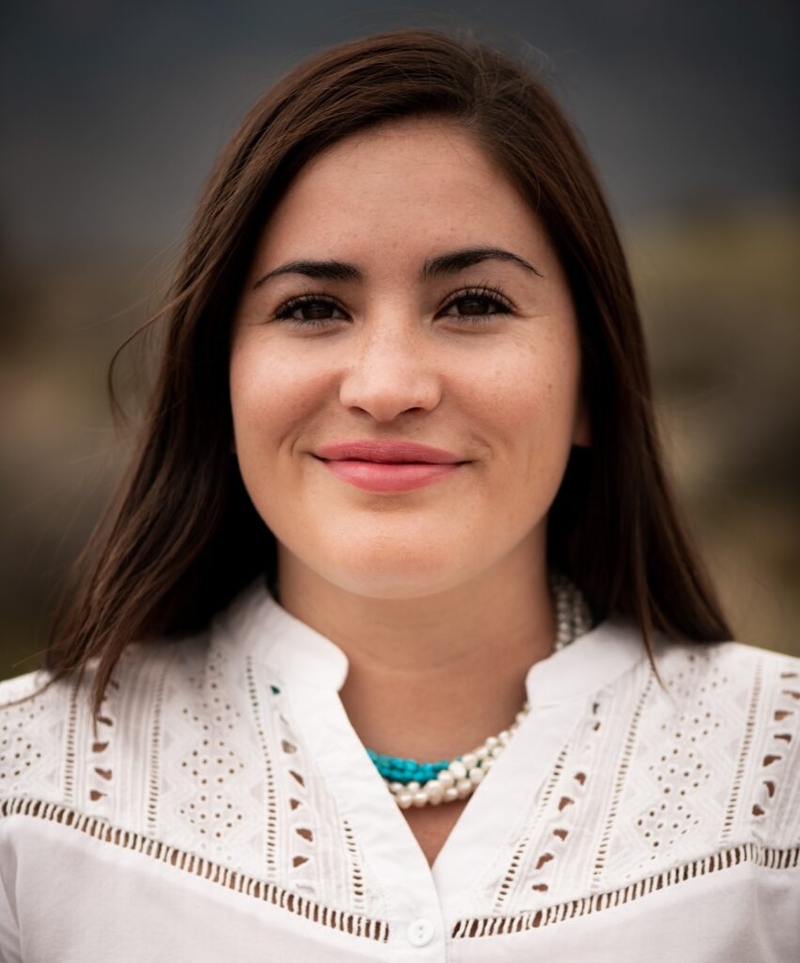
Myrriah Gómez is from the Pojoaque Valley in Northern New Mexico, an associate professor in the Honors College at the University of New Mexico and author. (Courtesy of Myrriah Gómez)
July 16, 2025 marked 80 years since the atomic test at the Trinity site, as well as the 46th anniversary of the toxic uranium spill at the Church Rock mine, a disaster that sent millions of gallons of toxic tailings in the Rio Puerco, contaminating Navajo Nation lands and waters. This year’s dual commemorations come in the wake of Congress expanding, for the first time, a program to compensate people harmed by the country’s nuclear programs to include New Mexico downwinders and post-1970 uranium workers.
Myrriah Gómez’s 2022 book, Nuclear Nuevo México: Colonialism and the Effects of the Nuclear Industrial Complex on Nuevomexicanos (2022), examines the history of New Mexico’s cradle-to-grave role in America’s nuclear project and the legacy of erasure, trauma and environmental racism toward Native American and Mexican-American communities.
Source spoke with Gómez, an associate professor in the Honors College at the University of New Mexico, about the state’s nuclear legacy and the recent renewal and expansion of the federal Radiation and Exposure Compensation Act.
The following conversation has been edited for concision and clarity.
Source: You open your book with an account of your cousin’s funeral in June of 2008, along with the deaths of your grandfather and great-uncles, all of whom died from cancer and worked at Los Alamos National Laboratory. Why start the story there?
Gómez: For those of us who are from the Valley, Los Alamos is always just part of our lives. We see family and friends who work at the lab, and we take for granted that it’s always been there. But really, there’s a much larger backstory. There’s a whole history of the Pajarito Plateau [that] my family has deep ties to, even before the Manhattan Project. Opening the book with the memories of my family grounded me in place, grounded me in community, and grounded me in this other story of Los Alamos that most people don’t have any context for.
Scientist says there’s legacy plutonium contamination in Los Alamos
What do you make of this moment as New Mexico downwinders are formally recognized for the first time?
The passage of RECA in what is now known as the ‘Big, Beautiful Bill,’ is sort of an ironic moment. At the same time that New Mexicans are finally being recognized and included…New Mexicans are having rights stripped from them.
All of New Mexico’s downwinders could be compensated under Senate’s ‘big, beautiful bill’
Not only because of taking away access to health care like Medicaid, but it’s also [the bill’s] increase in nuclear spending. Right now, New Mexico’s Los Alamos National Laboratory is the only place that has the capabilities to produce nuclear plutonium pits in the entire country.
It’’s a very bittersweet feeling because on one hand, it’s the recognition and the reality that New Mexicans will be able to apply [for] RECA, but it’s also at the cost of having all sorts of other effects that the bill will bestow.
You wrote ‘…despite what many people argue, New Mexico is not a national sacrifice zone. in order to be a sacrifice zone, the object being sacrificed has to hold value. New Mexico does not hold value to the nation other than being a wasteland.’ Has your opinion changed since you wrote that?
It hasn’t changed. I wish I would have nuanced that more, and I’m actually working on a whole other book that expands on that idea of what it means to be a sacrifice zone and why I don’t believe that New Mexico is one.
The New Mexico state Legislature voted to make it illegal to bring high-level nuclear waste in New Mexico. The government is blatantly disregarding that at all various levels: at the Nuclear Regulatory Commission, now the Supreme Court [which overturned lower courts’ decisions and reopened the possibility of high-level nuclear storage facilities in Texas and New Mexico]. They’re saying, ‘tough, we’re going to bring it anyway.’ We’re not making that sacrifice; they’re making that decision for us.
We’ve seen that from the very beginning. There used to be a film shown at the Bradbury Science Museum called “The Town That Never Was.” One of the things said in the film is that the residents proudly and willingly gave up their land to build Los Alamos — there is not one thing true about that. They just took the land. We see the same thing happening 80 years later: New Mexicans have said no to the high level storage facility, and they’re gonna proceed with it anyway.
Former uranium workers whom I spoke to in Paguate Village, which abuts the Jackpile mine, described the federal efforts to restart uranium mining in New Mexico as an insult, given the failure to acknowledge and care for people who were exposed previously. What are your thoughts on expansion?
Indigenous homelands have been ravaged by uranium mining since that started in the United States, and in particular, in and around Navajo Nation and Laguna Pueblo for us in New Mexico.
They’re seeking [expansion] again when there’s over 500 abandoned uranium mines on Navajo nation alone, with remediation efforts underway. Of course, we know we can never fully remediate these sites.
NM uranium mine proposals receive Trump priority designation
They think that people are either not going to care or not going to notice. But luckily, we have lots of organizations and individuals who are pushing back. And I think one of the things that I’ve seen is all of the efforts that are being done: cross-cultural, international efforts between places where uranium mining has occurred. It’s not just the Navajo Nation and Laguna Pueblo; this is happening to Indigenous communities across the world.
What are the most important changes in the nuclear landscape in the three years since your book was published?
The plutonium pit production expansion has significantly shaped and reshaped the landscape. U.S. Secretary of Energy [Chris] Wright, was in Los Alamos in early May of this year. He did a photo-op in front of Oppenheimer’s house, and he said, ‘We’re in the new Manhattan Project.’ What was so interesting about that statement was the fact that he was actually referring to AI. But in reality, it was an effort to distract us from the fact that we are in a new Manhattan Project with weapons production.
The other issue that really affects New Mexico is the fact that PNM has divested from Palo Verde Nuclear Generating Station in Arizona, an interesting opening into how New Mexico can divest from the nuclear industry.
Is there anything else that you wanted to expand upon in this moment of reflection?
People really want to put Trinity in the past. They want to think about it as history, that we can put it in a box to look at and we can talk about, but that it’s not really relevant [to today], right? And I think that we’re starting to see as American citizens, as global citizens, as New Mexicans, how important it is that we pay attention to the nuclear issues right now.
When Iran was bombed by the United States this summer, it sort of opened our eyes to the possibilities and the role that New Mexico plays in that. Instead of just going with the status quo and accepting the billions of federal dollars that we get for our national nuclear facilities, we really need to be questioning the role that we play as New Mexicans, the complacency in all of that weapons development. We can further increase discussion by educating each other and by having really difficult conversations at this moment.
Santa Fe, NM