Las Cruces Diocese says border wall at Mount Cristo Rey would violate religious freedoms
Jul 07, 2025 | 1:10 pm ET
Description
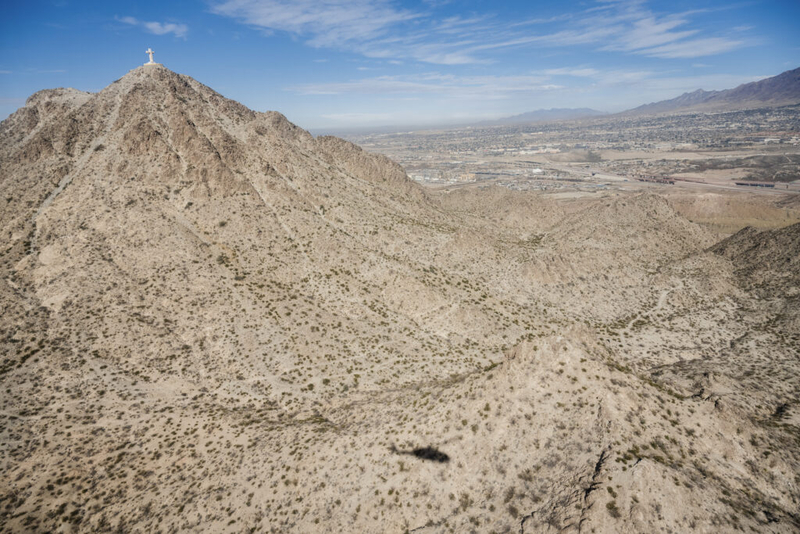
Mount Cristo Rey in Sunland Park, New Mexico, as seen from a U.S. Customs and Border Protection helicopter on Dec. 14, 2021. (Justin Hamel for Texas Tribune and Source NM)
Las Cruces Catholic leadership says it will continue to oppose a proposed border wall across Mount Cristo Rey in Sunland Park, as federal officials move to fast-track construction.
The Roman Catholic Diocese of Las Cruces owns 200 acres on the mountain situated in the Chihuahua Desert at the junction between Texas, New Mexico and Mexico, topped by a 29-foot tall limestone statue of Jesus Christ on the cross. The statue, installed in 1939, draws thousands of people every year in pilgrimage.
A U.S. Customs and Border Protection proposal to construct a 1.3-mile steel wall across the mountain’s southern flank drew condemnation from conservation groups last week, who said it would worsen migrant deaths, erosion and habitat losses.
Granting federal entry onto the land would deter migrants and pilgrims from exercising their faith, the diocese said in a statement provided by their attorney Kathryn Brack Morrow late Friday.
“The erection of a border wall through or along this holy site could irreparably damage its religious and cultural sanctity, obstruct pilgrimage routes, and transform the sacred space into a symbol of division,” the statement read.
Advocates: Mount Cristo Rey wall will worsen migrant deaths, erosion, habitat loss
In June, the Department of Homeland Security announced a slate of projects to “close critical gaps in the border wall and enhance border security operations” in the border areas of El Paso, Tucson and Yuma. Secretary Kristi Noem waived federal environment and water laws to speed up border wall construction projects, including the 12 miles between Santa Teresa and Mount Cristo Rey.
Public comment on the project closed July 3.
The U.S. The Department of Justice made multiple requests in the last several months to access land owned by the church for a series of border wall proposals, according to the statement.
The diocese said it has “respectfully but firmly urged,” the federal government to exclude the area from planning, surveying and construction.
“Any federal action to seize this land, construct physical barriers, or impede access to Mount Cristo Rey would constitute a significant infringement on religious freedom and the rights of worship, which are protected under both the First Amendment to the U.S. Constitution and the Religious Freedom Restoration Act (RFRA),” the statement read.
Santa Fe, NM