Facing loss of millions in state aid, Columbia council votes to repeal ‘conversion therapy’ ban
Jun 17, 2025 | 7:20 pm ET
Description
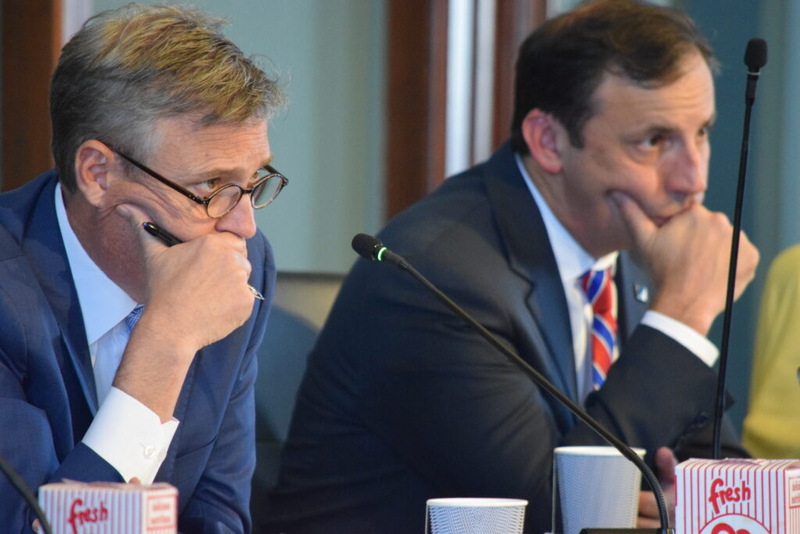
Columbia Mayor Daniel Rickenmann and Councilman Will Brennan, both of whom voted Tuesday, June 17, to repeal a conversion therapy ban, listen to testimony from LGBTQ+ advocates at city hall Tuesday, May 20, 2025, urging the city to maintain its ban on conversion therapy. (Photo by Jessica Holdman/SC Daily Gazette)
COLUMBIA — Columbia City Council voted Tuesday to repeal an ordinance banning so-called conversion therapy for minors, rather than risk getting sued and losing millions of dollars in state aid for a rule that’s never been used.
The 4-3 vote was the first of two votes required to officially repeal the 2021 ordinance, which threatens a $500 fine for licensed therapists who attempt to change the sexual orientation or gender identity of an LGBTQ+ minor.
The next vote will likely be sometime in July.
The split decision comes after the council twice deferred any decision on whether to repeal the ban. Over the course of three meetings, dozens of community members asked the council to keep the ordinance in place as a show of support for the LGBTQ+ community.
But keeping it would come at a cost of $3.7 million to the capital city after legislators inserted a clause in the state budget to revoke its share of money from what’s known as the “local government fund.” While the budget directive threatened any city with such a ban, it essentially targeted Columbia, since it remains the only city in the state with such an ordinance.
The directive takes effect with the fiscal year’s July 1 start.
In April, Attorney General Alan Wilson called on the council to repeal the ordinance or face a lawsuit. His letter argued the ban violated a constitutional guarantee of free speech and a 2022 state law that leaves health care regulation, including over therapists, up to the state.
“We are encouraged that Columbia City Council took a step forward today toward repealing its unconstitutional ordinance,” Wilson said in a statement Tuesday. “This ordinance was never truly about ‘conversion therapy,’ but stifling faith-based speech and targeting counselors guided by their religious convictions. Even this initial step is a meaningful victory for faith-based institutions.”
No fines or warnings have been issued under the ordinance, according to the mayor’s office.
The council didn’t pass the ban four years ago because members believed the practice was happening in the city, said Councilman Will Brennan, who voted for the ban at the time. Instead, the ban was meant to increase the city’s friendliness to the LGBTQ+ community based on the nonprofit Human Rights Campaign’s Municipal Equality Index, he said.
The index grades cities on a number of factors, including local laws, to show the LGBTQ+ community whether the city is a safe place to live, work or visit, according to the Human Rights Campaign.
A ban on conversion therapy can gain a city two of a possible 100 points, Brennan said.
If the goal is to increase the city’s score on the index, there are other ways to accomplish that, including bolstering city programs, he said.
If the goal is to protect LGBTQ+ youth from abuse, then officials should strengthen other rules that would prove more effective, he said.
“I do believe there’s a better path for working together, being more responsive when abuse reports are heard about,” Brennan said.
Looking at the Municipal Equality Index reminded Councilwoman Tina Herbert of all the times as a Black woman she has felt unwelcome, she said. She likened the scores to the Green Book, a guidebook that told Black travelers what places were safe to stop in the 1930s through 1960s.
Because of that, Herbert voted against repealing the ordinance.
“I know that feeling of walking into rooms and not feeling comfortable,” Herbert said.
The loss of funding if the city kept the ordinance in place was a concern for Councilman Peter Brown, who voted to repeal the ordinance.
Though the $3.7 million the city is expected to receive from the state in the coming year is a relatively small portion of its total budget, it would further tighten a spending plan that already has no wiggle room, City Manager Teresa Wilson said previously.
That would likely mean cuts to a grants program meant to bolster tourism in the area, Wilson said.
Columbia postpones vote on conversion therapy ban awaiting state budget decision
Brown worried failing to repeal the ban would mean larger cuts in the future, he said.
“These funds are important to maintain public safety and city services and not put an additional tax burden on our citizens,” Brown said.
Advocates asked whether that money was worth the potential for LGBTQ+ youth to face harmful practices or feel unsafe in the city.
“Columbia’s kids need you to be the leaders who refuse to play politics with their lives,” said Jace Woodrum, head of the state American Civil Liberties Union and a transgender man.
Sen. Tameika Isaac Devine warned the council that bowing to state officials’ demands in this instance could lead to more problems further down the road.
Devine, a former Columbia City Council member who voted to instate the ordinance, questioned whether the attorney general or legislators might try to force officials in Columbia and other cities to repeal other ordinances they don’t like.
“If you cave to the bullying of the state, you will be showing the state can bully us and take away things,” the Columbia Democrat said. “So, what’s next?”
City officials have said they were caught in the crossfires of statewide politics.
Attorney General Wilson and Spartanburg Republican Sen. Josh Kimbrell, who proposed the budget clause, have both said they’re considering runs for governor.

Columbia