Gov. Mills signs bill to fund more public defenders in Maine
Mar 21, 2024 | 1:16 pm ET
Description
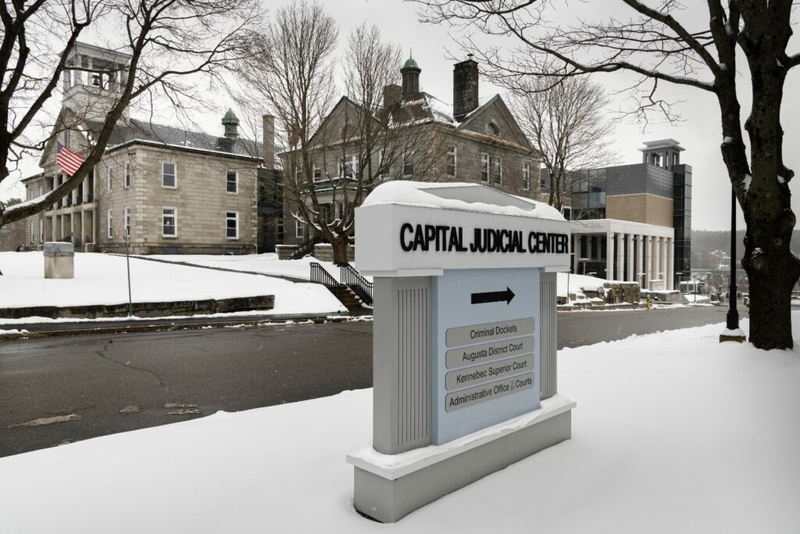
The old and new courthouses of the Capital Judicial Center in Augusta. (Jim Neuger/Maine Morning Star)
The Maine Legislature passed a bill Thursday to provide funding for more public defender offices and employees in an effort to improve the state’s insufficient indigent legal system.
Hours after passage, Gov. Janet Mills signed the bill, saying that it advances her commitment “to improving the delivery of legal services to low-income people to ensure their Constitutional right to counsel.”
“The right to counsel is one that I deeply value and have personally delivered myself, having represented low-income clients many times during my own legal career,” Mills said, noting that funding for the new positions was already included in her supplemental budget proposal.
Before Maine hired its first five public defenders in late 2022, it had solely relied on private attorneys to represent low-income defendants.
While more have been added since, along with the state opening its first public defender office in November, Maine is still largely relying on private attorneys, Jim Billings, executive director of the Maine Commission on Indigent Legal Services, told the Legislature during a budget hearing earlier this session.
“We’ve relied almost exclusively on these private attorneys for decades,” Billings said, “and at this point, we have to diversify our system of delivering the services and we have to implement a statewide public defender structure.”
After hearing Billings’ concerns, the Judiciary Committee asked the budget committee to remove some indigent legal services initiatives from the special appropriations table and instead fund them as emergency measures right away. The Appropriations and Financial Affairs Committee exempted the measures from the table Thursday morning and the House and Senate swiftly voted to enact an amended version of LD 653 as an emergency measure, securing the two-thirds votes needed to do so.
The Senate passed the bill 33-0, and the House 118-0.
Specifically, the bill will establish two new public defender offices, one in Aroostook County and another to serve Penobscot and Piscataquis counties. It also adds a public service coordinator to serve the existing office in Kennebec County and several new positions in the commission’s central office to assist with forming more new offices and training new public defenders.
These additions will not require more funding for the current or next fiscal year but the bill is projected to cost roughly $94,500 for 2025-2026 and $192,000 for the following fiscal year.
In addition to funding these expansions, the bill will change the name of the Maine Commission on Indigent Legal Services to the Maine Commission on Public Defense Services, in an attempt to more clearly describe the group’s mission and functions to the public.
Before the bill passed the Senate, sponsor Sen. Lisa Keim (R-Oxford) said the name change will not only provide clarity for the public but for future legislators like herself, as she said when she was first elected she’d had to Google the functions of the commission, due to its nondescript name.
Keim said she was pleased to see the expansion of government this legislation will create, even though she is generally opposed to bigger government. In the area of public defense, it is needed, she said.
Over in the House, Rep. Matt Moonen (D-Portland), co-chair of the Judiciary Committee, thanked Keim for letting the committee use her bill as a vehicle for solving the long-standing problem with legal representation shortages across the state. The Judiciary Committee unanimously voted in favor of the amended bill on March 18.
In March 2022, the ACLU of Maine filed a lawsuit challenging the state’s failure to provide adequate legal counsel to people who can’t afford their own attorney. Despite significant settlement negotiations, the case is set to return to court because of the extensive issues with the system.
As of late February, nearly 400 people in Maine were currently waiting for counsel to be appointed, with roughly a quarter of them sitting in jail.
Following Thursday’s votes, the ACLU of Maine confirmed it will continue its lawsuit, though applauded the Legislature’s passage of LD 653. ALCU Chief Counsel Zach Heiden said that the current crisis is not limited to the counties that will get new public defender offices through the legislation.
“The current system denies countless people their Sixth Amendment right to the effective assistance of counsel,” Heiden said. “We call on Governor Mills to sign LD 653 into law and for the Legislature to continue building upon this by funding public defense offices in all prosecutorial districts.”
This story was updated to include Gov. Mills’ signing of the bill.
AnnMarie Hilton contributed to this report.
Augusta, ME