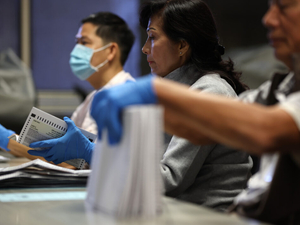
As Trump targets elections, states fight back in court
Since President Donald Trump’s return to office, elections have been a priority for his administration.
The FBI raid of an election warehouse in Fulton County, Georgia, seizing 2020 ballots. The Department of Justice demanding voter registration lists and other information from all states. Mail-in ballots at risk of not being postmarked. Trump’s threat of a federal takeover of state elections.
Trump has continued to push false claims that the 2020 election was stolen. The DOJ sued 21 states plus the District of Columbia in an attempt to gain access to state voter rolls.
But in Georgia and across the states, election officials and lawyers are trying to prevent the Trump administration from succeeding.






In Episode 16, you’ll hear from Fulton County Commissioner Rob Pitts. He sued the DOJ to get the county’s election records back and to find out why they were taken.
You’ll hear from Elisabeth Frost, the Litigation Chair at Elias Law Group, who has been leading the effort to push back against lawsuits filed by the DOJ to access states’ sensitive voter data.
And Stateline reporter Jonathan Shorman, who covers democracy, will fill us in on potential problems with mail-in voting and how those ballots will be counted.
Finally, Evening Wrap newsletter author Danielle Gaines shares the top stories she’s watching.
Episode produced and edited by Mallory Cheng. Music for Stories From The States composed by David Singer.
Got questions? An episode idea? Email us at [email protected].
Subscribe to Stories From the States on Apple Podcasts, Spotify and Youtube.
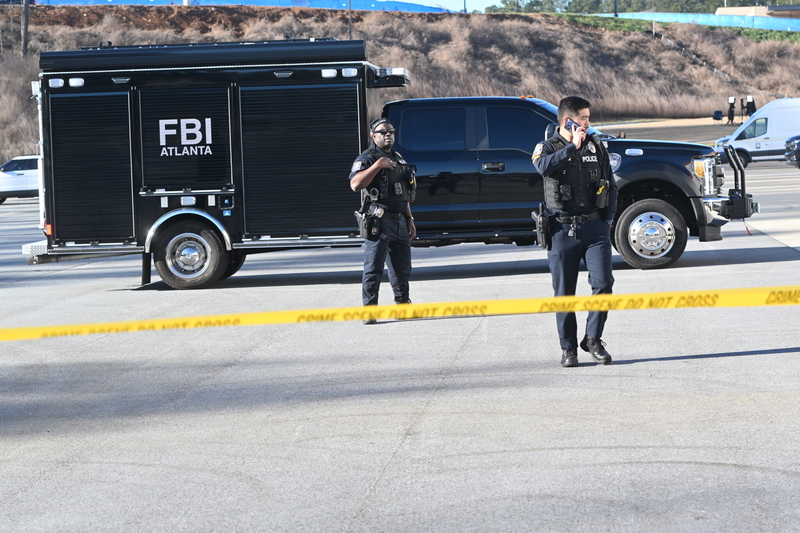
Photo: Fulton County Police officers stand by outside county election headquarters while FBI agents seize documents related to the 2020 election. (Ross Williams/Georgia Recorder)
Stories From The States is a production of States Newsroom, the nation’s largest state-focused nonprofit news organization, with reporting from every capital. At this pivotal moment in American democracy, our veteran journalists from all 50 states are reporting the consequences of government decision making. By zooming into one story each week, Stories From the States contextualizes and gives a human voice to what is happening now.
Transcript was created using an automated software.
Chris Fitzsimon
This is Stories From The States. I'm Chris Fitzsimon. Here at States Newsroom. We know there's a lot going on around the country, in every state capital. Thank you for being here today. We're talking about Trump's attacks on elections and how some states are pushing back. Since 2025 the Department of Justice has been demanding vot...
Transcript was created using an automated software.
Chris Fitzsimon
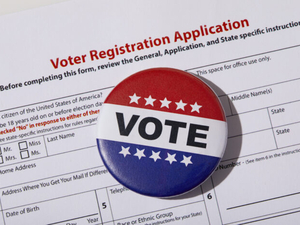
This is Stories From The States. I'm Chris Fitzsimon. Here at States Newsroom. We know there's a lot going on around the country, in every state capital. Thank you for being here today. We're talking about Trump's attacks on elections and how some states are pushing back. Since 2025 the Department of Justice has been demanding voter registration lists and other information from all the states, but more than 20 plus Washington DC have so far refused. The DOJ has been suing them, but some states are fighting back in court.
Elisabeth Frost
What's the big deal? The federal government has all your information anyway. But in fact, the federal government does not.
Chris Fitzsimon
And mail in ballots could be at risk with potential rule changes. And a recent FBI raid of an election warehouse in Georgia has a local official concerned with just how far Trump will go.
Chairman Rob Pitts
I have no idea where those records are. I have no idea who has those records. I have no idea what they're doing with those records.
Chris Fitzsimon
We'll hear from the Fulton County Commission chairman in just a moment.
Chris Fitzsimon
Fulton County, Georgia, has been on the receiving end of President Trump's baseless wrath over the 2020 election results for quite a while. The county is home to much of the city of Atlanta. Trump has repeatedly blamed his 2020 loss on unfounded accusations of rampant voting fraud, even though two recounts affirmed former President Joe Biden's narrow victory in Georgia. Fulton County also was where Trump was indicted in 2023 following his efforts to overturn the 2020 election results in Georgia. But Trump's claims are still around, and in January, the FBI raided an elections warehouse in Fulton County, seizing election records. The county immediately sued, challenging the raid and seeking the return of the election records and for an affidavit the Feds filed in support of the search warrant to be unsealed. Now that affidavit has been unsealed and showed that false election claims were at the core of the reasoning for it. Joining us now is Fulton County Commission Chairman Rob Pitts. Chairman Pitts, thank you for being here with us today.
Chairman Rob Pitts
Yeah. Thank you for inviting me.
Chris Fitzsimon
It's such a shocking development. But did you have any warning? Did you know that FBI was coming? Did you have any idea that this was going to happen back in January?
Chairman Rob Pitts
Had no warning whatsoever. In fact, I'll give you a little background. I was in my office working and received a telephone call from some workers at our elections hub who they informed me that the FBI was there with a search warrant. So I immediately called our county attorney, and she and I drove to our elections hub for two reasons. Number one, to make sure that our employees were okay, that they're safe, but number two, and more importantly, to make sure that we complied with everything that the FBI was asking for. We got there, we learned that when the first agent approached some of our workers, they had the presence of mind to ask for a search warrant which they didn't present. Then the agent went to, I guess, went to his vehicle and came back with a warrant which was not correct. So then they had to go back and spend a couple of hours getting a correct search warrant, and they got that problem resolved. Then the search began. By that time we the county attorney and I were there, and we thought that we would be able to go into the area where all of the ballots and everything from the 2020 election was stored, but we're informed by the agent that we were not be able to enter that part of the our own facility. So that's how it all began.
Chris Fitzsimon
What were you thinking then when you got there and FBI agents were not only there, but were prohibiting you from entering your own facility?
Chairman Rob Pitts
Well, I mean, they were courteous, and I have no issue with the men and women of the FBI whatsoever. They were doing their jobs. They were doing what they were instructed to do, and they were courteous, but yet, yet firm as they always are, I'm told. So when they said, 'Well, you're not going to be allowed in here', I said, 'I understand'. So in the final analysis, they took some approximately 700 boxes of ballots and other information, all items related to the 2020 election, and they left that evening. The other thing that happened that evening, while we were there, there was a sort of a rumor circulating that Tulsi Gabbard may show up, and in fact, she did. And so that's when it occurred to me, and I began thinking that, well, this is highly unusual, based upon what I know to be her job or her job to be. Why would she be in Fulton County, Georgia, overseeing an FBI raid of 2020 election ballots?
Chris Fitzsimon
As the National Intelligence Director? Right?
Chairman Rob Pitts
That's exactly. Right? So that's when I started thinking to myself that something bigger is going on here, now, and this all, I mean, about the 2020, election. It has been reviewed and looked at from A to Z, two or three times, hand counts and everything. In every instance we, you know, we come up clean. And I'll always say this too, that I've been involved personally in many, many elections. There's no such thing as a perfect election, always a possibility of human error, always a possibility of mechanical failure of some sort, but I can assure you and the world that there was no orchestrated effort to steal that election from President Trump. The other point I like to make is that since 2020 we have had 17 successful elections. Not a word about those elections. So it begs the question of why this fixation on Fulton County, Georgia? I mean, I can answer that. But if there is a county in Georgia, where there was arguably wrongdoing underhand itself. It was in Doffee County, where you have, you know, video of people going in after hours and taking stuff out. You know that didn't happen here. So why Fulton County, Georgia versus, let's say, Coffee County in Georgia?
Chris Fitzsimon
You think you know why Trump is attacking Fulton County? Why do you think he is?
Chairman Rob Pitts
Oh, I do know he lost the election here. So he's had a, you know, a bitter taste in his mouth for Fulton County, Georgia since he lost. The famous call phone call, find me 11,000 I think, 780 votes. That didn't happen. So he lost the election here in Georgia. Second of all, he was prosecuted by our district attorney, who was doing what she thought was her job. Number three, I had called him out and Rudy Giuliani, and then Congresswoman Marjorie Taylor Greene, and then Congressman Matt Gaetz from Florida told him stay out of Fulton County. It was my county. I can handle anything that's going on wrong here. So there, those are just four, three or four reasons why he has had a bitter taste in his mouth for Fulton County, Georgia. And I'd also add, when he had to come here to be fingerprinted and have his photograph taken at the jail that photograph. I think he's made a lot of money off of that photograph, but he did not like it whatsoever. That's five specific reasons why I think he's had a bitter taste in his mouth for Fulton County, Georgia, there's been a target. You know, we've been in target for some time, and in fact, give me one other little tidbit you didn't ask about this, but the Monday before the Wednesday night, January 28 FBI raid, the Monday during the day, I received a phone call from a source credible source in D.C., who informed me and warned me that certain individuals in Georgia, Fulton County, were going to be arrested. Secretary of State, his deputy and I was number three on the list. Nothing happened that Monday, nothing happened that Tuesday. But Wednesday, here's the FBI raid. Then on Friday, I get a call from the same source as well. 'You can't relax, even though the raid is taking place, arrests are still coming' so but as I sit here with you today, I haven't been arrested yet.
Chris Fitzsimon
Well, thank goodness. Well, I think for folks who don't follow this as closely as as others, it's probably worth noting that the state of Georgia Trump's complaints weren't just partisan. They were. They were complaints with Secretary Raffensperger, even the governor. He was upset with the entire election machinery in the state of Georgia after 2020 and continues to mention those folks as well today.
Chairman Rob Pitts
To this day, he does.
Chris Fitzsimon
So when you found out that that when the affidavit was unsealed, a guy named Kurt Olson, this is, according to Politico reporting, was the one who started the referral that spurred the FBI raids. Olson is a former Trump campaign lawyer, and he played a central role in the efforts to undermine the 2020 election. What did that tell you when you when that affidavit was unsealed?
Chairman Rob Pitts
Well, let me, let me speak to what happened before. So after the after the FBI left that evening, you know, I have no idea where those records are. I have no idea who has those records. I have no idea what they're doing with those records, and nor have I been contacted by the FBI or anybody else. And that occurred on January, the night of January 28 a couple of days thereafter, I filed a lawsuit in federal court Rob Pitts versus the United States of America, and I filed it for two reasons. Number one, to direct the FBI to return to us all of the documents that they seized those 700 boxes and number two was to unseal the affidavit that was used by the FBI to secure the search warrant, and the judge granted that, and it was unsealed. And looking at it, we wanted to see it, because we could not believe that there was that a judge anywhere would grant a search warrant. But in reading it, I mean, it's not worth the paper that is printed on is where I describe it. It's that same old, you know, conspiracy theories that we've been that have been reviewed, looked at, debunked in the past, nothing, absolutely nothing new. So that all of that adds up to this, to why is this happening here in Fulton County, Georgia. And what I believe is the case is that there's a master plan. And the president himself has mentioned, I think, 15 states that he's looking at. Obviously, Georgia will be the top of that list, and within Georgia, Fulton County, Georgia, but he's also mentioned three cities in addition to Atlanta, Philadelphia and Detroit. So what I think is going on here is that there is a move, and will be a move, to take over elections in Fulton County, Georgia for 2026 and 2028 through our state elections board. The reason that's possible because last year, or the year before our state legislature passed a law which gives the state elections board the authority the power to take over election boards under certain conditions. And I think this is all a part of setting up the play for them to take over our elections in Fulton County being maybe having it run by someone other than the people who are duly appointed to do so.
Chris Fitzsimon
If that is the plan, what can you do to stop it? Or how are you getting ready for that?
Chairman Rob Pitts
Well, we're getting prepared. I can't get into the, you know, the legal strategy at this point, but I can assure your listeners and the folk of Fulton County, Georgia that we're going to fight it with all the resources that we have. And I will assure them that the 2026 elections are going to be open and fair and transparent as they've always been, and we will defend their right to vote.
Chris Fitzsimon
Did you ever think that you would be having conversations like this? You've been around quite a while. Did you ever think that we were headed down this road?
Chairman Rob Pitts
Never in a million years. We've gone through a lot here. During my tenure here as chair, got through covid, you know, with flying colors. We fought off the Russian mafia when they attacked us. Had a cyber attack here in the county, and now this, but this is this takes the cake.
Chris Fitzsimon
And finally, what do you say to voters in Fulton County when you see them or people who are worried, how do you reassure folks?
Chairman Rob Pitts
Well, what they say to me is, I mean, just the average person on the street, 'fight them. Fight them. Don't let them take my right to vote and protect my all of my personal information. Just keep fighting. We'll back you'. They say we got your back. And this comes from Democrats and Republicans, blacks and white.
Chris Fitzsimon
Well, Chairman Pitts, thank you for what you're doing in Georgia, and we really appreciate you being with us. Thank you very much.
Chairman Rob Pitts
Thank you for having me.
Chris Fitzsimon
You can always visit the Georgia Recorder website to stay up to date on the latest developments from Fulton County. The Recorder is an outlet with States Newsroom. Trump's DOJ has been adamant about accessing all 50 states voter rolls. Some states have said they're not doing that, but the DOJ has, in turn, sued over 20 states for their voter information. Those states are now pushing back in court. In a moment, we'll chat with the litigation chair at the law firm supporting the states fighting Trump's DOJ.
Moses Esheit
At a time when so many communities are losing their local news outlets. States Newsroom is filling a gap. We are now the nation's largest state focused nonprofit news organization with reporters based in every state capital and Washington DC. But we can't do it without your support. Your contributions allow us to produce award winning journalism and deliver it to you for free. No pop ups, no pay walls. This is a crucial time to support local journalism, and every bit helps to give go to statesnewsroom.com/donate.
Chris Fitzsimon
States like Colorado, Georgia, Michigan and New Hampshire are pushing back against the Trump administration's Department of Justice from receiving their state's voter rolls. In total, there's 22 ongoing lawsuits by the DOJ seeking to compel states and Washington DC, to provide complete, unredacted voter registration files to the federal government. One law firm is participating in all the cases to intervene. Joining us now is Lis Frost. She's a litigation chair at Elias Law Group. Lis, thank you for being here.
Lis Frost
Thank you so much for having me.
Chris Fitzsimon
So this is a complicated and. And obviously incredibly vital issue for folks who haven't followed this all along. What's really at stake in all these suits with the federal government reaching into states and trying to get detailed voter files?
Lis Frost
Yeah, so this is a completely unprecedented effort by the federal government through the Department of Justice to effectively compel all the states in one way or another, to turn over all the information that they have about every registered voter in their database, and that information includes and in fact, what the fight is really over incredibly private and confidential information, such as birth dates, social security numbers or fragments thereof, you know, and other kinds of information that Americans are rightfully very protective of. The Constitution gives the power to the states, in the first instance, to maintain and administer elections, including at the voter roll level. There is no such thing as a federal voter role. And so I think that there is maybe when this news started, and I think that, frankly, probably the Department of Justice initially thought when it started this effort last spring, it'd be able to just kind of do it under the radar. And some of the things you've heard Assistant Attorney General Harmeet Dhillon say is, 'what's the big deal? The federal government has all your information anyway'. But in fact, the federal government does not have all your information. The information that it does have is supposed to be, and at least historically has been, and I say historically, obviously, because this has not been the case recently with DOGE but really walled off and protected, and what the states have is very granular, up to date, detailed information about every person who's a registered voter in their state, and that's what the Department of Justice is trying to get.
Chris Fitzsimon
What is the danger, or what are you worried about the federal government having this?
Lis Frost
So I think there are some dangers that are maybe more obvious than others, and some of those dangers sort of let your imagination run wild, but we know some of the things they want to do with it because they've said it. So for example, Assistant Attorney General Harmeet Dhillon has said that basically what they intend to do with this information, should they get it, is use it to force states to remove hundreds of thousands of voters from the rolls. Now we can extrapolate from that statement and also from reports that have been made both by the Department of Justice itself, in courts and in the news, the Department of Justice has been sending so called memorandums of understanding to some of the states that have been more willing to have this conversation with Department of Justice, and we've seen some of those memorandums of understanding, and they effectively agree to take voters off the rolls of the Department of Justice tells a state that the voter should not be on the rolls. That by itself, by the way, would violate federal law. There's all kinds of protections to keep voters from being wrongfully removed from the rolls. And the reason is, is because whenever this, this kind of activity happens, where you engage in the legal term for it is list maintenance, and go through and try and identify voters who maybe shouldn't be on the rolls because they've moved out of the jurisdiction, because they've died, right? Any of these reasons, there are so many Americans and so many of us actually have overlapping common information, so much more than you could ever imagine. And so these these processes always end up catching lawful voters and pulling them off the rolls. And those voters don't realize often they're not on the rolls until they show up. So there's a real danger there.
Chris Fitzsimon
To back up for a second. But it's not like this is all based on, I think, some theory that there are, we are told, some wild theory that there are millions of people who are ineligible, there's undocumented immigrants, there's all these folks. And yet, the research in every study has shown that's not the case, correct?
Lis Frost
And it's not just just to be clear, it's not just research by academics sitting in their universities trying to figure out, you know, oh, are these, frankly, wild allegations that Donald Trump has made about millions of non citizens voting in American elections, is there any grain of truth to them? The Republicans and conservative organizations like the Heritage Foundation, the Republican National Lawyers Association, organizations like these, which are truly conservative organizations, have been trying for decades now to figure out, can they prove these claims that they're non citizens voting? And you know what they find over and over and over again, it's just not true. It's simply not true. So you're exactly right. This is, to some degree, the justification for this unprecedented effort to gather hundreds of millions of Americans. Probably. The data and put it in the hands of a government that's already had a lot of very troubling data breaches. Is this idea that, Oh well, we just want to run it through to make sure that we'll check it against these immigration databases that we don't have citizens. We're just going to do another check. And that's problematic for several reasons, including sometimes those databases are out of date. This sort of new data matching they've been doing already reports are coming out that it's wildly inaccurate, so it's based on a lie, and then the output of it is going to be a lie that, in fact, there are voters who shouldn't be there.
Chris Fitzsimon
There are cases I was thinking of New Hampshire where it's not just Democrats pushing back against this. There are some Republicans in some states like New Hampshire, that think this is a bad idea.
Lis Frost
Oh, absolutely. Look. And one of the intervenors we represent in New Hampshire is a gentleman who himself was the Republican representative in the New Hampshire General Assembly, who was responsible for some of the privacy protections in the New Hampshire constitution, because that's so critical. But also we saw a letter out of West Virginia basically telling the Department of Justice to go pound sand.
Chris Fitzsimon
And that's a legal term, by the way.
Lis Frost
Correct. It's actually one I learned from a federal judge I worked for, and now it's found its way into my into my vocabulary, but, but yeah, I mean, West Virginia told the Department of Justice they weren't going to willingly hand over their vot ers data. And what's been interesting is a fair amount of Republican states have refused to, and they refused the last time around in Trump's last administration, when he had Kris Kobach, the former Secretary of State and current attorney general of Kansas, going to try and get this information. Traditionally, Republicans, they've resisted. Now what's interesting is, who has the Department of Justice sued? With the exception of Georgia, they've sued almost over almost entirely and exclusively Democratic run states, right?
Chris Fitzsimon
Tell us about the case in Michigan where a Trump appointed judge ruled there's no federal law requiring states to turn over the voter registration list.
Lis Frost
Yeah, absolutely. So that's a really interesting case, and it's a really interesting decision. And one of the things that's most interesting about it, from my perspective as a litigator, is the court didn't hold a hearing. Federal judges don't have to hold a hearing. They often do if they have questions about the matter. But that judge looked at all the papers and presented to her decided, You know what? This is a pretty easy case. I don't need to waste my time having everyone come in and talk about it. There's just clearly no path here. And that's right, that was a Trump appointed judge, which, of course, continues this history, which we've seen throughout both administrations, and we're seeing again, that Trump appointed judges often will look at what the administration is trying to do and say, 'No, I'm sorry, but that's not appropriate'.
Chris Fitzsimon
All these challenges and many more that we haven't even envisioned or likely to be tied up in litigation. Is there a danger or a fear that we will vote in November or before, and that some key races will be tied up in the courts for weeks, which will sort of, I don't know if it shake the public confidence or promulgate some theories that it's all being decided outside of our realm? Is that is the chaos the point?
Lis Frost
I think that there are several different points here, and I do think that the chaos is the point. I think to some degree it's always been the point for Donald Trump, that the more distrust he can sow, the more it doesn't matter whether he actually wins or loses an election, because he can convince some amount of people that he actually won it. Now I think that he actually has not been as persuasive as he thinks he's been, or would like to have been, in that realm. I think that there actually is not a lot of Americans that believe he, in fact, won the 2020 election. I do not believe that when Americans show out in 2026 in force and vote their conscious, as we're seeing in a lot of special elections. They're telling the Republican Party how they feel about them, I think that it will not garner as much, you know, authority with the public as I think Trump and his allies would like it too. But yes, I do think that some of this chaos is the point, and I do expect that if races are closer, even if they're not, frankly, because that has not really seemed to bother Donald Trump in the past. We will see some litigation. I will say this, that the courts have, by and large, taken these allegations seriously. They looked under the hood very carefully in 2020 and they just found that they were not true. And I think that my expectations and that is true also of many Trump appointed judges are that they will look at these allegations and they will rule them to be false. But I do think that we are now living in a period where this kind of swirling misinformation is part of the official partisan playbook from the Republican Party. And that, in and of itself, is obviously very concerning.
Chris Fitzsimon
It is. It's almost as scary as you saying that to let my imagination run wild, though, that's a whole that's another podcast. Thank you very much for all this information. We really appreciate your time.
Lis Frost
Very happy to be here. Thank you so much. Take care.
Chris Fitzsimon
As of this recording, Trump's DOJ has not won any of the lawsuits demanding states voter rolls. To stay up to date on the latest developments about voter rolls across the states. You can always visit newsfromthe states.com Now another aspect of voting that Trump is attacking, mail in ballots. Coming up, We'll chat with a Stateline reporter on what's going on there.
Nelle Dunlap
Hi it's Nelle Dunlap, product and engineering director at state's newsroom. At state's newsroom, we believe journalism should be fair, fearless and free, with reporters working on the ground in all 50 states and Washington DC, we provide non partisan coverage of the state issues that matter most to you. You can subscribe to our work by going to statesnewsroom.com/subscribe.
Chris Fitzsimon
The federal government is trying to put up more obstacles to voting. The House of Representatives has passed the SAVE Amaerica Act, also known as the safeguard American voter eligibility act, that includes strict voter ID requirements and requires states to submit their voter rolls to the federal government. People would be required to present a valid US passport or a birth certificate when registering to vote. There's also been threats to mail in ballots. Joining us now is Jonathan Shorman, h's a reporter at Stateline, which is part of States Newsroom. Jonathan, thanks for being here.
Jonathan Shorman
Good to be here.
Chris Fitzsimon
So the SAVE America Act is on its way to the Senate. Unclear, of course, just like most things in Congress, when and if the Senate will vote on it, what do you think the sort of the headline of this, what's most concerning to folks about this legislation?
Jonathan Shorman
Well, I think certainly your frontline concern is the access to the ballot itself, and is there potential to disenfranchise individuals or otherwise have individuals who are able to vote now be unable to vote in the future, or people who are interested in registering who for whatever reason, maybe they can't find the right document, like a birth certificate, you know? So that's, that's really the first concern, but, but beyond that, you know, you look at the way these bills potentially play into narratives surrounding election denial, and the possibility that if you can create a narrative, that somehow there are people who are voting who shouldn't be voting, that you can kind of lay the groundwork to say that the results in November are somehow questionable or otherwise invalid.
Chris Fitzsimon
I want to ask you about mail in ballots. That's a big a big issue. Could face some uncertainty, where the Supreme Court could require that all ballots arrive by election day. I know you've done some reporting on this and talked to local election workers, tell us about the where we are with mail in ballots, and what you think is happening.
Jonathan Shorman
Right some states, plus DC, where they accept mail ballots that arrive after Election Day. This is sometimes called the grace period. Usually always it requires that these ballots have to be postmarked on or before Election Day. That's how you know that the voter didn't just vote their ballot after the polls closed, but these ballots, they can arrive late and they're counted. What the case before the Supreme Court right now is basically asking the justices to say, Well, no, all voting has to be over by the end of polls on Election Day. So if your ballot is not physically you know at the election office by 7pm or whatever it is on election day, it's not going to count. And the consequences of that are, frankly, I think anyone who uses the mail in the last five or six years has seen that there is a difference in performance there. Now the Postal Service says that they prioritize election mail, but frankly, election officials say if you're going to vote by mail, you got to get your ballot in very early. But you urge people to vote early. That can be good, but at the same time, you know there are individuals who maybe they haven't made up their mind until right before, or for whatever reason, they couldn't get around to it. And so, you know, it's the difference between, are those votes and ballots going to be counted, or are they potentially going to be set aside? And you multiply that over all of these states, and you are talking about 10s of 1000s of voters. So it does add up.
Chris Fitzsimon
It's interesting. I guess I'm old enough to remember it wasn't that many years ago, and this didn't seem that controversial if it was, if it was postmarked by the election day, and it came in, you know, the Thursday after the election, everybody knew that was sort of prior to the process, and the election night results were one thing. And then all the reporters. Would say, okay, as of election night, there's still uncounted mail in ballots, overseas ballots, and we all waited if it was a really close election to find out what happened. That didn't seem to be that controversial not long ago.
Jonathan Shorman
Right. Right. I think really, there's been, really, since 2020 there's been a kind of a conflation between the unofficial results that we all in the media talk about on election night and the actual formal official results, which are usually certified in the days after the election by official boards across the country. And so we're kind of collapsing those two. And when you have a particularly close race, it does happen sometimes where the election night tally, the race looks like it's leaning one way. And when you add up all of the those late arriving ballots, maybe you have provisional ballots where you have to sort through and decide, does this ballot count or not? And when you put all of that, maybe, maybe the result does change, or maybe that margin gets a lot more narrow. And I think we're kind of in a world now where people just look a little bit more suspiciously on that. They have this perception that that election night total is somehow the gospel, and if it changes after that, something must be wrong. And so I think, I think there's a desire to you know, certainly if you say the voting is over at 7pm on election night, no ifs ands or buts. Maybe that makes it cleaner. It also means that some people's votes probably won't count.
Chris Fitzsimon
You've reported quite a bit about issues around the voting places election officials with high turnover. There's also been reporting from the Arizona Mirror, a States Newsroom outlet, about how Republicans there are pushing legislation that could require ICE agents at polling places. What do you make of sort of the Election Day experience now changing, and whether it's some people would consider that voter intimidation? I guess one side would say they're trying to make sure the people who aren't eligible vote. It just feels like the election day experience, for lack of a better word might be changing.
Jonathan Shorman
You know, there's a lot of fear and posturing around this, and I think to a certain extent it remains to be seen what actually happens. But I think federal law itself is pretty clear that this federal law enforcement presence, whether it's military or ICE or FBI or whoever else that I mean, federal agents really aren't allowed to be at the polling place unless there's a real active law enforcement reason to arrest someone or something like that. They are not supposed to be there intimidating or having that kind of looming presence. And so when you see a bill like in Arizona, where you have the Republican majority in the Arizona Senate actually proposing to have the state enter into some kind of agreement to have ICE agents at the polling place. I think a lot of the at least the early analysis says, well, we can pass this. We can talk about it, but it's still against federal law. So at the end of the day, is this? Is that really going to mean anything? But the flip side is okay. So we have the we have these bills, we have all this legislation. We're all talking about it. Maybe ultimately it doesn't add up to much. But if we and legislators are spending weeks and months talking about this, you know, we're kind of kicking up dust in a way where someone is going to say, see something on the news, and they're going to wonder, well, maybe I shouldn't show up because ice is going to be there, even if that's not actually the case. So I think, you know, it's important for us to kind of distinguish between what is actually legally possible and what's not legally possible. You know, right now, a lot of that talk about ice being at the polls, at least, to me, strikes me as a little bit more of posturing or symbolism. But I guess we'll see as we get closer to the election.
Chris Fitzsimon
And finally, before I let you go, what do you make of Trump's comments about nationalizing elections, or the fear that seems to be the thing that a lot of folks are talking about in terms of how I don't know whether it's getting voter rolls and doing things, whether it's law enforcement showing up at the polls or what do you make of this talk of nationalizing elections, right?
Jonathan Shorman
Well, it certainly sounds scary. I mean, the reality is, under the US Constitution, we have a very decentralized election system in the United States. The states, they administer elections both for federal offices and for state and local races. Congress has the authority to step in and set uniform regulations for federal races if it chooses, and that's when we talk about the SAVE America Act and some of this proof of citizenship requirements. That's what we're talking about. Congress does have that role, and Trump can sign or veto that legislation, but that's exactly what his role is. He can talk about nationalizing elections all at once, but the way this is outlined in the constitution of what his responsibilities are is actually really clear.
Chris Fitzsimon
Jonathan, thank you so much for your great reporting and being with us. Thank you very much.
Jonathan Shorman
Well, I appreciate it, Chris,
Chris Fitzsimon
You can stay up to date on Jonathan's reporting at stateline.org. Coming up shortly Evening Wrap newsletter writer Danielle Gaines will chat about the top stories of the week. And one last thing,
Speaker 0
Well, it is that time of the week on Stories From The States, when we check in with Danielle Gaines, our Evening Wrap newsletter writer extraordinaire, to find out what's been happening and what's coming up. Danielle, how are you?
Danielle Gaines
I'm good. How are you?
Chris Fitzsimon
I am doing well, all right, so this week, tell me something that caught your eye.
Danielle Gaines
Yeah, I've been looking at a series of stories we've had about communities pushing back against ice facilities and the success and the limitations of those efforts. So Stateline did a bit of a roundup of all of this and wrote specifically about the limitations in a legal sense, that towns and communities have in opposing the Trump administration plans for this wide ranging expansion of immigration centers. So the administration wants to convert industrial buildings, often warehouses, into prisons, and they faced fierce opposition about this over humanitarian and economic concerns. Local governments are opposed to this in several states, but they say they're really limited by the US Constitution, supremacy clause in fighting them, cities are concerned for a wide range of reasons. It can be that it takes industrial space off their tax rolls, it can cause strain on city services. And then there are, of course, the humanitarian concerns. So what state line wrote was really that kind of leaves city officials and residents alike with one strategy, which is just public outrage. That's working in some cases, and so there are public pressure campaigns to deter these private developers from going forward with these contracts with the federal government.
Chris Fitzsimon
It's interesting. I think I saw there was also a national story this past week too. Some of the areas that are opposing them are areas that support President Trump. So it's not just a Democratic or a Blue City, for example, that doesn't want a detention facility.
Danielle Gaines
Exactly the reasons can kind of range, but there is kind of a bipartisan pushback to the idea that cities, towns, counties can have no say in what's happening around them.
Chris Fitzsimon
All right, what about something coming up?
Danielle Gaines
Well, another thing that we're just seeing everywhere is the ever growing creep of AI and deep fakes, and how lawmakers are trying to handle that. So there are work groups, committees, a lot of different approaches happening across the country. The Missouri legislature has this interesting committee in their house, the Emerging Issues Committee, and that committee took up several AI deep fake bills this week. What struck me is that it's kind of a situation in many cases, where lawmakers are attempting to understand technology while they're also trying to put the guardrails on it, and that's a really hard process. It's kind of easy to see where AI is going wrong, but it's harder to put the offenses and the remedies into written law. And lawmakers are doing this all in contested territory, so they're looking at what other states are doing, while the White House says that they want a federal approach, and it's leading to a lot of interesting committee hearings. It's leading to a lot of different interesting bills. I could list some of the ones that I've been looking at.
Chris Fitzsimon
Give us a good give us one good
Danielle Gaines
Oh one good one. It's hard to pick, but I guess I would say in Ohio, there's an anti sentience bill, which would prohibit AI from marrying somebody or owning property that there are, you know, have 10 or 15 listed here that are really interested so read States Newsroom.
Chris Fitzsimon
Absolutely, and read the Evening Wrap, but we are living in the future. Somehow, I can't quite get my head around it.
Danielle Gaines
When did it happen? I don't know.
Chris Fitzsimon
All right. And finally, one last thing, what's our last thing for this week?
Danielle Gaines
We have kind of a slow agenda with evening rap, which is where I try to get as many dogs in as possible.
Chris Fitzsimon
I support that.
Danielle Gaines
So we had this adorable photo of Biscuit the dog out of Utah, in for our one last thing this week. Biscuit is a little girl puppy. She's about four years old, and she has a sad but happy story. So she was confiscated from her original owner as a victim of animal abuse, and she was at the shelter, and she was unable to be adopted, not because of her personality or any behavioral concerns, but because she was viewed as property, and she was under a property hold via the courts. And so she is the new face of an effort in Utah to change the state law to create custody proceedings for animals that are being held as a result of abuse cases. Her new owner, who is a volunteer at the animal shelter, talked about, you know, how different the whole course of her life could be if she hadn't been held at the shelter for so many years.
Chris Fitzsimon
I am a big supporter of the Biscuit Bill.
Danielle Gaines
The Biscuit Bill is great, and you've got to go see there's so many little pictures of biscuit, and she's a cutie.
Chris Fitzsimon
Danielle, thank you very much. As always, keep up the great work. Thanks for listening to stories from the States. I'm Chris Fitzsimon. Mallory Cheng produced and edited the podcast. David Singer produced our theme music. If you liked what you've heard today, please leave a rating and review. It means a lot to us to hear what you think about the podcast, to stay up to date on the latest episodes. You can subscribe now to Stories From The States we're a podcast produced by States Newsroom available wherever you listen to podcasts. We'll talk to you soon.