WV voters will decide on proposed citizen-only voting constitutional amendment in November
Sep 15, 2026 | 4:06 pm ET
Description
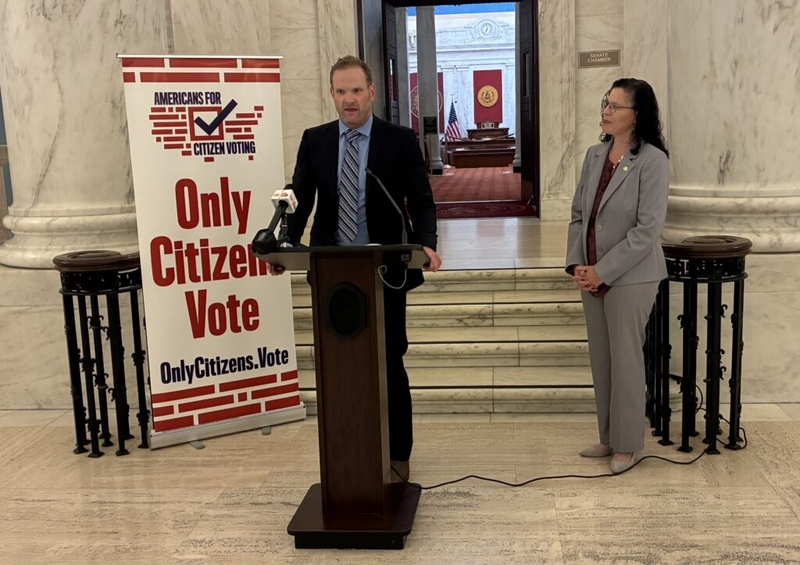
Jack Tomczak, vice president of outreach for Americans for Citizen Voting, and Sen. Patricia Rucker, R-Jefferson, spoke to reporters Tuesday in support of a ballot measure that would add an amendment to the state constitution prohibiting people who are not citizens of the United States from voting in West Virginia elections. (Photo by Lori Kersey/West Virginia Watch)
West Virginia state code prohibits people who are not United States citizens from voting in elections. A measure on the ballot in the November election would take the prohibition further by adding it to the constitution.
Sen. Patricia Rucker, R-Jefferson, a naturalized U.S. citizen and the lead sponsor of Senate Joint Resolution 9, which put the measure on the ballot, told reporters Tuesday citizen-only voting is a very important issue.
“West Virginia already has in code that only citizens can vote in elections, but that isn’t enough,” Rucker said. “That’s law. Law can change, as we know. Every legislative session we have, we can change law.”
She said the state constitution is not clear: it requires voters to be citizens of the state, but does not specify that they be U.S. citizens.
“This proposed amendment would ensure that no future Legislature could just simply change the election law with only a bill,” she said. “It also gives us greater authority to enforce the law we currently have in place.”
If the amendment is approved by West Virginia voters, that section of the state constitution would read as follows:
“Only citizens of the United States who are citizens of this state shall be entitled to vote at all elections held within the counties in which they respectively reside; but a person who is a minor, or who has been declared mentally incompetent by a court of competent jurisdiction, or who is under conviction of treason, felony or bribery in an election, or who has not been a resident of the state and of the county in which he or she offers to vote, for 30 days next preceding such offer, shall not be permitted to vote while such disability continues; and, a person in the military, naval, or marine service of the United States shall not be deemed a resident of this state by reason of being stationed therein.”
Besides Rucker, Senate Joint Resolution 9 was also sponsored by Sens. Chris Rose, R-Monongalia; Darren Thorne, R-Hampshire; Amy Grady, R-Mason; Craig Hart, R-Mingo; Laura Chapman, R-Ohio; Senate President Randy Smith, R-Preston; Rollan Roberts, R-Raleigh, Eric Tarr, R-Putnam; Jay Taylor, R-Taylor; Charles Clements, R-Wetzel; Trenton Barnhart, R-Pleasants; and Mark Maynard, R-Wayne.
The Senate and the House of Delegates both unanimously approved the resolution during the 2026 legislative session.
The League of Women Voters of West Virginia opposes the ballot measure. A statement on the organization’s website said the proposed amendment is “completely unnecessary.”
West Virginia Citizen Action Group also opposes proposed Amendment 1.
“This unnecessary amendment perpetuates long-debunked conspiracy theories and scapegoats our immigrant neighbors to sow mistrust in our election results,” Julie Archer, a representative of CAG, wrote in an email to West Virginia Watch. “West Virginia’s election process already includes strong safeguards to ensure only eligible citizens vote. Despite these safeguards, some politicians continue to spread falsehoods to undermine trust in our elections and justify restrictive voting policies that do more harm than good by disenfranchising eligible voters.”
Rucker was joined Tuesday by Jack Tomczak, vice president of outreach for Americans for Citizen Voting, an organization that works to pass citizen-only amendments around the country.
Fifteen states have amended their constitutions to prohibit non-citizens from voting in local, state and federal elections, Tomczak said.
“In every state, it has passed with overwhelming support, and we anticipate that again here in West Virginia,” he said.
Tomczak said the amendment would prohibit cities from allowing non-citizens to vote, as has happened in four other states.
Rucker said she’s unaware of non-citizens being charged with illegally voting in state elections but said while campaigning door to door, she had met some people who were registered to vote and did not realize that they were ineligible because they weren’t U.S. citizens.
“I had to inform them of that,” she said. “So it was, in their case, inadvertent; (they) just didn’t understand. Some of them had … automatically checked a box at the DMV without understanding that the box says you must be a U.S. citizen.”
A representative of Secretary of State Kris Warner’s office said that as the state’s chief election officer, Warner does not take a formal position on ballot issues or candidates.
Constitutional amendments need a simple majority of more than 50% of votes in order to pass. The general election is Nov. 3.
- September 16, 202610:21 amThis story has been updated to reflect that Julie Archer is a representative of West Virginia Citizen Action Group.
Charleston, WV