Wilmington artist remixes pop culture and politics to tell two sides of the American story
Nov 03, 2026 | 5:00 am ET
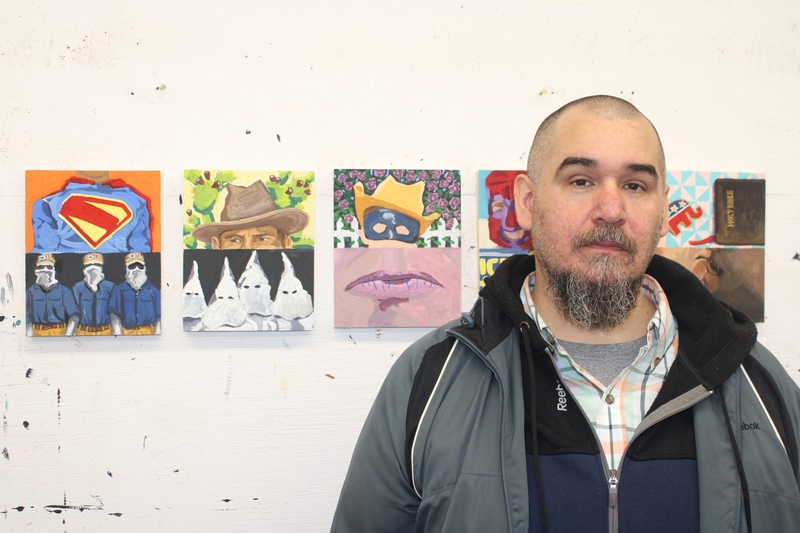
Description
Photo courtesy of Spotlight Delaware
Wilmington-based artist and writer Oscar Eduardo de Paz grew up on the north side of Chicago, a community he describes as brimming with both gang violence and police violence. de Paz was 13 when he first experienced the latter.
He was taking the trash out to the dumpster when a black sedan with tinted windows sped into the alley. Two police officers exited the vehicle, guns drawn, asking what was in the garbage bag de Paz had just dumped and whether he had any drugs on him.
Hearing the commotion, de Paz’s panicked abuela ran outside, yelling, “He’s a good boy!” Once the police officers checked the dumpster, finding only trash, they left.
Get Involved
Oscar Eduardo de Paz’s exhibition “Remixing Americana” is on display at Create Magic Art Shop (419 N. Market St., Wilmington, DE 19801) Nov. 6-28, with an opening reception on Friday, Nov. 6, 5-8 p.m. Create Magic’s regular hours are noon-7 p.m., Wednesday through Saturday.
de Paz will also participate in the Shifting Perspectives: Art in America symposium at The Delaware Contemporary (200 S Madison St. Wilmington, DE 19801), on Thursday, Nov. 12, 11 a.m.-4 p.m. Tickets are $25.
de Paz never thought of himself the same way again. He realized that, simply because of his ethnicity, some people saw him as “a threat whose life was expendable.”
de Paz found himself reflecting on that incident after a white police officer shot and killed 18-year-old Michael Brown in Ferguson, Missouri in 2014, reinvigorating the Black Lives Matter movement.
“I’m sitting there, watching the news. I have my little ones. I’m like, ‘Man, my life could have been totally different had that cop just pulled the trigger,’” de Paz recalled.
de Paz told the story of that run-in with police in his 2024 book “A Violent Break,” which originated as an audio essay called “After Dinner.” He submitted the audio essay to a 2018 contest by the University of Delaware Center for Political Communication, which he won.
de Paz was a Ph.D. student at the Biden School of Public Policy and Administration at the time, a program he’d entered with the hopes of affecting change around policing, healthcare, immigration and more.
But he’d become even more disillusioned with the system while working on his dissertation about environmental justice.
de Paz had interviewed residents of cities like Chester, Pennsylvania (home to the largest trash incinerator in the country) and Flint, Michigan (where an emergency manager’s switching the water supply as a cost-cutting measure in 2014 resulted in the contamination of the city’s drinking water).
de Paz noticed residents had a lack of faith in institutions like the government, universities and nonprofits, believing they could not bring about positive change. As de Paz learned more about the pitfalls of bureaucracy in his research, that belief began to rub off on him.
The “death of (de Paz’s) Ph.D.” came during the award ceremony where he performed “After Dinner.”
“After that event, someone came up to me, and they shared with me, ‘I really appreciate that you didn’t hit me over the head with your political argument. You just shared your story. I have to think of policing differently,’” de Paz recalled.
While learning about public policy had begun to make moving the needle feel impossible, art filled de Paz with a passion to change minds and start conversations.
So, when the COVID pandemic hit, de Paz decided to quit his Ph.D. and commit himself to writing and the visual arts.
“I get a lot of side-eyes,” de Paz said with a laugh. “I’m a little bit of an all or nothing person, and I think that’s partly because that’s what survival has taken. I was homeless at 16. I had to drop out of high school. There was no, ‘Let’s take our time.’ Maybe that’s why I paint the way I paint, too — like time will run out.”
It’s an apt description for such a prolific artist. de Paz is constantly working in his studio at The Delaware Contemporary.
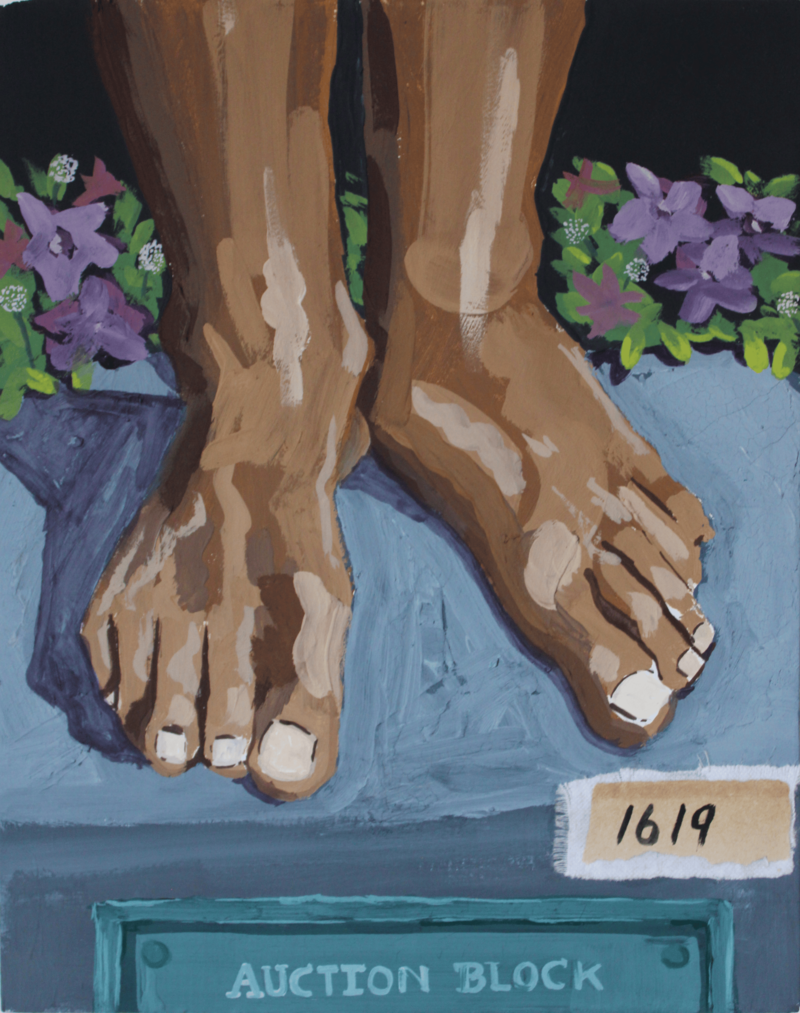
In the past six months, de Paz has painted over 40 paintings as part of a series called “Remixing Americana,” which will be on display at Create Magic Art Shop in Wilmington this month.
Each painting is divided in two, usually with a symbol from American mythology or pop culture on one half of the canvas and a more political image on the other half.
For example, in one painting, the top half of the canvas shows a football helmet. The bottom half depicts a military plane in a warzone (the billowing smoke is a collage of presidents’ hair from fake dollar bills).
In other paintings, de Paz pulls from his childhood obsession with comic books. He juxtaposes two depictions of costumed vigilantes by placing Superman alongside masked members of the white supremacist group the Patriot Front. Meanwhile, he questions Americans’ willingness to fight for liberty by placing Captain America next to a plantation house.
“Do we have the revolutionary spirit that we claim to have in this country? That’s something that I think we have to ask ourselves,” de Paz said.
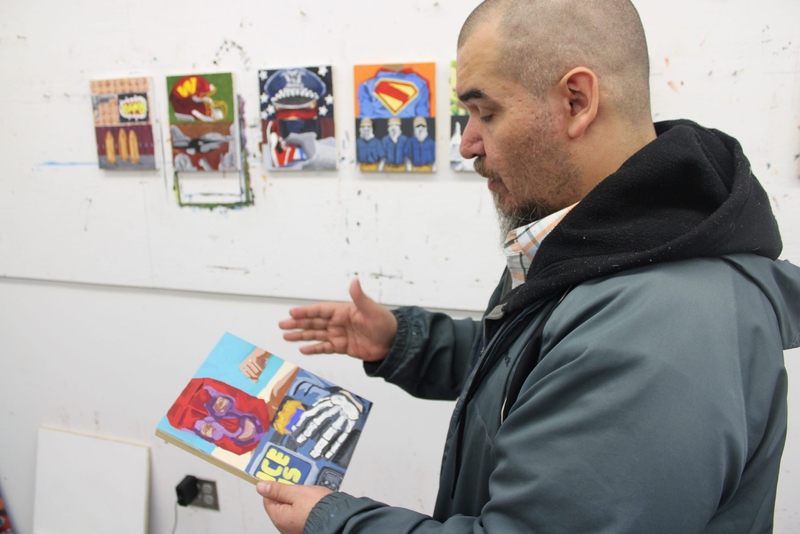
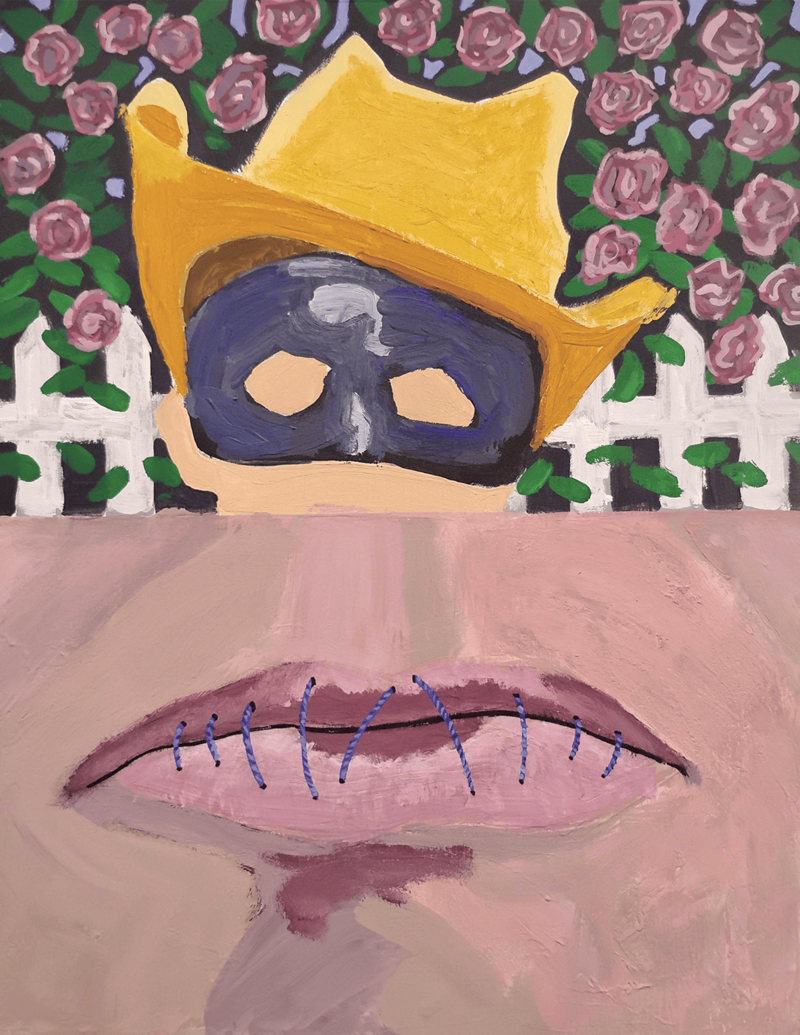
In another piece, de Paz paints his 11-year-son in a luchador mask next to a U.S. Immigrations and Customs Enforcement (ICE) agent.
“There’s this contrast between the child’s play as a hero — saving the disadvantaged, saving those who are weaker — (and) who we claim to be heroes. They’re often enacting violence and actually, often, policing the weak and the poor,” de Paz said.
The painting is also a commentary on the stereotyping of immigrants as criminals under the Trump administration.
“We’re losing the image of the innocence and playfulness of them as children,” de Paz said.
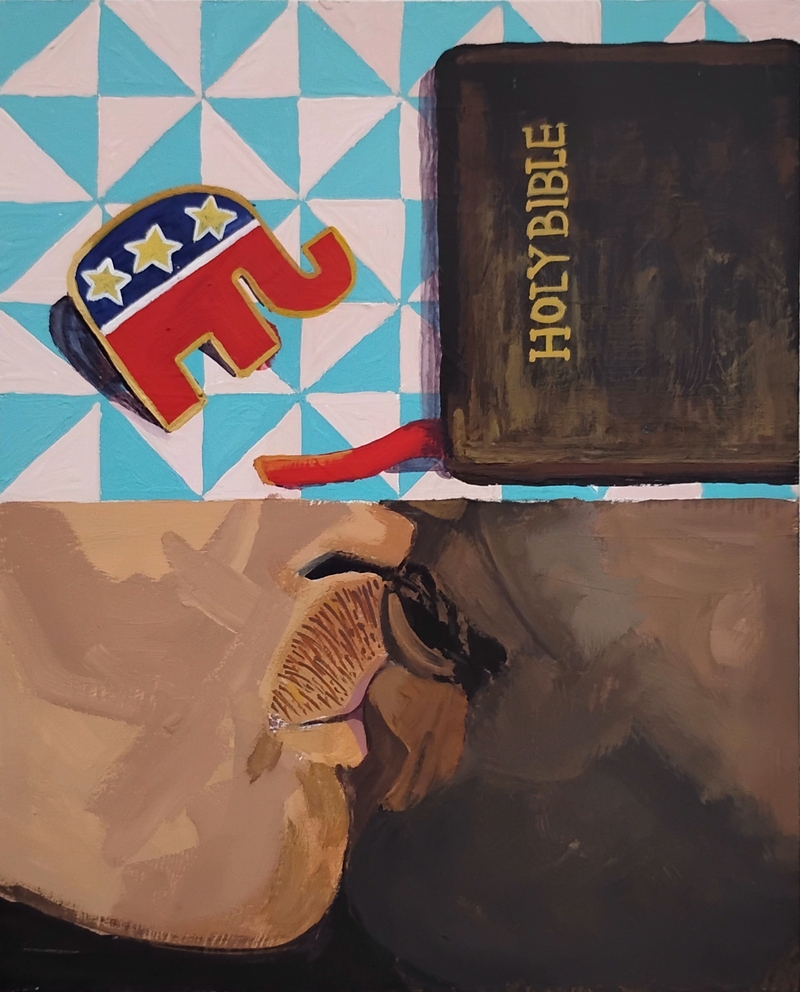
The experience of looking at one of de Paz’s remixed paintings is not dissimilar to the tonal whiplash one experiences while scrolling on social media. By creating collisions between iconography and stark reality, de Paz hopes to inspire the viewer to think critically about what story America has told in its first 250 years.
de Paz sees violence as “staggeringly central” to the American story, from the near-genocide of Native Americans to the societal acceptance of police violence “as a solution, versus a flaw.”
“We seem to only be leaning into it further, with increasing militarization of our streets, with rises of homophobia, anti-trans language and treatment, and a continued prison system that hasn’t shrunk, has grown, and has had such an appetite that now, it’s had to find new groups to detain in large numbers. We see that with the increase of ICE and these detention facilities,” he added.
While de Paz doesn’t provide solutions or answers in his work, he hopes it sparks rumination and discussion.
“I think to be reflective of the human experience is recognizing the light with the dark, how our social experiences come with these trade-offs,” he said. “An American story can’t be told without both halves being in conversation.”

Dover