Will Rhode Island claw back SNAP benefits per USDA memo? To be determined.
Nov 10, 2025 | 4:43 pm ET
Description
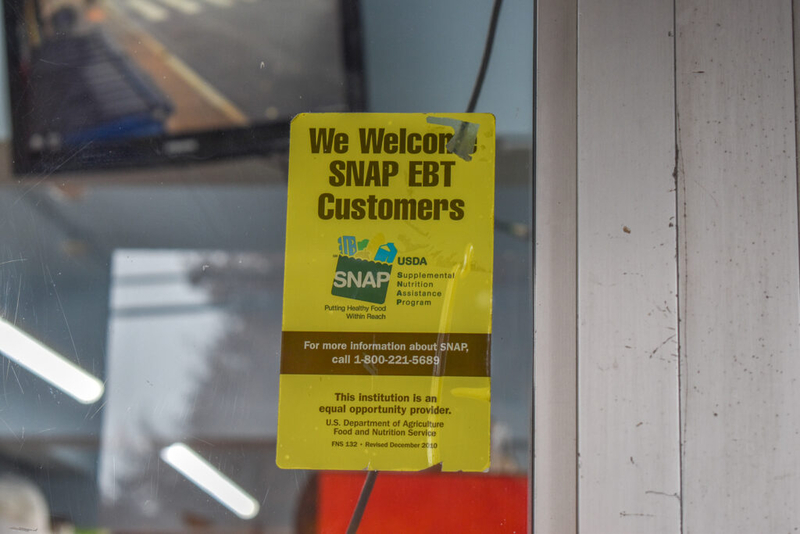
A sticker welcoming SNAP recipients seen on the door of La Familia Meat Market in Providence's Silver Lake neighborhood. (Photo by Christopher Shea/Rhode Island Current)
Update: Gov. Dan McKee’s office responded to Rhode Island Current’s repeated inquiries for comment Monday night. Olivia DaRocha, a spokesperson for McKee’s office, referenced a federal judge’s order from earlier Monday that temporarily prevents the federal administration from clawing back food assistance as an answer to the governor’s intent to comply with the federal order.
“We are committed to ensuring Rhode Islanders continue to access 100% of their benefits for the month of November,” DaRocha said.
Gov. Dan McKee made clear the Trump administration was to blame for the “chaos and hardship” created by the series of conflicting directives over federal food assistance for low-income families.
But McKee’s Sunday afternoon statement was fuzzy on whether Rhode Island will comply with an eleventh-hour U.S. Department of Agriculture (USDA) memo, demanding states undo the payments that in some cases had just been distributed to recipients of the Supplemental Nutrition Assistance Program (SNAP) hours earlier.
“We have reached out directly to Food and Nutrition Service (FNS) within the USDA related to the latest federal communication,” McKee said. “At this time, recipients’ [electronic benefit transfer] cards remain active, and we are seeing Rhode Islanders successfully using those cards.”
He also alluded to in-progress “contingency strategies,” promising, “we will continue to keep Rhode Islanders updated.”
DaRocha declined to share details on contingency strategies Monday night.
The routine transfer of funds to debit cards for SNAP recipients at the beginning of each month has been anything but ordinary during the government shutdown. Funding ran dry ahead of Nov. 1, stoking fears among the 42 million SNAP beneficiaries across the country, along with community nonprofits and grocery stores who depend on the business.
Just in time, on Oct. 31, a pair of federal court rulings in Rhode Island and Massachusetts presented what looked like relief by ordering the Trump administration to tap emergency federal funding to revive the program — first with partial payments, and then, the full amount ordinarily given per recipient per month. By Friday, the money started flowing to recipients; 79,000 Rhode Islanders had received the full monthly payments as of 4:30 p.m. Saturday — a little over half of the 140,000 total beneficiaries in the state — according to McKee’s office.
All SNAP recipients have received full benefits as of Monday night, DaRocha said.
A few hours later, the infamous USDA memo ordered states to “undo” payments, warning that the move was “unauthorized.”
Other Democratic governors stated outright they would not comply with the USDA order. Gov. Tony Evers of Wisconsin summed up his response in a single word, “no,” while Massachusetts Gov. Maura Healey challenged President Donald Trump to a legal fight, declaring “we will see him in court.”
Even Connecticut Gov. Ned Lamont, who like McKee has attempted to walk the line between condemnation and conversation with the federal administration, said he would not pull back the SNAP payments already distributed to Connecticut residents, according to news reports.
McKee’s moderated response mirrors his administration’s messaging toward Trump through most of the year — critical, but not bombastic.
“I think it’s in keeping with his relative unwillingness to sort of play the fighter against the Trump administration for lack of a better word,” Adam Myers, an associate professor at Providence College, said in an interview Monday. “Some governors really thrive on that and are trying to make a national name for themselves. That hasn’t really been [McKee’s] approach.”
Myers also sought to distinguish the SNAP funding fight from other battles states have led against the Trump administration for overstepping federal authority on immigration policies, public health, and education, among others. By contrast, federal food assistance has historically been propped up entirely by federal dollars, with states acting as program administrators.
“Intergovernmental programs like food stamps make it difficult for voters to hold government accountable because they don’t know which level of government is at fault,” Myers said.
McKee, who is already facing a stiff reelection battle next year, made clear the blame lies with Trump and the USDA’s “whipsaw memo.”
Helena Buonanno Foulkes, the former CVS executive who is challenging McKee in the 2026 Democratic gubernatorial primary, criticized the governor in a statement Monday afternoon.
“As Governor, I would refuse to take back SNAP benefits from families who are counting on them to feed their children,” Foulkes said. “This is a president who was trying to make people go hungry as a bargaining chip and I will use every legal tool available to protect Rhode Islanders from President Trump’s harmful attacks.”
But finger-pointing offers little assurance for the low-income Rhode Islanders who depend on the federal food assistance program to afford groceries each month.
The back-and-forth continues to play out in court — both the U.S. Supreme Court and a separate case being heard in U.S. District Court in Massachusetts. Meanwhile, the U.S. Senate advanced a short-term funding bill Sunday night that includes full funding for SNAP.
As of Monday, full payments appear to still be available for Rhode Island SNAP beneficiaries, said Kate MacDonald, a spokesperson for the Rhode Island Food Bank. The Rhode Island Department of Human Services, which administers the program on behalf of the state, did not respond to requests for comment Monday.
La Familia Meat Market in Providence’s Silver Lake neighborhood, which accepts EBT cards, saw fewer shoppers last week and over the weekend, cashier Maria Hernandez told Rhode Island Current on Monday afternoon. The bodega was quiet except for the hum of fluorescent lights and refrigerators.
“They already don’t have that much money, now they can’t even put anything on their (EBT) cards,” she said in Spanish.
But 500 feet down Pocasset Avenue at Chapines Market, shoppers were seen ordering cuts of meat and picking up plantains from one of the fruit crates near the entrance.
“It’s more or less the same here,” said cashier Evelyn Quiroa.
Local food pantries and soup kitchens reported surges in clients in late October, suspecting the increase was because people were trying to stock up ahead of the loss in monthly federal food assistance.
Meanwhile, questions and concerns about food assistance flooded the phone lines for United Way of Rhode Island’s 211, a 24/7 service provider line. The nonprofit reported 970 calls in total within the first week of November — 30% higher than the typical volume, Michael Cerio, a spokesperson for United Way, said in an interview Monday. Questions specific to food pantries were up 250%, while calls seeking information about the latest guidance on SNAP rose 157%, Cerio said.
Call data does not reflect in-person interactions through United Way’s outreach services. The nonprofit regularly sends employees to community service locations, including food pantries, to educate, answer questions and help people apply for federal food assistance.
Reporter Christopher Shea contributed to this story.
- 6:41 pmUpdated to include a response from Gov. Dan McKee's office.
- 4:53 pmUpdated to include a comment from Helena Buonanno Foulkes.
Providence, RI