Who’s tracking Arizona drivers through Flock cameras? Often, it’s police from other states.
Sep 25, 2026 | 11:59 am ET
Description
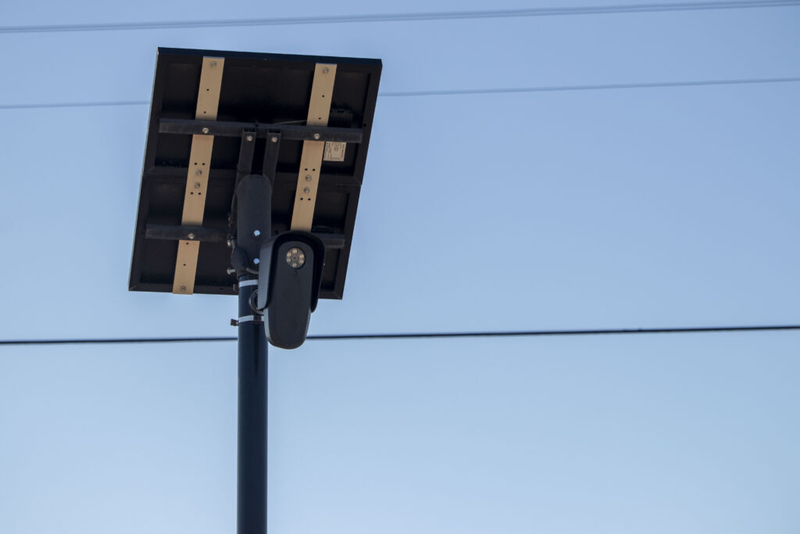
A Flock Safety license plate reader camera near Casa Grande, Ariz., in October 2025. (Photo by Jerod MacDonald-Evoy/Arizona Mirror)
Law enforcement agencies outside of Arizona are some of the biggest users of Flock data gathered by the Maricopa County Sheriff Office and Lake Havasu Police Department, records obtained by the Arizona Mirror show. Both agencies say they’re limiting that data sharing, but privacy advocates are still concerned.
The records detailing Flock usage by the two law enforcement agencies, which the Mirror obtained under Arizona’s public records law, show how police both locally and nationally have been using the AI-powered automatic license plate reader technology that has become a pain point for agencies as cities across the country are canceling their contracts over privacy and misuse by police officers.
Several cities in Arizona have terminated their contracts with Flock Safety in recent weeks, including Chandler and Surprise, over privacy concerns raised by citizens and instances of misuse that have been discovered both locally and nationally. The city of Tempe is currently discussing an outright ban on the technology, and Attorney General Kris Mayes is conducting a review of its use in Arizona.
Locally, police have come under investigation for misuse of the system, including an Apache Junction police officer who used the system to track his wife. The Apache Junction Police Department, whose chief testified earlier this year in favor of a bill that would have shielded ALPR data from public release, has decided to continue using the system.
The Mirror analyzed Flock data from both MCSO and Lake Havasu PD to understand what police have been using the system for — and who has been using it.
Of the 137 agencies Lake Havasu PD shared its data with, 58 were in-state agencies. Searches of Lake Havasu’s system were dominated by agencies hundreds of miles away from the small city in northwestern Arizona.
The Houston Police Department, which is some 1,300 miles away from Lake Havasu City, made up 31% of all searches from June 1 to July 1, 2025. By comparison, every other law enforcement agency in Arizona made a combined 53,214 searches — or roughly 22% of all searches — in the same time period.
“It is extremely concerning the amount of out-of-state agencies accessing where Arizonans are on a day-to-day basis,” Katelynn Contreras, policy strategist at the American Civil Liberties Union of Arizona, told the Mirror.
The MCSO records show that the agency shared its Flock “hotlists” with a number of out of state agencies, both federal and state, as well as non-law enforcement entities, including at least one school district in Nevada and the Nevada Department of Motor Vehicles.
Hotlists are lists created by law enforcement that allow them to get specific notifications on vehicles of interest that pass by Flock or other ALPR cameras. MCSO’s hotlists were also shared with 77 other agencies, including Customs and Border Protection and the Secret Service.
Both MCSO and Lake Havasu said they are now sharing their hotlists only with in-state agencies with Lake Havasu stating they implemented the policy this month.
“We did share search functions to other (law enforcement agencies), but the position of the office has been to keep this with AZ agencies only,” MCSO spokesman Lt. Jason Thomas told the Mirror. “Any data shared with Federal Agencies was most likely brief and before we had established any … data sharing (policies).”
While other municipalities have been suspending or terminating their Flock contracts due to public backlash and controversies involving members of their own departments, Lake Havasu said that it intends to continue moving forward with the program.
“The Lake Havasu City Police Department is aware of the concerns that have been raised regarding the use of this technology. The Department takes these concerns seriously and remains committed to maintaining public trust and transparency,” Sgt. Kyle Ridgway with the agency’s Professional Standards Unit told the Mirror. “At this time, there are no plans to cancel or discontinue the Department’s contract with Flock Safety. The Department intends to maintain the existing agreement while continuing to evaluate and implement appropriate safeguards to ensure the technology is used responsibly and consistent with Department policy.”
But data sharing between agencies isn’t all the Mirror found.
MCSO’s hotlists included names like “Meth Jungle,” “All” and “Salty,” which doesn’t comply with the agency’s rules or Flock’s training guidelines. MCSO said it could not explain all the hotlist names.
“These were labeled by the user. Without contacting the user, we would not be able to explain this,” Thomas said of the hotlists. Many of the hotlists in question list MCSO as their creator.
Additionally, the Sheriff’s Office said it could not explain why 35% of the organizations its hotlists were shared with were listed as “organization not found.” Thomas told the Mirror to reach out to Flock for an explanation, but the company did not respond to a request for comment.
Thomas said the purpose of the hotlists is for “recurring alert-based query” and that some of the lists may be part of ongoing investigations. And, he said, they are only shared with other law enforcement.
“Sharing a hotlist to other LE is acceptable. The investigator decides on sharing (a) hotlist depending on the facts of the investigation,” he said. “The base factor is, does the investigator believe there is a need for other agencies to assist in locating a wanted person associated (with) a vehicle.”
MCSO itself is a prolific user of the technology, with data on searches by the agency from November 2024 to August 2025 showing deputies performed over 13,000 searches. In that time period, the agency searched individual Flock cameras more than 100 million times. (Every search can be applied to hundreds or thousands of cameras at a time.)
The reasons for those searches also have privacy advocates raising questions.
When utilizing the Flock system, law enforcement must enter a reason for the search, and MCSO policy requires deputies input the case number the search is related to. A large number of MCSO’s searches appear to include case numbers, however, many are incomplete, include odd phrases or are just a series of letters.
“Snap investigation,” “Facebook,” “a,” “Case,” “eee,” “LAW ENFORCEMENT INVESTIGATION,” “Surveillance” and “search” are just some of the reasons given to search the system.
MCSO said that those notations are not allowed, though it could not explain what any of them mean.
“For a brief period, a user was not using case numbers as instructed. This has been rectified. The words listed were only useful to the user that entered them,” Thomas said.
But the ACLU of Arizona said it is indicative of the larger privacy concerns around the technology, especially when outside agencies are involved.
“Law enforcement not entering a legitimate reason, that being a case number, is really concerning.” Contreras said, adding that “not all of these other organizations that are accessing this data share the same values as us as Arizonans.”
Both MCSO and Lake Havasu PD said they are using the system appropriately.
MCSO said that “all users are given instruction that personal or curiosity searches are prohibited” and Lake Havasu said it has been implementing new safeguards “over the past several months.”
“These measures include updates to our policy establishing more consistent and comprehensive auditing procedures,” Ridgway said, adding that monthly audits and “spot checks” are now performed. “We have also implemented administrative alerts to identify potentially repetitive or unusual search activity. These alerts notify administration when an individual user enters the same license plate multiple times or searches the same license plate more than 30 days apart. These safeguards provide additional oversight and help ensure Flock data is accessed appropriately and for legitimate law-enforcement purposes.”
Even with those rules in place, the ACLU and other civil libertarian organizations say the technology should be banned outright, or at least require a warrant for its use.
“Where you are driving can reveal very personal details about which doctors offices people go to, religious institutions they attend, AA meetings, gun shops, protests, things like that. So, when we have out-of-state agencies searching where Arizonans go on a day to day basis, it does cause a lot of concern,” Contreras said. “It is not only the impacts on rights to privacy but all our other rights as Arizonans are being targeted by this mass surveillance dragnet system.”
Phoenix, AZ