Wendell Berry’s death should be his revival in our culture
Sep 07, 2026 | 5:30 am ET
Description
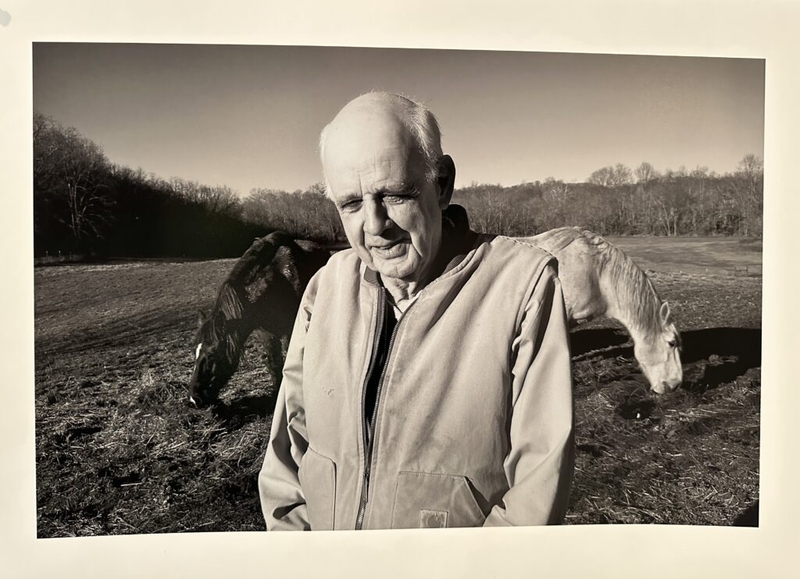
Wendell Berry with Nip and Jed, Lane's Landing Farm, Henry County, KY 2012. (Photo by Guy Mendes)
Throughout his life, Kentucky writer Wendell Berry described death not as an end, but as a stage in a cycle of renewal. Those who die return in body to the earth and endure in the memory of those who loved them. In “Three Elegaic Poems,” dedicated to his dying grandfather, Berry says the old man is “set free in our remembering.” “Grown brighter than vision. . . he’s hidden among all that is, and cannot be lost.”
Berry’s death at age 92 comes while his ideas are as relevant as ever. The tired labels of “liberal” and “conservative” are blurring, just as Berry himself always defied easy categorization. He held prescient and timely fears that rootless people would snap in the face of rapid change and ruthless power.
In a time of division, and with the hope of reconciliation, it’s worth examining how Berry’s ideas might apply to Kentucky today.
Hard work is a central value in Berry’s writings and at the forefront of what Kentuckians hold dear. And from debates about welfare cuts to the need for jobs that can pay rising bills, it is at the core of our major political debates.
For Berry, work was not just about sacrifice and drudgery. He was in favor of labor as a vocation; work as a calling with purpose. He advocated for more small farms not just because he was an agrarian. He had a Jeffersonian vision of widespread ownership where work is a source of pride and a nourishing contribution to self and community. It’s a far cry from the many jobs of today that are stripped of ownership and meaning, and that leave workers alienated and vulnerable.
Wendell’s Berry’s writings were also about place. In a world of “anywheres,” Berry encouraged becoming a “somewhere.” Knowing a physical place and its people intimately and over time instilled an ethic all on its own. “What I stand for,” said Berry, “is what I stand on.”
That principle is on display in the current debate over data centers in rural Kentucky. Republicans, Democrats and Independents are defending the character of their communities, an integrity they see as threatened by power- and water-thirsty data centers.
Opposition to data centers also comes from growing concerns about artificial intelligence, especially among young people. Berry, who never owned a computer and farmed with horses, was a lifelong critic of unbridled technology.
At his angriest, Berry railed against the power of unaccountable corporations that ravaged communities to bolster profits. These concerns are also spreading, as with a Mercer County man who spoke out against a local data center proposal and told Kentucky Public Radio, “Conservatism is dead, and that’s unfortunate. And a corporatocracy has taken over.”
Berry’s criticism of the economic system focused most on agriculture, as in his 1977 book “The Unsettling of America.” There he took on the agribusiness model that ever more rapidly consolidates food production in the hands of a powerful few. Now dwindling beef farmers, for example, are caught in a globalized system and captive to the wishes of four massive corporations that control the market. They struggle under the Trump tariffs and are speaking out about new efforts to undercut prices with imported beef.
Berry praised the alternative of the New Deal-era tobacco program, which his grandfather inspired and his father helped create. The program was designed around farmer-led cooperation and resulted in fair prices from modest patches. Here was a government that created a framework that empowered local people and communities. That’s much different than one that takes control away and distributes wealth upward.
In “The Hidden Wound,” Berry described racism as something that doesn’t just harm Black people but corrupts whites as well. In a time of backlash against talking about race, he reminds us of the loss we all experience from a broken whole.
Berry was a small-r republican and a small-d democrat. He expected people to live with virtue and devotion. And he hammered the powerful that exploit and extract. His alter ego, the “Mad Farmer,” called on people to “denounce the government and embrace the flag.”
Wendell Berry sought an economy that linked the soul and the household to the land, community and everything beyond. If we want to avoid “The World-Ending Fire,” the title of another Berry book, we might well listen to his words “lest the dead die a second and more final death.”

Frankfort