Well Reopening Near Red Hill Stirs Up Lingering Concerns Over Poisoned Plume
Oct 05, 2026 | 6:01 am ET
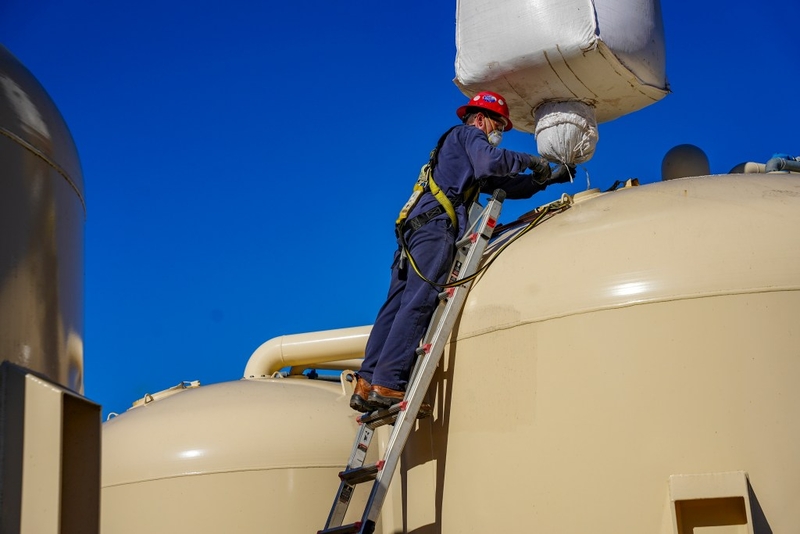
Description
Photo courtesy of Honolulu Civil Beat
In the coming weeks, the Navy plans to reopen a well closed since an estimated 20,000 gallons of jet fuel from the Red Hill Bulk Fuel Storage Facility spilled, seeped into the aquifer and contaminated drinking water for thousands of homes.
Following a March report by the Environmental Protection Agency that declared the drinking water in the Joint Base Pearl Harbor-Hickam water system “free of fuel contamination since 2022,” the state Department of Health notified the U.S. Navy earlier this month it would grant conditional approval to reopen the ʻAiea-Hālawa Shaft. According to the department, the Navy must continue to meet the state’s standard rules for drinking water quality and notify the department of any additional potential contamination.
The well is one of two federally owned wells that have been closed since the spill in December 2021 and could be reopened at any point. It has been outfitted with a multistep filtration and disinfection system.
The move is a step toward bringing parts of the fractured water system back online nearly five years after fuel from the Navy’s World War II-era facility leaked into Pearl Harbor's drinking water and sickened thousands of residents, some of whom say they continue to feel health impacts to this day.
But the decision to reopen one of the wells shuttered in response to the fuel contamination disaster is fraught with community anxiety as many remain distrustful of the military.
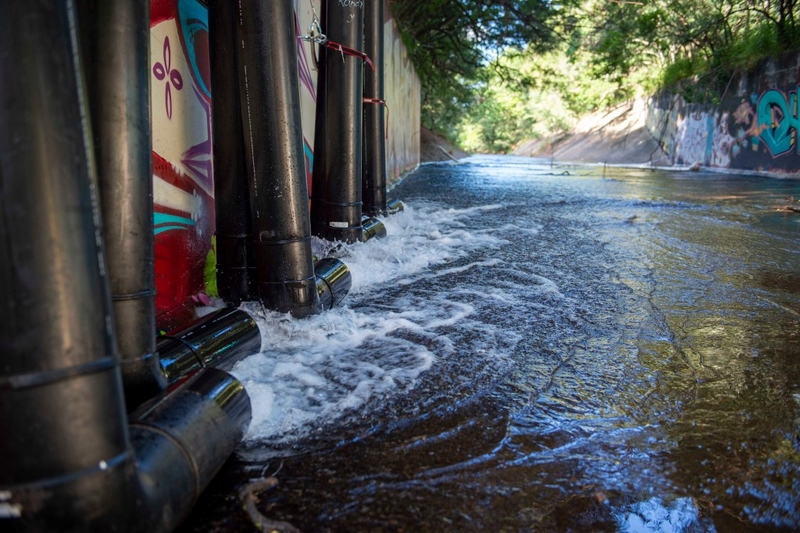
Some of the area’s residents, along with several clean water advocates, view the reopening as premature. The aquifer below the Navy’s World War II-era tanks remains contaminated, and advocates are concerned pumping water out of the ground could suck that lingering jet fuel into the drinking water system.
“We really have no clear idea of how this contamination plume could move, if they reactivate a shaft and start pumping it again,” said Wayne Tanaka, director of the Sierra Club of Hawaiʻi. “If you suck a slug of contamination into this experimental filter system, we don't know if that might overload the filtration system.”
He added that detection of the “forever chemical” PFAS in wells run by the Honolulu Board of Water Supply, and those found in Navy wells, suggests that groundwater tends to move west and northwest from the Red Hill Facility.
Seeking to reassure residents, the Navy maintains that it will test and filter the water from the reopened well. However, the military’s track record of water testing has not inspired public confidence.
The ʻAiea-Halawa well only accounts for an annual average withdrawal of 0.697 million gallons per day, or between 2% and 5% of the Joint Base Pearl Harbor-Hickam water system’s overall capacity. But it will serve as an important backup source of water for a system that has for the last five years relied solely on the Waiawa Shaft well to serve over 93,000 customers on the base and in the surrounding community.
A week after the announcement, base commander Capt. John Frye notified water customers in the region that the Navy would begin operating the well, with a multi-step filtration system “no earlier than September 28.”
The aquifer below the Red Hill tanks is still believed to be contaminated. To contain that pollution, the Navy is currently pumping, treating, and dumping an average of 1.7 million gallons of water — the equivalent of 250,000 swimming pools — from the Red Hill Shaft well every day. It says there is no jet fuel in water being pumped through the Waiawa shaft.
“The current network of 49 groundwater monitoring wells in and around the Red Hill Bulk Fuel Storage Facility has demonstrated that there is no evidence of fuel migration from Red Hill,” Charles Anthony, the public affairs officer for Joint Base Pearl Harbor-Hickam, said in an email.
While the elements of crude oil — total petroleum hydrocarbons or TPH — are still being found throughout the water system, they can be easily mistaken for other organic material, including algae. There have also been no scientific studies to determine the exact impact jet fuel or its remnants may have on human health.
Second only to tourism as an economic engine in the state, the U.S. military spends billions and employs thousands of people in Hawaiʻi. It wields considerable power over the state’s key agencies, said Marti Townsend, engagement specialist at Earthjustice and a Red Hill watchdog since the first documented fuel spill in 2014.
“What we're seeing is an example of the military gets what the military wants,” Townsend said, “and the military wants to have backup sources of water, and so they're going to get that.”
The Navy’s Plan: ‘Back To Normal’
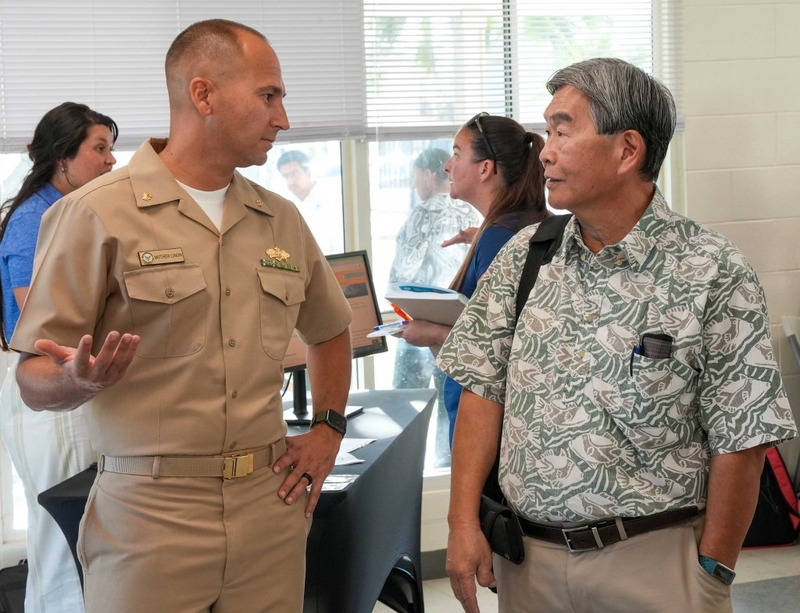
In mid-September, the Navy held two town hall meetings in the neighborhoods surrounding the joint base. Residents, including many who had been impacted by the fuel spill, turned out in droves to hear from the Navy and air their concerns.
Rear Adm. Lester Ortiz, a spokesperson for the Navy Closure Task Force — the group working to clean 20 fuel tanks stored at Red Hill and remove the pipelines around them — said the Navy had removed “about 3,785 gallons of residual fuel” and is working on a plan to remediate the toxicity in the area.
He also spoke of the EPA report from March, and announced that in addition to reopening the ʻAiea-Halawa shaft, the Navy intends to reopen the Red Hill shaft by 2028 and build a water treatment facility by 2030.
“Now that we are in compliance and everything is fine … we can just go back to normal and provide the joint base with all the tools that they need to continue the effort of providing drinking water in a safe manner,” Ortiz said.
The Navy, he and other officers emphasized, has been working toward transparency to earn back residents' trust, and it samples and posts water testing results on the Joint Base Safe Waters website. The most recent samples were taken in July.
Per- and polyfluoroalkyl substances (PFAS) have been found in the ʻAiea-Halawa well at a level that exceeds EPA’s recent maximum contaminant level of 4.0 parts per trillion. A simultaneous investigation is going on for PFAS at Red Hill, but it is still at an early stage. The Navy has installed both granular activated carbon or GAC and ion exchange resin to remove PFAS and TPH.
Mystery Of Total Petroleum Hydrocarbons
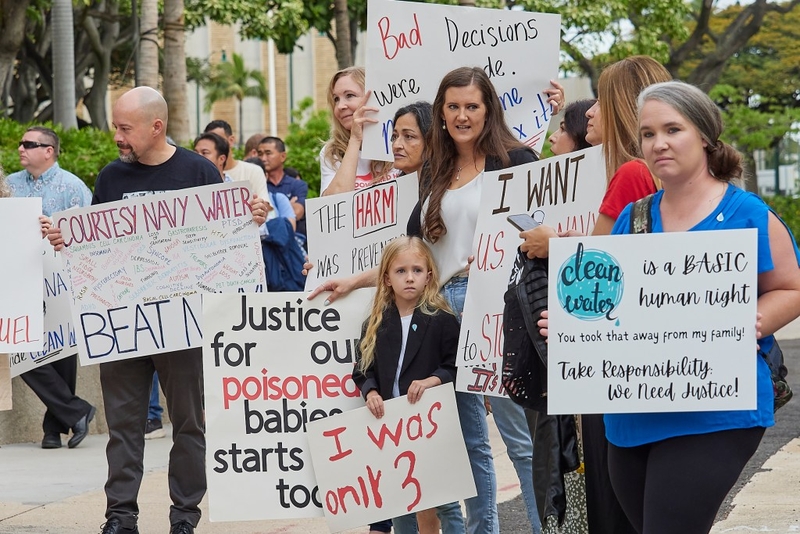
Michelle Popplin was at the second town hall meeting, held in ʻEwa Beach. She, her husband and her daughter have dealt with rashes and other health issues they blame on exposure to the water in the Joint Base Pearl Harbor-Hickam Water System.
Popplin’s daughter is one of thousands of plaintiffs in an ongoing lawsuit against the military that has yet to be resolved for all but 16 people, who were awarded $17 million in May 2025.
The family lives in Kapilina Beach Homes, a private mixed military and civilian development in ʻEwa Beach once owned by the Navy. Popplin says they were “the last community to be notified during the crisis” and that they didn’t receive a notification of the ʻAiea-Halawa well’s reopening earlier this month either, when military families did.
Popplin sees it as a significant change to her family’s water system, and said she believes residents have a right to be informed about “what is changing, what protections are in place, and what is known about how our community's water supply is connected.” So far, she said, that hasn’t happened.
At the town hall, Popplin asked a question she had been mulling for a while. Once the ʻAiea-Halawa well reopens, will the water it produces be combined with the water from the Waiawa well? Commander Jason Dunn answered: Yes.
“The system is designed so that all three wells, when they do supply drinking water into the system, come into the same distribution transmission area and get disseminated or distributed across the system,” Dunn said.
Hearing this worries Popplin, in part because a recombined water system could make it difficult to determine the source of contaminants in the future.
She had for years been told that the Red Hill contamination didn’t reach her community and yet, she said, multiple neighbors complained of rashes and other health problems in 2021.
“There were decades of contamination,” she said. “What happened in November of 2021 happened to just be so bad, finally, for enough people to get sick all at once.”
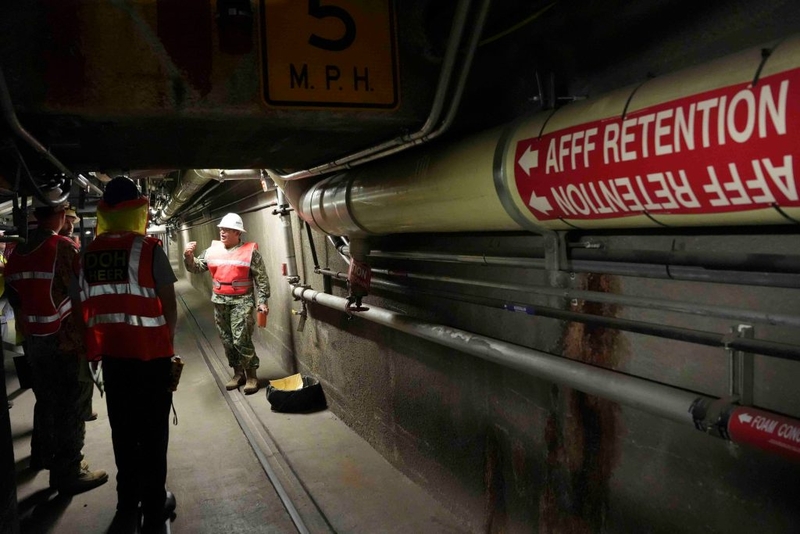
Since 1943, Red Hill has recorded at least 73 fuel leaks totaling at least 178,000 gallons, according to a 2020 assessment commissioned by the Honolulu Board of Water Supply. However, the Navy has disputed this.
Susan Gorman-Chang, the outgoing chair of the Red Hill Community Representation Initiative, a group of Red Hill residents and their advocates, had similar concerns.
The Navy conducted a pilot study in 2025 that involved sending water from the ʻAiea-Hālawa shaft well through the granular activated carbon and ion exchange filters. The study found evidence that the systems would be capable of removing PFAS from the water once it starts pumping it, and it estimated that it would likely also remove TPH — although the evidence about that was less definitive.
When Gorman-Chang read the appendix to the pilot study, she learned that the laboratory had already found TPH identified as remnants of diesel, gasoline and oil in the shaft’s water at levels above the Department of Health’s “environmental action levels” of 91 micrograms per liter. Because TPH is a sign of so many different chemicals, the Navy said those numbers could have been caused by chlorine found in the laboratory.
At the town hall meeting Stephen Hurff, director of environmental restoration and compliance policy in the Office of the Deputy Assistant Secretary of the Navy, said chlorine is typically used to preserve the water samples and neutralized before the testing is completed.
“When you neutralize the chlorine, it doesn't produce that false positive,” Hurff said. “And with the samples that we're talking about, that neutralization step wasn't conducted.”
After years of asking for receipts when military leaders offer explanations, but not receiving them, Gorman-Chang said, “there are just too many unanswered questions” to open the well now, and “too much documentation we would still like to see.”
Who is Holding the Bag?
The Department of Health is the primary regulator overseeing the reopening, in collaboration with the EPA. Joanna Seto, administrator of the Environmental Management Division at DOH said the department plans to monitor the Navy’s water test results closely, but it won’t do regular testing of its own.
In February 2024, Seto told Civil Beat, DOH contracted with an independent petroleum forensic expert to analyze water from all three Red Hill wells and 12 homes on the base. The testing included chemical fingerprinting and a full-scan analysis using a method used specifically for semivolatile organic compounds to determine whether detected organic material was petroleum-related. DOH determined that the results indicated the water was safe.
Seto added that DOH conditional approval of the former well was based on “extensive testing, treatment, monitoring and other requirements designed to protect the public water system.”
Experts at the agency say they are not concerned about how the plume could be impacted by pumping at the ʻAiea Hālawa Shaft either, due to the low rate at which water is expected to be withdrawn and other conditions specific to the site.
Tanaka and Gorman-Chang both told Civil Beat they have asked the Navy for evidence that the water in the ʻAiea-Halawa well will be certified by National Sanitation Foundation and American National Standards Institute at the NSF 61 level — the national standard for drinking water — but the Navy has not produced this evidence.
When asked by Civil Beat about whether the water would be NSF 61 certified, Anthony, the Navy spokesman, said, "The Navy is following the Hawaii Department of Health (DOH) requirements for the reactivation of the Navy Aiea-Halawa Shaft. NSF/ANSI/CAN 61 certification is a standard practice for ensuring materials are safe for drinking water."
The Department of Health, when responding to questions from community members in April, said the NSF standards are not required under state or federal law.
The military's disinterest in sharing proof that it has met those standards worries the residents and their advocates, said Gorman-Chang.
Scientists still don’t have a clear sense of exactly how water moves through the aquifer under the base. Researchers at the University of Hawaiʻi Mānoa undertook a dye tracer study in 2025 with the express goal of tracing the movement of groundwater at Red Hill. The study was briefly funded by the Office of Naval Research but is no longer. A very small quantity of dye they released has been found and the study is still far from complete.
Eva Davis, a hydrologist who worked on Superfund groundwater cleanup projects for the EPA for decades, has recently gotten involved in reviewing data from the pilot study through the Environmental Protection Network, a nonprofit organization that connects current and former EPA scientists. She agreed that the level of TPH found in the existing water inside the ʻAiea-Halawa well and elsewhere is reason to pump the brakes on reopening it.
Davis also raised the issue of a 2023 EPA report, done in response to complaints from several Joint Base Pearl Harbor-Hickam Water System customers about symptoms related to exposure to the water, as well as unusual odor and an oily sheen on the water. The researchers found elevated TPH levels then, too, and chalked it up to the process of testing the water in a laboratory. However, the water was tested after a series of visits to homes in the area, including one in which the EPA official also observed and documented the oily sheen.
“Anything that happened at the lab is not going to be something that would affect the water coming out of the tap at the residences,” Davis said. “So that makes absolutely no sense.”
Alejandro Díaz, an EPA spokesperson, said the agency reviewed all instances of reported sheen and TPH data in 2023 and “concluded that no fuel contamination remains in the drinking water system.”
In a June op-ed for The Star Advertiser, Davis wrote that in the large fuel spills she has observed throughout her career, the byproducts that remain after natural processes break the fuel down — the TPH — are “just as toxic and persistent” as the original material. She added, “pumping contaminated groundwater, as the Navy has done with Red Hill Shaft since 2022, can remove some dissolved fuel components, but it does not eliminate the underlying source: liquid fuel trapped in soil and floating on the groundwater.”
Ernie Lau, chief engineer of Oʻahu’s Board of Water Supply, has for years expressed concern about the instability of the pollution within the aquifer below Red Hill. The department has kept its Hālawa well closed since 2021.
The Board sent a letter in June saying the Navy’s current sampling frequency is inadequate and should be increased. This week, Lau told Civil Beat the board’s position hasn’t changed.
For all these reasons, Gorman-Chang and others continue to press for information. And some lawmakers on the island are following suit. Last week, the Honolulu County Council announced a resolution urging state and federal regulators to require the Navy to expand groundwater testing around the Red Hill Storage Facility — after the EPA had just said it would allow the military to reduce testing.
Earthjustice’s Townsend sees the well’s reopening as an example of a shifting baseline — a phenomenon in which people get accustomed to environmental degradation over time and more or less forget what was possible.
“We lived through the worst-case scenario, and we were completely unprepared,” Townsend said. “The military did not have systems in place to ensure that people had access to clean water.”
Honolulu, HI