‘We can’t just be anti-Trumpers’: Gallego pitches education vision for Democratic majority
Sep 08, 2026 | 11:01 am ET
Description
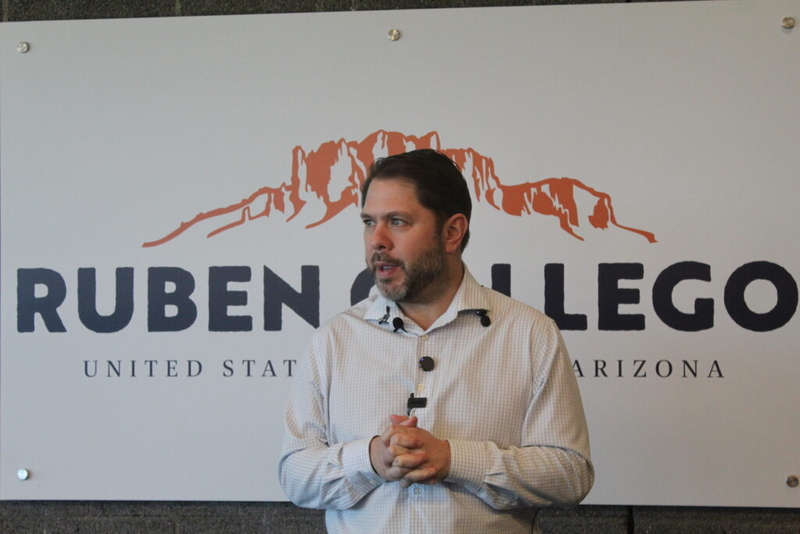
U.S. Sen. Ruben Gallego speaks to reporters at his Phoenix office on Feb. 27, 2026. (Photo by Gloria Rebecca Gomez/Arizona Mirror)
If Democrats take control of one or both chambers of Congress in November, U.S. Sen. Ruben Gallego wants to be ready.
On Tuesday, Gallego released a wide ranging plan to reverse President Donald Trump’s dismantling of the U.S. Department of Education, and to improve public education across the country with increased support from the federal government.
“We can’t just be anti-Trumpers,” Gallego told the Arizona Mirror. “We have to actually have a vision of where we want to go with education.”
The first-term senator acknowledged that, even if Democrats do as well as expected in the midterm election, with the majority of polls predicting a strong advantage for the party, implementing this plan will still be difficult with Trump in the White House through 2028.
“Also, we may strike gold, you know? Who knows with this guy?” Gallego said of Trump. “He’s so very flexible with his thoughts and ideology that, on the way out, he may not care.”
Gallego’s education plan includes a wish list of policies that Democrats have been pushing for years — some that were implemented at one point and then rolled back after Trump took office.
But top priorities include restoring the power of the Department of education to ensure Title I schools, which serve low-income students, are properly funded and that the federal government is holding schools accountable for implementing individual education plans for students with disabilities.
Gallego’s plan also includes a framework for reversing the nationwide teacher shortage, getting chronically absent students back in the classroom and increasing support for rural and tribal schools.
The plan calls for addressing the teacher shortage by making it more affordable to become a teacher with scholarships, grants and student loan forgiveness. Teacher working conditions would be improved by reducing class sizes, making mental healthcare more accessible to teachers, hiring more support staff like paraprofessionals and to provide teachers with more planning and collaboration time.
In the 2022-23 school year, about 41% of Arizona’s public school students were chronically absent, among the highest rates in the country. A student is chronically absent if they miss at least 10% of school days, or about 18 days a year. Absenteeism rates have increased across the country since the COVID-19 pandemic.
Gallego’s plan would address chronic absenteeism by providing more federal funding for school-based mental health services, as well as providing transportation, hygiene resources and family outreach to address specific reasons that students are missing school.
Expanding after school and summer learning programs would also play a part, to cut down on summer learning loss and to help students who’ve fallen behind catch up with their classmates.
“These kids start falling behind, and then they just decide to drop out, because mentally, it is very hard when you know you’re not doing well,” Gallego said.
And he says that comes from personal experience. As a child of Mexican and Colombian immigrants, Gallego moved to the United States as a second grader who didn’t speak English, and was held back to first grade because of it.
“Because I couldn’t speak English and they thought I was never going to catch up,” he said. “And I remember having real confidence problems. Even though I thought I was really smart, I only spoke Spanish.”
Gallego’s plan would de-prioritize Trump’s national school voucher program, aiming resources at public schools that have to accept all students and meet certain standards.
“We’ve seen what vouchers have done in this state, crippling our public schools, and also just sucking money out of our rural schools, and they have no standards whatsoever,” he said.
Arizona’s school voucher program, formally known as the Empowerment Scholarship Account program, allows any K-12 student to pay for private or home schooling with public funds, regardless of their family’s income. It costs the state more than $1 billion a year, and has been criticized for its lack of oversight, though Republicans have been wholly unwilling to limit its scope or support any efforts to impose accountability on its recipients.
Finally, Gallego’s plan calls for better preparing students for college and career training, by hiring more counselors and career advisors who can help students explore their options and to access financial aid. He also calls for providing federal grants to schools to update equipment and recruit teachers for career and technical education and to expand dual enrollment opportunities as well as paid internships and apprenticeships.
“The challenges facing public schools are closely connected,” Gallego’s plan reads. “Funding shortages make it harder to recruit and retain educators, limited staffing affects the academic and mental health support available to students, and unequal access to advising and career programs can leave students unprepared for what comes after graduation. Addressing these problems requires a coordinated and sustained response.”
Phoenix, AZ