Voting Is Speech. Courts Should Start Treating It That Way.
Aug 31, 2026 | 9:00 am ET
Description
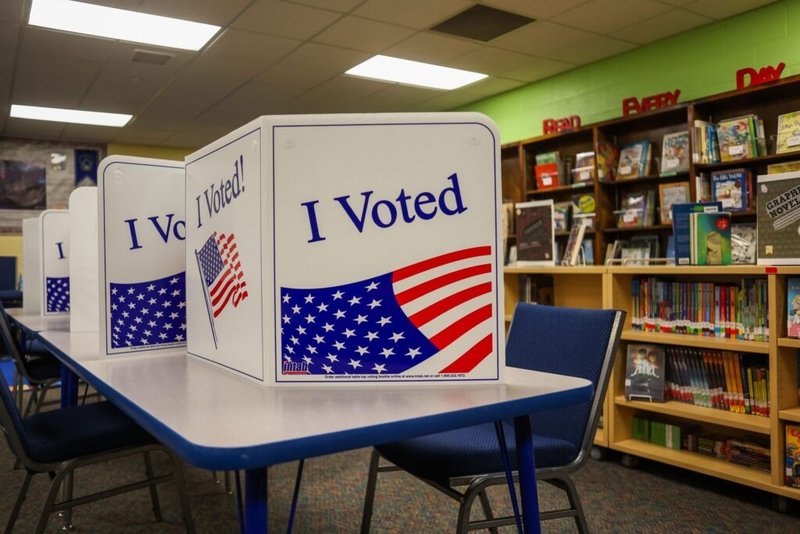
Booths await voters during the May 19, 2026, primary election at Temple View Elementary School in Idaho Falls, Idaho. (Photo by Pat Sutphin/Idaho Capital Sun)
Last week, the Supreme Court allowed the Trump administration to begin implementing key parts of its executive order on mail-in voting, allowing Homeland Security to compile a federal citizenship list and share it with states, the Attorney General to prioritize prosecuting state officials who issue ballots to people the federal government deems ineligible, and the U.S. Postal Service to proceed with new rules governing ballot design.
Despite a federal judge on Friday temporarily pausing rules from advancing, due to a new case against the Postal Service brought by Democratic state attorneys general, the Supreme Court’s move was revealing. The Trump administration almost immediately appealed the latest pause, again likely sending the question of federal interference in statewide elections to the nation’s highest court to decide.
The Court did not hold that any part of Trump’s executive order is unlawful when they allowed federal agencies to begin implementing it. The 6-3 decision was procedural. U.S. District Judge Indira Talwani had found that claims about elections after Nov. 3 were not yet ripe for review, and the majority lifted her injunction on that basis while acknowledging that if her ruling were eventually reversed, it “would come too late for the 2026 midterms.”
Justice Sotomayor’s dissent said it plainly: the decision “does not address whether the President’s attempts to interfere with States’ administration of the November 2026 elections are lawful. Nor does it suggest that the Executive Branch has any constitutional or statutory authority to implement the President’s directives.”
Oregon has more at stake in that distinction than almost any state in the country. Voters approved conducting elections entirely by mail in 1998, making Oregon the first state to do so. There is no in-person fallback for most Oregonians on Election Day.
In one early lawsuit brought against the Trump administration over the president’s executive order, U.S. District Judge John Chun blocked parts of it as applied to Oregon and Washington, finding that the Constitution assigns states authority over the time, place and manner of elections and that “the President’s authority to promulgate a national ballot-receipt deadline cannot stem from the Constitution.”
The litigation continues to move weekly. After the Supreme Court ruling, a Boston judge canceled a separate nationwide block on Postal Service, which is now temporarily back in place following the state attorneys general suit against USPS.
Elections happen on fixed dates. A constitutional question deferred past November is a constitutional question answered, whatever a court says in 2027.
I spent eight years fighting a federal agency that used paperwork to punish speech it didn’t like. The U.S. Patent and Trademark Office never said my band couldn’t use our name. It just refused to register the trademark, which meant we lost the legal protections that come with it. Every year the case dragged on and cost us money and time. The Supreme Court ruled unanimously in our favor in 2017. That was the right outcome…but it also took almost a decade to get there.
Election cases compress that problem into a calendar. There is no version of a favorable ruling that restores a ballot not delivered.
Courts analyze voting disputes through the Reconstruction Amendments and election administration doctrine, frameworks that ask whether voters as a class have been denied equal access. They rarely ask whether casting a ballot is itself an act of political expression entitled to First Amendment protection.
A ballot is the most direct communication a citizen makes to their government. The Supreme Court already treats spending money to influence an election as fully protected speech subject to strict scrutiny. It has never extended comparable protection to the vote all that spending is trying to influence. Unlike a petition signature or campaign contribution, a ballot is cast in secret, but secrecy protects the voter rather than making the act less expressive.
A First Amendment frame wouldn’t strip states of authority to run elections, prevent fraud, or set deadlines. It would ask a sharper question than the procedural one currently before the courts: is a given rule burdening a citizen’s most fundamental act of political expression, and is that burden justified by an interest serious enough to survive real scrutiny? That question is harder to defer than a ripeness analysis.
In the meantime, there are things Oregon can do that don’t require waiting on federal courts.
The state can document, in detail and in real time, what implementation of the federal citizenship list actually does to Oregon voters. A factual record built now is what makes later challenges viable.
County clerks can communicate early and clearly about drop box availability, which matters more than usual given recent Postal Service service reductions. And, the Legislature can review whether Oregon’s 2021 grace period for ballots postmarked by Election Day needs additional statutory protection against federal preemption arguments.
The Court decided this week that it could wait. Oregon cannot. If we treated voting as the expression it is rather than as an administrative procedure the government happens to run, that mismatch would be much harder to ignore.
Salem, OR