Voters to weigh different approaches to housing affordability in November
Oct 01, 2026 | 5:00 am ET
Description
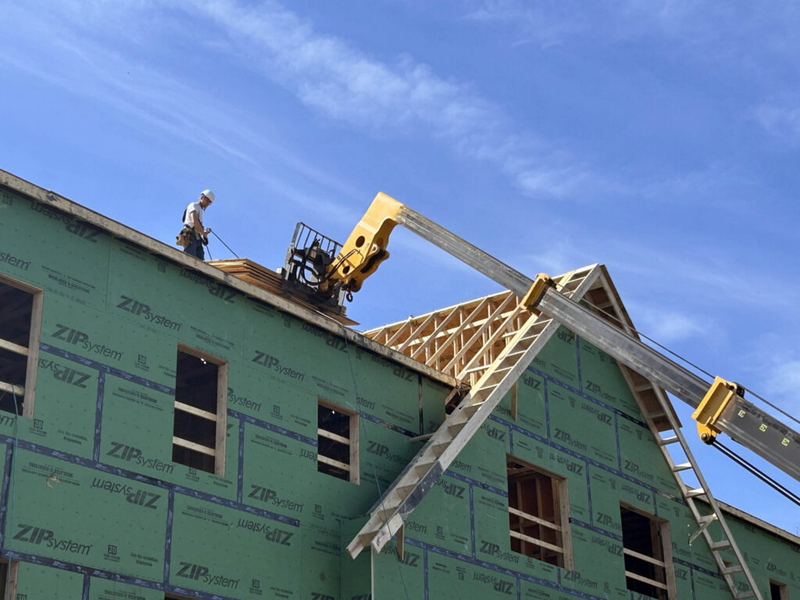
A construction worker retrieves plywood sheets lifted to the roof of a an affordable housing complex for seniors under construction in Portsmouth, Rhode Island. It's one of four states that have housing measures on the ballot this November. (Photo by Janine L. Weisman/Rhode Island Current)
Voters in four states will decide housing-related ballot measures in November, providing testing grounds for different strategies to boost affordable homes.
The six measures across California, Hawaii, Massachusetts and Rhode Island are the highest number in a single election year in at least two decades, according to Ballotpedia, a nonpartisan election research organization.
The ballot issues include approving billions of dollars in bonds for new housing and to help finance home purchases, loosening minimum lot-size rules, speeding environmental reviews and funding infrastructure needed for new development.
“Voters are being asked to choose among very different theories of how you make housing more affordable,” said Caroline Welles, executive director of The First Ask, an organization that works to elect first-time, female Democratic candidates for state legislatures across the country. “None of those approaches is interchangeable with another, and they affect different people on different timelines.”
A Massachusetts ballot measure would allow single-family homes to be built on lots of 5,000 square feet or more in certain residential areas, if they have at least 50 feet of street frontage and access to public water and sewer services. Zoning policies for single-family homes currently are set by local governments, not the state, and many require lot sizes of 40,000 square feet or more.
Jesse Kanson-Benanav, executive director at Boston-based nonprofit advocacy group Abundant Housing Massachusetts, told Stateline the “incredibly large” minimum lot sizes in Massachusetts have effectively stunted the amount of single-family homes that could be built in the state.
Landmark federal housing law tries new ways to boost local building
“So it’s basically taking the average minimum size in Massachusetts, which is much more comparable to an NFL field to build a single-family home on, much more to the size of an NBA basketball court,” Kanson-Benanav said.
The Massachusetts Municipal Association, a statewide organization advocating on the behalf of local governments, opposes the measure, arguing that land use decisions should be a local decision made by cities and towns. The group also argues that access to water and sewer does not necessarily mean those systems have capacity for added development and that there’s no guarantee that future projects will result in houses being more affordable or priced below market rate.
Analysis from Tufts University estimated that if the ballot measure passes, it would generate roughly 750 new homes per year, with modeling suggesting a range from 350 to 1,200 per year. That “would have a real but modest impact on overall production,” it said.
A 2025 Maine law similarly stipulates that municipalities cannot require a minimum lot larger than 5,000 square feet in residential areas served by public or centrally managed water and sewer.
Environmental reviews
California’s Proposition 45 would shorten and streamline the permitting for housing projects — but it also extends to other types of projects, including water system, clean energy, medical, fire and law enforcement, broadband, education and certain transportation projects.
Supporters of Proposition 45 argue that permitting delays add $75,000 to the cost of a new home.
According to the California Legislative Analyst’s Office, the measure would tighten deadlines for environmental reviews and court challenges, and change agency and court review processes under the state’s California Environmental Quality Act or CEQA.
Robert Rivinius, president of the Family Business Association of California, an organization that represents the interests of family-owned businesses, called CEQA a “tremendous inhibitor” to new housing in a state where it’s sorely needed.
“It takes, you know, eight or 10 years to develop a project here and this initiative would give some certainty to the process and some timelines which we don’t currently have,” Rivinius told Stateline. “(Proposition 45) does not eliminate CEQA. It does not eliminate environmental review, but what it does is creates a more certain process, so projects don’t take nearly as long.”
The proposal has drawn pushback from environmental groups and pro-housing groups that have pointed out that a 2025 state law was passed with the intention of speeding up construction by exempting certain urban infill projects from CEQA.
Woody Little, an organizer for the Vote for No campaign, told Stateline that he thinks Prop 45 could be a loophole for developers to push ahead with unpopular data center projects and to streamline sprawl projects.
According to Democratic state Sen. Catherine Blakespear, since 2002, California legislature has passed 36 laws updating CEQA to streamline the review of housing projects, and that “nearly all” infill housing projects are already exempt.
“One of the reasons that we have provided CEQA exemptions for infill housing is that we are trying to incentivize infill housing,” she said in a call involving legislators opposed to the ballot measures. “If we give these exemptions for sprawl housing in the wildland urban interface and we make those projects more affordable, essentially incentivizing them, then we are going to have more of that type of development.”
Bond issues
Up for a vote in Rhode Island is a measure that would authorize $120 million in bonds for affordable and accessible housing. At least $25 million would go toward producing housing intended for homeownership, and up to $10 million may support public housing development.
This isn’t the first time Rhode Island voters have had a housing ballot measure in their hands, as 65% of voters approved a $120 million housing bond in 2024.
Rhode Island is burning through cash to build housing. It’s hardly made a difference, RIPEC says.
“What a bond can offer is that it provides the resources that are needed to build housing units specifically targeted at lower-income price points because the cost of housing development is high right now,” said Melina Lodge, executive director of Housing Network of Rhode Island. “I don’t think it’s enough for any place, but particularly for (Rhode Island), to just say we’re gonna build more housing and hope that square pegs land in square holes and round pegs land in round holes.”
However, some groups in the state such as the Rhode Island Public Expenditure Council, a nonpartisan public policy research nonprofit, argue that recent state subsidies have not produced nearly enough housing to affect affordability for most residents. Analysis by the group found that as of April, $52.2 million from the 2024 bond had financed 200 new rental units at an average development cost above $512,000 per unit, according to the Rhode Island Current.
Jeffrey S. Hamill, senior policy analyst for the council, told Stateline that while the group does not take formal positions on ballot questions, it thinks the state’s recent housing spending has produced too few homes at too high a cost. An alternative the council floated is for additional borrowing to be paired with changes such as per-unit cost limits and a more consolidated funding system.
California’s other ballot issues
California’s Proposition 1 would allow the state to sell $11.25 billion in general obligation bonds for housing, with $10 billion dedicated for housing programs and $1.25 billion for veterans’ home loans. The Legislative Analyst’s Office says the bond would provide subsidies for up to 40,000 multifamily rental units.
The Legislative Analyst’s Office estimates a $500 million to $600 million annual cost to the state for about 25 years to repay the housing bond.
Opponents of Prop 1 questioned the “wisdom of borrowing” more money to pay for housing without affecting the underlying reasons why building is so expensive, CalMatters reported. Supporters said the money would help the state’s roughly 180,000 unhoused residents, as well as assist those who spend a high portion of their income on rent and can’t afford to buy a home.
Another initiative, Proposition 37, would authorize the California Housing Finance Agency to issue up to $25 billion in bonds to create a down payment assistance program. Each loan would cover up to 17% of the home price. Qualified buyers are defined as those who have been a California resident for at least a year, plan to occupy the home, earn less than 200% of the area median income and can pay at least 3% down.
Nonpartisan analysis from the California Legislative Analyst’s Office office says there are some unknowns on how Proposition 37 would affect housing, such as the extent of the demand from investors, how much loans would cost homebuyers compared with other down payment assistance options, and whether the program would spur increased home construction and buying.
Rivinius, from the Family Business Association of California, voiced support for Proposition 37.
“The $25 billion bond is revenue bonds, which means it’s not an obligation to the state. It’s all paid back through the mortgages it creates,” he said. “This helps the young people that’d like to buy a home, get into a home more easily.”
Hawaii constitutional amendment
Hawaii voters will decide on a constitutional amendment that would allow counties to use special bonds to pay for infrastructure such as roads, water and sewer systems in designated areas, with the bonds repaid from future growth in property tax revenue in those districts rather than through an increase in the property tax rate.
Supporters argue this could unlock housing, particularly transit-oriented development along the Honolulu Skyline rail project.
The Tax Foundation of Hawaiʻi argues the constitutional amendment is unnecessary because the bonds already are allowed by law, according to the Honolulu Civil Beat. The attorney general disagreed and said that an amendment is needed before counties could issue the bonds.
Stateline reporter Robbie Sequeira can be reached at [email protected].