US House GOP pushes through budget blueprint for Iran war funding, farm aid
Jul 22, 2026 | 5:00 pm ET
Description
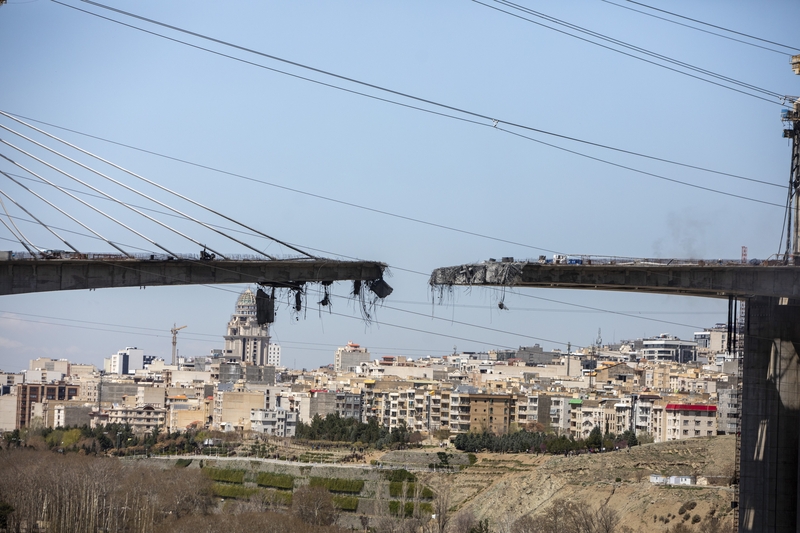
A vote on a budget resolution in the U.S. House on July 22, 2026, sets up a confrontation between GOP lawmakers in Congress over exactly how much funding to provide for the war in Iran. Shown is the damaged B1 bridge, a day after it was destroyed by an airstrike, on April 3, 2026 west of Tehran in Karaj, Iran. (Photo by Majid Saeedi/Getty Images)
WASHINGTON — Republicans in the U.S. House on Wednesday approved their outline for the third party-line budget measure of the second Trump administration, though they won’t be able to begin work on that package until they reach agreement with their Senate colleagues on a plan forward.
The 216-214 vote on a budget resolution sets up a confrontation between GOP lawmakers in Congress over exactly how much funding to provide for the war in Iran and farm assistance as well as whether lawmakers should pay for it by cutting spending elsewhere.
House Republicans proposed a total of $95 billion in spending in their budget resolution. The instructions in that blueprint would allow four committees to eventually write bills that would spend up to $60 billion on the military, $13 billion on intelligence agencies, $12 billion on agricultural assistance and $10 billion on some sort of grant program for states that implement voter ID laws.
But work on that package can only begin after Republicans in both chambers vote to approve the same budget resolution with identical sets of reconciliation instructions.
Third time around
House Budget Committee Chairman Jodey Arrington, R-Texas, said during floor debate that the GOP has used the reconciliation process twice to achieve policy goals that wouldn’t garner Democratic support.
The first time was last year, when Congress approved the “big, beautiful” law. The second occurred earlier this year, when lawmakers approved three years of funding for Immigration and Customs Enforcement and the Border Patrol without new constraints on federal agents. Both were signed into law by President Donald Trump.
“Here we are, reconciliation 3.0, supporting our troops in their time of need,” Arrington said. “Just baseline battlefield readiness. Bullets and bombs to finish the job.”
The yet-to-be-written reconciliation package, he added, would also likely "strengthen our food supply” and "safeguard the integrity of our elections.”
Pennsylvania Democratic Rep. Brendan Boyle, ranking member on the panel, said that Republicans’ support for the two earlier packages and this budget outline shows they aren’t focused on bringing down costs for Americans.
Boyle also questioned whether campaign promises from GOP candidates to lower the annual federal deficit were genuine, given that this and the previous party-line laws will have a substantial impact on the national debt.
“Yes, that’s right, the same crowd that loves to cry crocodile tears about deficit and debt whenever there’s a president in the White House who's a Democrat — cumulatively now they have added $5 trillion to our national debt, more than any other 18-month period in the history of Congress,” he said. “And they’re about to add $100 billion more.”
Senate GOP not on board
Senate Republicans don’t fully agree on their House counterparts’ proposed spending level, with some wanting considerably more in defense funding, and others looking for ways to offset the costs.
Senate Majority Leader John Thune, R-S.D., said during a Tuesday afternoon press conference that he’s unlikely to bring any budget resolution to the floor until after lawmakers figure out a way to fund the government ahead of the Oct. 1 shutdown deadline.
Congress’ budget resolution is just a blueprint, similar to a blueprint for building a house. It isn’t a bill and never goes to the president for his signature.
Lawmakers use a completely separate process to fund the government through a dozen annual appropriations bills.
But since lawmakers are nowhere near close to finishing that appropriations task before the start of the new fiscal year they must agree to some sort of short-term spending bill to avoid another shutdown this fall.
The House this week passed a stopgap bill that would extend that deadline until Dec. 4, but it doesn’t have the support needed to advance in the Senate, where leaders from both political parties are working toward a bipartisan compromise.
Thune said he expects the Senate will vote on its stopgap spending bill before leaving for the August recess, which could delay work on a budget resolution until that chamber returns in mid-September.
“It’s possible that that would be something that would get punted into September,” he said.
That could lead to a significant time crunch for Republicans if they want to use the complex budget reconciliation process to enact their party-line defense and farm aid spending package before the November midterm elections.
There are just three weeks in September when both chambers are scheduled to be in session before lawmakers depart for their five-week October break.
And while the House can approve the budget resolution and an eventual party-line package without taking up a single amendment on the floor, the Senate process is considerably more arduous.
The Senate has unlimited amendment debate on both measures, giving Democrats in that chamber dozens of opportunities to challenge Republicans on spending and policy choices.
That’s not necessarily an ideal scenario for Republican Senate leaders, who hope voters will allow the party to hold onto its narrow majority for another two years.
Shauneen Miranda contributed to this report.
All States Newsroom content is free to republish. Read our republishing policy for more information.